The
AI for outbound
guide
How to turn signals into pipeline without adding more work for your reps.

TL;DR: Why AI outbound is failing (and what works instead)
Most AI outbound tools promised to scale your pipeline. What they delivered was more email volume, which turns out to be the wrong answer to a problem that was never about volume.
Every team has signals, but almost none have a system to act on them fast enough. Intent tools tell you which account is in-market but leave reps to figure out who to contact, what to say, and when. Generic AI SDR tools write emails without knowing why this moment matters to this person. Both of these approaches end up creating more work for reps.
UserGems fixes this by connecting signal detection, contact identification, and personalized outreach into one closed loop, so by the time your reps start their day, the contact is already identified, the email is already written, and everything is sitting in their SEP ready to send.
With UserGems teams are hitting 6-20% reply rates and running twice the outbound volume on the same headcount. In this guide, we'll show you exactly how to build the same motion.
AI outbound promise vs. reality
Go-to-market teams heard a compelling promise over the last two years: AI would write your emails, find your contacts, and scale your outbound. Every AI SDR tool, intent platform, and email generator in the market was making the same promise.
What actually happened?
Teams bought tools that generated more email volume and then watched their reply rates fall off a cliff. Other teams plugged in their intent tool expecting it to tell them who to pursue, only to realize intent data surfaces accounts, not contacts. So reps were back to manual research, still writing one-off emails, still stuck on the same fundamental question: how do you reach the right person with the right message at the right time?
The premise behind most AI outbound tools rested on three assumptions that turned out to be wrong: that generic AI can write outreach as effective as a human (it can't, without signal), that intent tools can identify the right buyer to reach (they flag accounts), and that email automation alone can scale your pipeline (without personalization and the right signal, it just increases noise).
UserGems takes a different approach and acts as the AI Command Center for outbound, the brain behind your GTM that connects signal detection, contact intelligence, and personalized execution into one closed loop.
Three reasons current AI outbound doesn't convert
More emails isn't the answer
Most AI outbound tools follow the same playbook: upload a contact list, select a template, hit send. AI can generate thousands of emails in an hour which is impressive, until you check the conversion rate.
Volume-first fails because outreach without signal assumes email alone can overcome objection. The reality is it can't and higher response rates come from sending emails that reference something specific: a stack shift, a role change, a deal that looks just like one they closed last quarter. That specificity comes from signals, and generic AI SDR tools miss this step.
Reality check: Only 7% of sales and marketing leaders report "very successful with clear ROI" from AI in sales and marketing (UserGems + Wynter, 2025). The gap is almost always the same: tools that handle data, intelligence, or action, but never all three. UserGems does all of it.
Intent tools were never built for outbound
They're systems of insight, not outbound execution. When sales teams try to prospect from account-level intent, they immediately hit the same wall: intent tells you which account is in-market, not which contact inside it to reach. So reps still have to manually figure out who to email, what angle to take, and why that specific person should care.
Because the data is account-level, you often end up with three reps emailing the same account simultaneously with three slightly different messages.
Why account-level intent is a trap: Account-based intent was built for "one company, one campaign." Modern outbound requires "one company, five contacts, five tailored conversations." The manual gap between flagging an account and reaching the right person inside it is exactly where pipeline gets lost.
Manual signal-to-action is slowing everything down
Even teams with good signal detection hit the same bottleneck: the gap between detecting a signal and acting on it. A job change fires on Monday. By Friday, after tagging, researching, list-building, and drafting, a rep finally sends an email. The window was open for about 48 hours. It's now been five days.
The other version of this problem: your team does everything right, writes a great email, and then manually adds the contact to a sequence with no integration, no automatic follow-up, and no way to measure whether the signal converted.
The answer is a model that closes all three gaps automatically, before a rep ever gets involved.

What signal-based AI outbound actually looks like

Step 1: Signals first
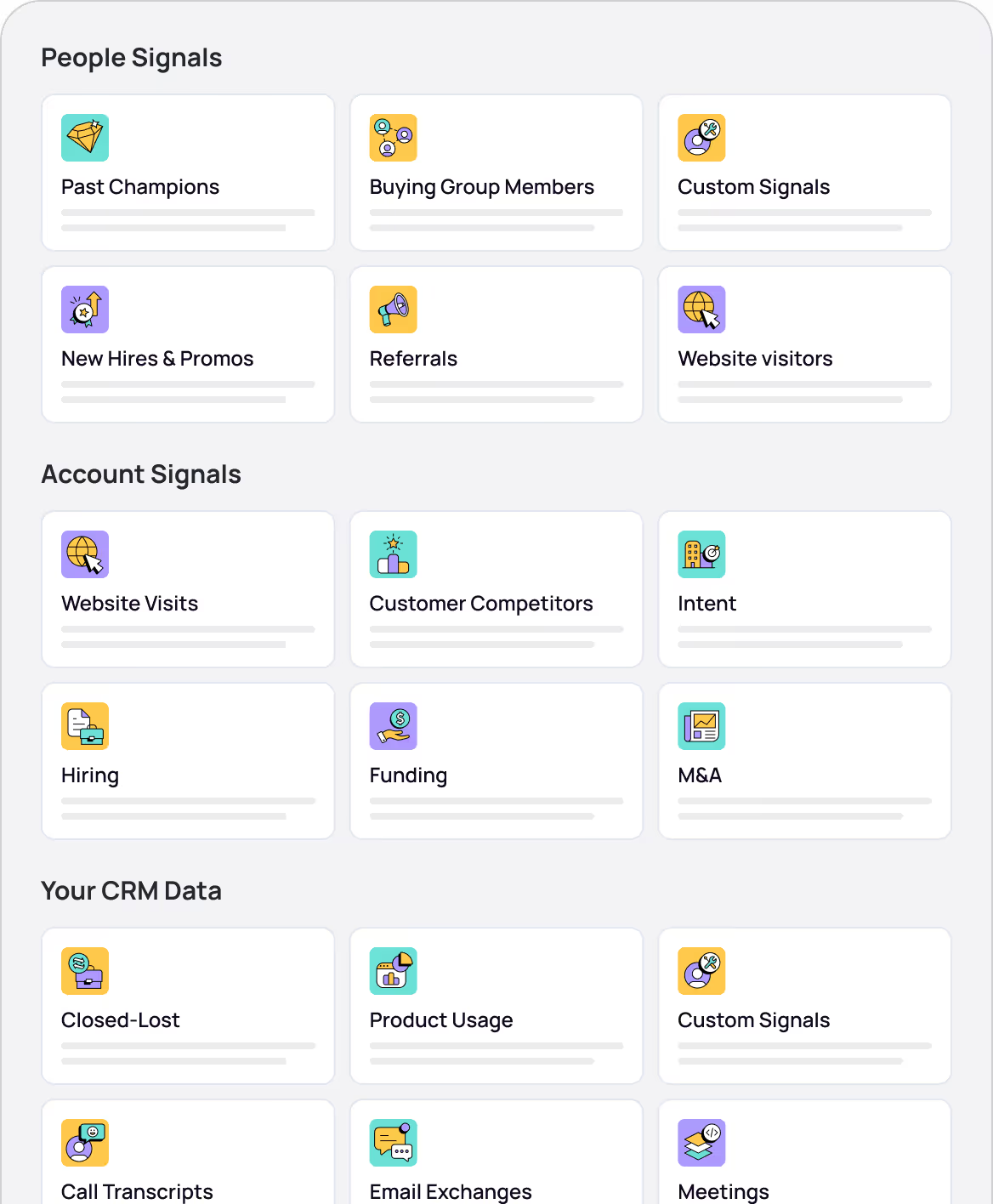
Begin by identifying a change in a prospect's world that creates a genuine buying window. Intent spikes on your pricing or comparison pages mean someone is actively researching. Tech stack shifts suggest an evaluation is already in motion. M&A activity brings new budgets, new priorities, and organizational change at scale. Closed-lost intelligence means a contact who said no six months ago may be in a very different position today. These are events, and events create windows where a conversation is relevant.
You can combine multiple signals to prioritize the warmest buyers and make outreach more relevant. UserGems comes with 21+ native signals out of the box, and you can layer in your own first-party data and any third-party providers you already use.
See the full signal library here.
Step 2: The right contact
With signals selected, UserGems identifies the exact person within that company who needs to care about your message, the specific contact whose role connects to the signal. When a closed-lost deal resurfaces, UserGems surfaces the contact who now has the authority or the fresh context that didn't exist when you first pitched. It’s all about contact-level precision, not account-level guessing.
Gem-E makes this precise by combining its own signals with your CRM data and any third-party signals you already use into a single score, so marketing can prioritize the top accounts while sales focuses on the warmest contacts within them.
Step 3: Gem-E outreach
Gem-E drafts an email, a call script, or a LinkedIn message that references the signal, the contact's role, and why this moment is relevant. Every message combines your CRM data and buying signals into outreach that actually earns a response.
Gem-E also writes follow-on emails and references the context mentioned in previous emails.
.png)
.gif)
Step 4: Automatic enrollment
Once the outreach is ready, the contact and drafted message flow directly into your sales engagement platform (Outreach, Salesloft, or HubSpot Sales Hub), where reps can review, approve, and send without leaving the tools they already use.
Gem-E is a starting point, not a blank box so reps stay in control of every message that goes out. If the contact replies, the sequence pauses and a rep takes over the conversation. UserGems handles the intelligence; your SEP handles the execution.
Step 5: Track and improve
You now have data connecting specific signals to specific outcomes: which signal types convert to opportunities fastest, which sequences perform best on which triggers, which industries respond to intent plays vs. tech stack shifts.
Gem-E continuously feeds these insights back into its research layer too, analyzing call transcripts and email exchanges to surface buyer goals, objections, and pain points, then using that context to sharpen future outreach automatically.
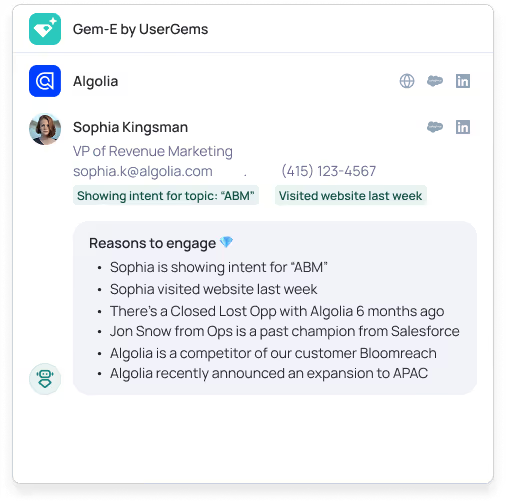
Reps can also access everything directly in the Gem-E Chrome Extension, inside their CRM, their sales engagement tool, or LinkedIn. No tab-switching, no copying context between windows. The signal, the score, the drafted message, and the contact's full history are surfaced right where the rep is already working. Most AI outbound tools create a new workflow on top of your existing one. Gem-E fits into the one you already have.
How Gem-E for outbound works
It combines two types of agents: Data Agents and Intelligence Agents working in sequence to take a prospect from "signal detected" to "drafted and prioritized in your rep's queue" with no manual research required.
Data agents: Signal capture and contact research
Data agents run continuously across a wide range of signal sources: intent spikes at the account and contact level, news mentions, tech stack shifts, M&A activity, funding rounds, and 10-K filings. At the same time, they're ingesting your first-party data: CRM history, closed-lost deal records from your Gong call transcripts and emails, website engagement, and marketing interactions.
When a signal fires, the data agent automatically researches that contact, pulling their current role and email, your team's prior history with that company, recent news about the organization, and what they've engaged with from your content. Everything the Intelligence Agent needs is ready before a human even knows the signal exists.
This is the foundation that makes everything else possible, and it's the part that most AI outbound tools skip entirely. Starting with a contact list and layering AI on top produces volume, not precision. Starting with a signal and letting agents do the research produces outreach that actually lands.
Intelligence agents: Scoring, prioritization, and personalization
First, they score the opportunity. Your custom AI model, built specifically from your historical closed-won data, assesses the contact's fit against your ICP. The model isn't asking "is this a good contact?" in the abstract. It's asking whether this contact matches the profile of the buyers your team has actually closed. Those weights come from your sales history, not from an industry benchmark, so the signals that have historically predicted your wins get prioritized first. No two companies get the same model.You can also see exactly why an account or contact is scored the way it is, and you can override it. There's no black box, just transparent, editable intelligence.
Second, they prioritize. Once scored, Intelligence Agents rank the contact against everything else in your prospect universe. A high-intent account at a $500M+ company in your core vertical might score at the 95th percentile and land in today's queue. A mid-market account showing early research behavior might score at the 70th percentile and get queued for next week. This is automated prioritization that reflects what actually matters for your business, without requiring a rep to make those calls manually every morning.
Third, they personalize the outreach. Once a contact clears the priority threshold, a Gem-E agent drafts the email, call script, or LinkedIn message. It opens with the signal, references the contact's specific company, role, and industry, and connects that context to a relevant outcome your customers have experienced.
Automatic enrollment and orchestration
Once the email is drafted and sent, Gem-E moves the contact automatically into a sequence in your sales engagement platform (Outreach, Salesloft, HubSpot Sales Hub, or whatever you use) where reps can review, approve, and send. Follow-ups run on a smart schedule. If the contact replies, the sequence pauses and a rep picks up the thread. If they convert to an opportunity, that signal-to-opportunity path is logged, measured, and fed back into your scoring model.
Your team's morning experience changes entirely. Instead of opening their laptop to a list of research tasks, they open it to a prioritized set of conversations to have. The heavy lifting happens overnight.
The AI for outbound playbook
Play 1: The closed-lost re-engagement play
What to target: Contacts from past closed-lost deals where your team already pitched, built a relationship, and either lost to a competitor or saw the deal stall.
Why it works: Markets shift, priorities change, and the person who passed six months ago is often dealing with a very different reality today. New budgets open up, decision-makers come in with fresh mandates, problems that felt manageable suddenly become urgent. And because they already know who you are, re-engaging a closed-lost contact is dramatically cheaper and faster than cold prospecting.

- Use our Research Agent to analyze your closed-lost deals from call transcripts and emails: what signals did these contacts have when you first pitched, what objections came up, and what has changed since
- Intelligence Agents identify closed-lost contacts from deals that closely match your current closed-won profile
- Monitor for new signals on those contacts: company changes, tech stack shifts, news mentions, and funding activity
- When a signal fires, draft a re-engagement email that acknowledges the previous conversation and addresses what is different now: new capabilities, new customers in their industry, solved problems they raised before
- Enroll in a shorter sequence (4-5 touches over 2-3 weeks) since they already know the problem your solution addresses
Play 2: The intent spike play
What to target: Companies showing engagement spikes on your highest-intent pages: pricing, product comparisons, case studies, or solution walkthroughs.
Why it works: When a prospect is actively on your comparison guide or pricing page, they're in research mode right now. Most sales teams get this signal and then sit on it for two or three days. The teams that win are the ones that move within 24 hours, while the prospect is still deep in their evaluation.
- Data Agents capture website and marketing engagement spikes at both account and contact level, surfacing which companies are researching and which specific contacts are doing the looking
- Intelligence Agents score and prioritize those contacts based on your custom model, weighting toward the people conducting the actual research rather than peripherally associated contacts at the same account
- Gem-E agents draft personalized outreach that references the research activity and moves directly toward a conversation
- The contact and drafted message flow into your sales engagement platform, where they're enrolled in a short, fast-moving sequence without rep intervention
Play 3: The tech stack shift play
What to target: Companies that recently changed their toolstack in a way that signals an active evaluation or a shift in priorities relevant to your solution.
Why it works: A tech stack change is a decision signal. A company that swapped out a tool in your category three months ago is likely still adjusting, still evaluating what comes next, and potentially open to a conversation if you time the outreach well. A company that just adopted a competing product may be in the middle of a broader evaluation that you should be part of.
- Data Agents monitor tech stack shifts across your target accounts continuously, flagging changes that are relevant to your solution category
- Intelligence Agents identify which contacts at that account own the purchasing decision for that category, so your outreach goes to the person whose role actually connects to the shift rather than a peripheral stakeholder
- Gem-E drafts outreach that acknowledges the stack change and positions your solution as the natural next step or complement in their evaluation
- The contact and drafted message flow into your sales engagement platform, where they're enrolled in a medium-length sequence (5-6 touches over three weeks) to account for the longer consideration cycle that tech decisions typically involve
Results: What signal-based AI outbound delivers
2x SDR outbound capacity
SDRs using Gem-E for outbound manage twice the outbound volume with the same headcount. Gem-E handles the research, contact discovery, and personalized outreach drafting automatically, so reps spend their time on what humans do best: having conversations and closing deals.
It was no more 'I'm going to go research this account for the next hour and a half as an SDR and come up with a good email.' It is now 'this was an amazing email written by a ton of information and I'm going to say yeah, press go.' Like it was a night and day light bulb moment. - Austin Sandmeyer, Sendoso
Higher reply rates from outbound
Gem-E sequences achieve 6-20% reply rates compared to the industry average of 1-2%. Signal creates relevance, and relevance creates replies. An email that opens with a genuine observation about a prospect's world has earned the right to a response in a way that a generic "we help companies like yours" email never will.
In our most recent earnings call, outbound performance was 104% of plan. Our reply rate had gone from about less than 2% to 11 and 14% for the two main sequences that we were using. - Mark Kosoglow, Docebo
Reduced process time
Teams using Gem-E for ABM have reduced their 4-week account-based list building and outreach process to approximately 2 weeks by letting Gem-E agents handle research, scoring, and personalization at scale. Outbound teams running signal-based plays see comparable efficiency gains when signal detection and contact research are automated rather than manual.
We felt like we would get ROI almost immediately. Like it was almost a no-risk bet. Every time we have a sale from UserGems, I get an email, there's a little celebration internally, and they seem to happen in our organization at least every week. - Andrew Morton, Haystack
Signal-based outbound compounds
Outbound motions should be getting smarter over time. Every signal that converts, sequence that lands, and reply that comes back feeds into a model that makes next week's outreach more precise than this week's.
Your reps shouldn't have to think about who to contact next. The hours they used to spend on research, list-building, and drafting are the hours they should be spending in conversations that actually close deals and that's exactly what the UserGems AI Command Center gives back to them.
If you're building the full signal-based GTM motion, these two guides cover what comes next:
- The Signal-Based ABM Guide — How to turn signals into account-based campaigns that move accounts through the funnel
- Replace 6sense with UserGems — How to move from a system of insight to a system of execution
FAQ
AI SDR tools start with a list and use AI to write emails. That's email generation. UserGems starts with a signal, uses Data Agents to research the right contact, scores them with a custom AI model built on your sales history, and then personalizes the outreach. Because everything from signal detection through sequence enrollment runs automatically, you get a closed-loop system that measures what converts and improves over time. That's the difference between adding volume to your outbound and actually improving it.
Intent platforms were built to identify accounts and support advertising and marketing campaigns, they're systems of insight. When you try to run outbound from account-level intent, you still have to manually figure out who to reach and what to say to them specifically. UserGems works from contact-level signals, so you skip the research phase entirely. And unlike intent platforms, the outreach is personalized automatically. You're not receiving data and deciding what to do with it. Instead you're getting prioritized, ready-to-send action.
UserGems combines multiple signal sources into one model: job changes, account-level and contact-level intent, tech stack shifts, M&A activity, funding, news, 10-K filings, and your first-party data from your CRM, Gong call transcripts, calendar, and marketing engagement. The model weights these signals based on your specific closed-won history, so the signals that have historically predicted your wins get prioritized first. Different companies close differently, and the model reflects that.
No. UserGems is the intelligence layer that sits between your data and your sales engagement tool. We send prioritized contacts, drafted emails, and built audiences directly into Outreach, Salesloft, HubSpot Sales Hub, or whatever you're running. Your existing platform handles execution and tracking. UserGems handles the hard part: determining who to target, what to say, and when. The two work together.
Yes, UserGems is modular by design. If you have signals or data from 6sense, Demandbase, ZoomInfo, or other providers, you can bring them into UserGems. We combine them into one unified scoring model and weight each source based on your historical sales data. You're giving the intelligence layer the raw material to build a smarter, more actionable model on top of everything you already have.
Your first cohort of signal-driven outbound can be live within 7-10 days. You'll have enough conversion data to validate performance within 3-4 weeks. Full ROI measurement typically takes 90 days, which is when you have enough data to optimize which signals convert best for your specific business and to start feeding those learnings back into the scoring model.