The signal-based
ABM guide
Most ABM programs have the signals. Few have a system to act on them. This guide walks you through how to build one.

TL;DR
Most ABM programs fail because they're built on data that doesn't connect and signals that nobody knows how to act on. Marketing targets accounts. Sales works leads. Nobody agrees on who to go after or why. And the intent tools you've invested in tell you a company is "in-market" without ever telling you who to actually call.
UserGems fixes the layer that's been missing. It sits across all your signals, figures out who deserves your attention right now, and gets your sales and marketing teams moving on the same contacts at the same time, for the same reasons.
The result is ABM that actually converts. Reps wake up with contacts already surfaced, emails already written, and tasks already queued. Marketing is running ads to those exact same people. The whole motion compounds the longer it runs, without anyone having to rebuild it from scratch every quarter.
That's the AI Command Center and that's what this guide walks you through.
Why most ABM programs fail before they start
The promise of ABM is simple. Focus on the accounts that matter, align sales and marketing, personalize everything.
Most teams start by building static target lists, add an account-level intent tool like 6sense that tells you a company is interested but never tells you who, and stitch together point solutions expecting the stack to somehow become a strategy. And that's usually when we see sales reps quietly stop trusting the whole thing because they can never tell who to actually prioritize right now or why.
ABM isn't marketing taking a list of accounts and pushing ads to it.
If sales and marketing aren't working together around the same accounts and the same contacts, you've just got two teams doing their own thing and calling it ABM.
And even when the intent data is there, nobody builds a system to turn those signals into decisions and actions. So the data just sits there while teams guess who to prioritize and why.
That's the gap UserGems was built to fill. We call it the AI Command Center for go-to-market teams. A system that sits between your data and your actions, and makes the decisions that actually generate pipeline.
Signals alone don't create pipeline
Here's why that gap exists in the first place. Teams aren't short on data, they've got intent data, website analytics, CRM activity, ad platform data, and usually a few too many spreadsheets on top of that. But none of it connects, and none of it tells you what should happen next.
So marketing targets accounts that look good on paper but aren't genuinely in-market. Sales works leads with no real buying intent behind them and both teams are reaching out to completely different contacts. When you add AI tools on top of that you still end up reaching the wrong people but doing it more efficiently.
When nobody can confidently answer "who should we go after right now, and why?" everything that follows is built on guesswork and assumptions.
The missing layer: A system that decides
Knowing a signal exists isn't the same as knowing what to do with it. What's missing is a layer that sits across all of your data, connects the dots, and tells your team exactly who to prioritize and why now.
That's exactly what UserGems delivers. Our AI Command Center unifies every buyer and account signal, learns your ICP and conversion patterns, and continuously surfaces the right accounts and contacts. Then it activates Gem-E, our AI agent, alongside your sales and marketing teams to move on the same targets at the same time.
.avif)

Five layers of an ABM AI Command Center
.png)
Layer 1: Intelligence (understanding your business)
Most ABM platforms score accounts using generic models built on someone else's data. UserGems learns from yours.The AI Command Center connects to your CRM and historical data to build a scoring model specific to your business:
- Which accounts convert fastest
- What signals actually precede pipeline
- Which personas show up in your winning deals
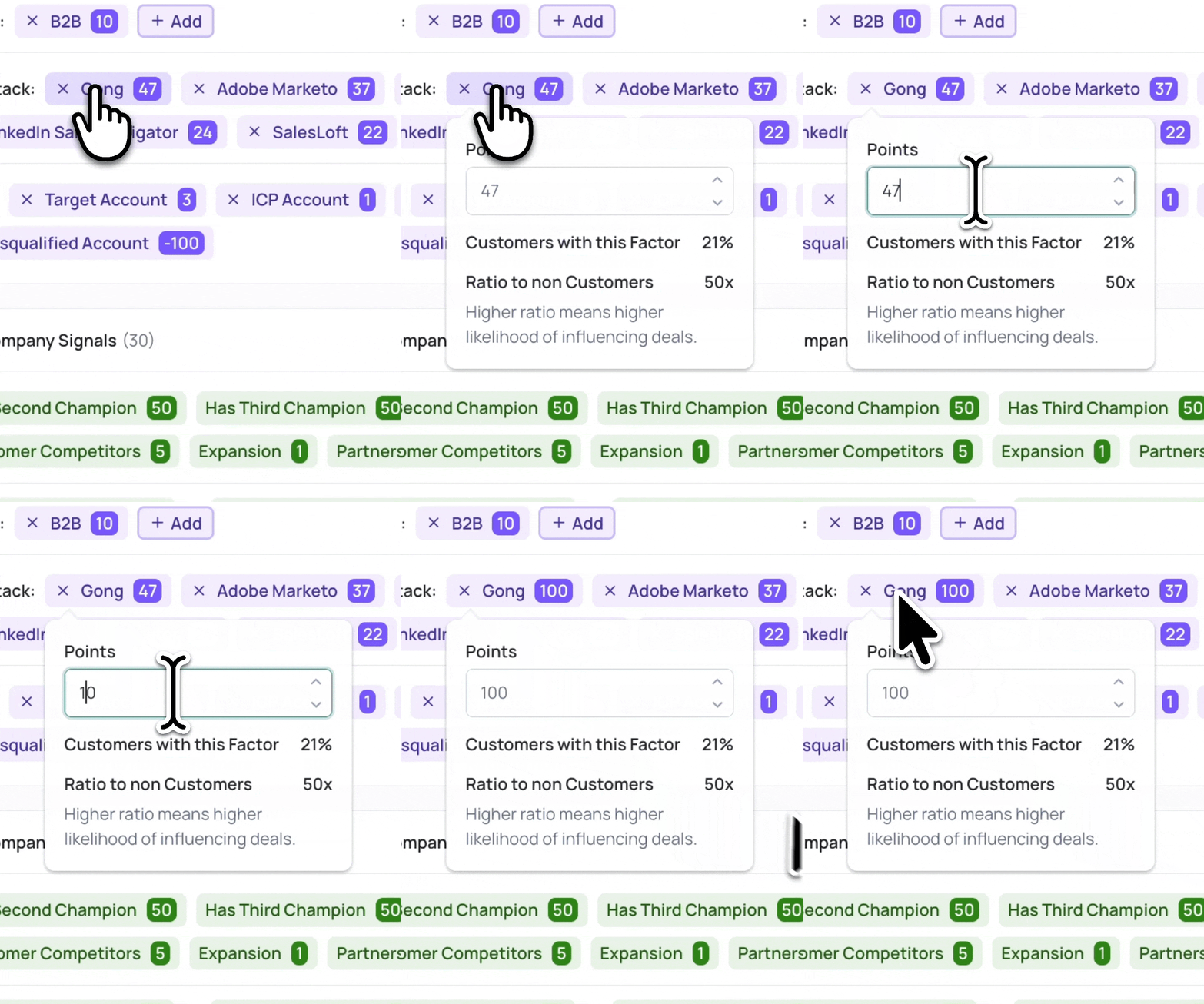
- How every scoring factor compares across customers vs non-customers
Those learnings feed back into the system continuously, so the scoring reflects your GTM reality.
You get full visibility into why every account is scored the way it is so sales and marketing have a clear, shared understanding of who to target, when, and what to say.
Layer 2: Signal orchestration (one place for all buyer signals)
UserGems brings every signal into one system:
- Contact-level intent. Know exactly who is researching your topics
- 42,000+ intent topics. Precision monitoring across the keywords that matter for your market, including competitor research activity
- Contact-level website de-anonymization. See who is visiting your site, how often, and how recently, even if they aren't in your CRM yet
- Native UserGems signals. Job changes, past champions, new hires and promotions into buying roles, account movements
- Your 1st, 2nd, and 3rd-party data. Event registrations, webinar attendees, G2 intent, CSVs, anything your team collects
All unified, deduplicated, and verified in one place. This means no more toggling between tabs, and no more debating which signal matters most.
Layer 3: Prioritization (AI scoring you can actually trust)
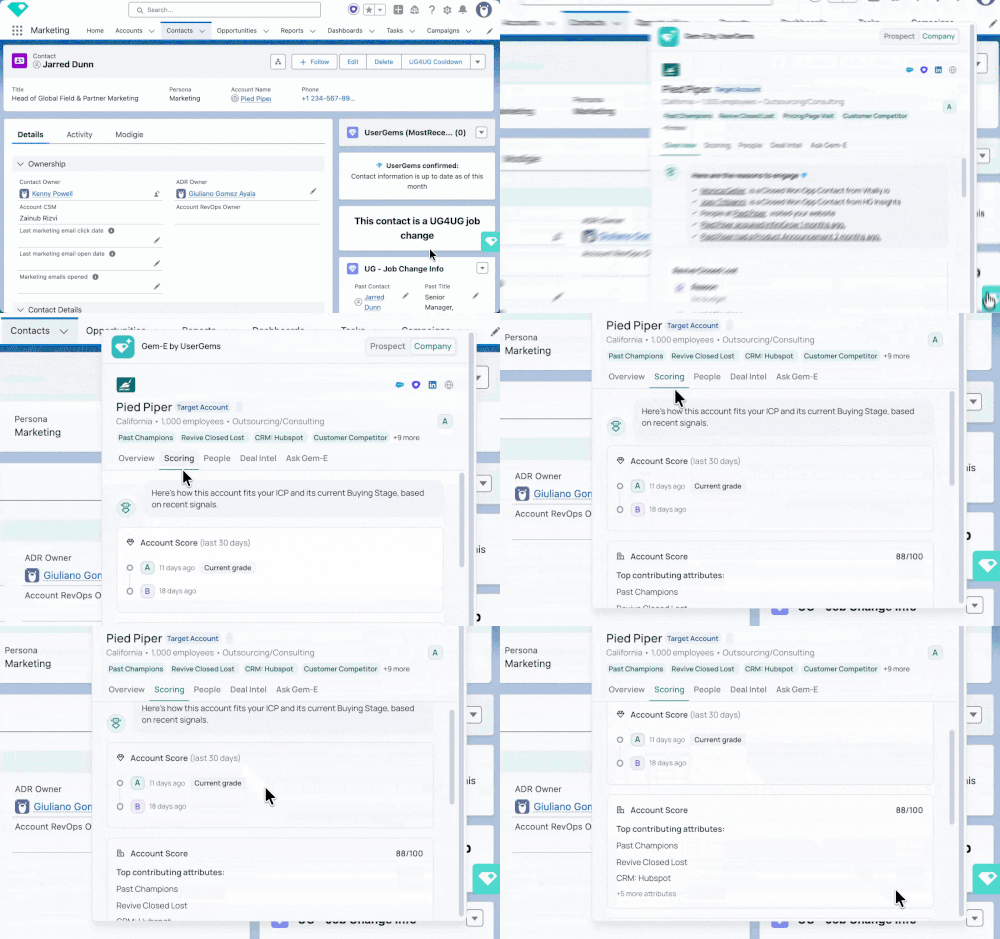
Gem-E analyzes 600+ signals weekly to generate account scores, contact scores, and a clear explanation behind each one. When reps can see exactly why an account was surfaced and say "yeah, that tracks," they actually use it.
A few things that make this different:
- Admins can adjust signal weights and preview changes before saving
- No data science team is required
- Scoring goes beyond account level to contact level
When the reasons behind every selection are visible and specific, there's rarely anything for sales and marketing to not be aligned on.
.avif)
.gif)
Layer 4: Intelligent workflows (turning signals into action)
Most ABM programs break down at the handoff between insight and action. This layer closes that gap.
Once a contact hits a signal threshold, Gem-E takes over:
- Adds buyers into sequences automatically
- Writes hyper-personalized emails using CRM context, past interactions, and the specific signals that made this person worth reaching out to
- Queues tasks directly in Outreach, Salesloft, or wherever your reps work so they wake up with tasks ready to ship
- Syncs contact-level LinkedIn ad audiences in real time as signals change
- Updates CRM records and expands buying groups automatically
This doesn’t change how reps work as Gem-E meets them inside the tools they already use.
Layer 5: Coordinated sales and marketing activation
Traditional ABM points sales and marketing at the same accounts and calls it alignment. In practice, sales is emailing someone they found on LinkedIn while marketing serves ads to a persona filter. It’s usually the same company, different people, different messages, and little to no coordination.
At enterprise especially, “same account” does not mean “same people.” If the program isn’t built around contact coordination, your overlap approaches zero, sales is talking to one set of people while marketing advertises to another.
The AI Command Center fixes that by syncing both motions to the same contacts for the same reasons at the same time.
The goal is to manufacture coincidence: a prospect sees messaging aligned to their moment (new role, competitor research, past champion) and then receives outbound referencing that same signal, without ever needing to say “we saw you on our site.”
For sales: Every rep gets specific contacts pre-surfaced with reasons to engage, outbound written automatically, and sequences pushed directly into their existing tools. Reps spend their time on calls and conversations instead of research.
For marketing: Those exact same contacts sync to LinkedIn ad audiences dynamically. Match rates stay above 80% because the contact data is verified and fully enriched. Creative is grouped by signal type so messaging matches the moment: past champions see role change acknowledgment, contacts researching competitors see relevant content, new hires see onboarding-stage messaging.
When a prospect gets an outbound email referencing their new role and then sees a LinkedIn ad about that same move, the experience feels intentional. That coordination is what turns a 1-3% conversion rate into 10-15%.
.gif)
What teams actually see
Teams running signal-based ABM through the AI Command Center see significant shifts across pipeline, efficiency, and team alignment.
Our internal ABM program converts 10-15% of targeted accounts to sales-accepted opportunities. Across our customer base, the median ROI is 47x in pipeline generated and 11x in revenue.
Reps produce more with less manual work. We doubled capacity per rep last year because research, contact surfacing, and email writing are handled before a rep even logs in. Sendoso generated 44 opportunities and over $1M in pipeline within 30 days of launching Gem-E, with 20% reply rates. Accord now sources 50-60% of outbound meetings through UserGems and Gem-E.
ABM drives inbound as well as outbound. ABM drives inbound as well as outbound. When you're actively targeting accounts with outbound and LinkedIn ads, some of those contacts come back to you on their own terms, requesting demos and engaging on their timeline. That coordinated motion turns outbound targeting into inbound demand.
CRM data gets cleaner as a byproduct. Gem-E continuously updates contact records, marks outdated information, and transfers activity history as people move between companies.
Sales and marketing alignment becomes a reality. Both teams work the same contacts for the same reasons. When scoring is transparent and the reasons to engage are visible, the back-and-forth about account selection drops dramatically.
The ABM signal playbook
Here's a four-step playbook you can run on repeat, and it gets stronger the longer it runs.
.png)
Step 1: Identify real buying signals
Before you layer in any tooling, talk to your reps. Ask them: who do you reach out to first on a Monday morning, and why? What makes you pick one account over another?
You'll hear things like: "I always go after companies where I know someone." Or "I pay attention when a champion moves." Or "I watch for new leadership because they actually have budget." That's signal intelligence. It just lives in people's heads instead of your CRM.

Your job in this step is to surface it and systematize it. Run a short discovery session with three or four of your top reps and document their instincts. What patterns come up consistently? What account or contact triggers reliably lead to conversations?
Once you know what your best reps are already doing intuitively, you can build a scoring model that reflects it and scale it across the whole team. That's when Gem-E stops being another data layer and starts acting like a rep's second brain.
Step 2: Review and prioritize (human + AI)
There's no manual research and no guessing who should own what.
Once your scoring model is set, Gem-E produces a ranked list based on signal strength and recency, already filtered for ICP fit and new business only, with ownership confirmed automatically. From there, Gem-E identifies missing personas and buying group members.
For teams entering new markets where historical conversion data is thin, you can build separate scoring models and ICPs for those segments. Even without a large customer base in a new market, signals like increased hiring velocity in the roles you sell into can identify companies scaling the exact function your product supports.
Step 3: Activate sales and marketing together
By this point, Gem-E knows who to target, why they matter, and what to say. Now it’s time to reach them together.
Sales activation
High-intent contacts get added to sequences automatically. Emails are written by Gem-E with real buyer context. Gem-E then queues tasks directly in Outreach, Salesloft, or wherever your reps work and they know exactly why they're reaching out before the first call.
Gem-E can be trained on competitive messaging, product launches, or any thematic campaign your marketing team is running, keeping outbound aligned with the broader narrative.
Marketing activation
Those same contacts sync to LinkedIn ad audiences in real time, with dynamic inclusion and removal as signals change. Because the contact data is verified, match rates stay above 80%, and you're serving signal-based messaging to specific people instead of running generic awareness ads against an entire account.
For teams using gifting platforms, you can trigger personalized gifts to the warm points of entry at a target account rather than blanketing the whole company, which keeps costs down and makes the gesture feel intentional.
Multithreading
The moment an opportunity opens, Gem-E surfaces every relevant contact at the account so your AE can multithread immediately. While they're outbounding, marketing is already running persona-specific ads to those same contacts. The sales leader, the marketing leader, the RevOps lead, all seeing messaging that reflects where their team actually is in the process. That kind of coordination accelerates deals, increases deal sizes, and improves win rates.
One rule worth repeating
Don't open with "saw you researching X." Stay in front of the buyer with relevant value and let the coordinated touches do the work. Email plus ads to the same contact is what makes the motion feel intentional rather than invasive.
Step 4: Run ABM as an always-on system
Most ABM programs get rebuilt every quarter. This one doesn't.
Gem-E monitors accounts continuously, updates scores weekly, adds and removes buyers as signals change, and keeps execution aligned without anyone having to intervene. The 1:1, 1:few, 1:many framework makes this manageable even for lean teams. Your highest-signal accounts get fully custom campaigns.
The next tier gets grouped by theme or signal cluster. The long tail runs on automated plays where Gem-E handles outbound and reps focus on calls and LinkedIn.
Our own demand gen team runs this exact playbook. Four ADRs and one program manager cover 500+ target accounts per month, with that one program manager owning everything from paid to creative to campaign orchestration.
That's what ABM looks like when it's actually working. A program that runs, learns, and compounds. And one you don't have to rebuild from scratch every quarter.
Why precision beats more signals
If you've run ABM programs before, you already know that more signals don't automatically mean better results. Most vendors pitch volume, more data sources, intent feeds, and integrations. But in practice, stacking signals without a clear way to act on them just gives your team more work to sort through.
"Signal-based GTM does not mean throwing every signal into the mix. A few well-chosen signals, optimized for impact, can yield better results than hundreds of unoptimized signals." - Christian Kletzl, CEO @ UserGems
That's why data quality matters more than data quantity. UserGems maintains a 95% match rate and less than 5% bounce rate on email addresses, with contact and account data refreshed on a biweekly and monthly basis.
Every layer of your ABM program, from scoring to outbound to advertising, is only as good as the data feeding it. If the data is stale or inaccurate, reps won't trust the recommendations, and the automation you've invested in won't deliver.
What really makes the difference is context layered on top of accuracy, knowing who the buyer is and why this week is the right time to reach out.
ABM needs a brain
ABM started with static target account lists and firmographic filters, then account-level intent tools like 6sense came along and gave marketing something new to work with. But sales still didn't know who to call or why.
The next phase of running ABM from a single command center means your team is making prioritization decisions grounded in real contact-level signals, executing coordinated plays across sales and marketing at the same time, and running a system that learns from your outcomes and compounds the longer its active.
We built UserGems to power that shift. If you've spent the last few years feeling the distance between the data your team has and the decisions your team can confidently make with it, this is what closes that gap.
FAQ
Account-level intent tools (like 6sense) tell you that a company is researching a topic. Contact-level intent tells you exactly which person at that company is doing the research. That distinction matters enormously for outbound as sales reps need a specific person to reach out to. Contact-level signals give reps the who and the why, not just the what.
AI scoring in ABM works best when it's transparent and specific. UserGems' scoring model analyzes 600+ signals weekly and surfaces a clear explanation for why each account or contact was prioritized. When reps can see the reasoning and say "yeah, that tracks," they actually use it. Admins can also adjust signal weights and preview changes without needing a data science team, which keeps the model aligned with how your team actually sells.
Real sales and marketing alignment in ABM requires both teams to be working the same contacts, not just the same accounts, for the same reasons, at the same time. That means sharing a transparent scoring model, syncing outbound sequences and LinkedIn ad audiences to the same verified contact list, and using signal-based messaging that reflects where the buyer actually is. When both teams can see why a contact was surfaced and what action is being taken, the debate over account selection largely disappears.
Stacking more signals without a clear way to act on them just creates more work for your team to sort through. What actually drives results is accuracy and context, knowing who the buyer is, having a verified email address that will actually reach them, and understanding why this week is the right moment to engage. UserGems maintains a 95% match rate and under 5% email bounce rate, with contact and account data refreshed on a biweekly and monthly basis, because every layer of an ABM program is only as strong as the data feeding it.
Gem-E is UserGems' AI agent. It handles the execution layer of ABM: adding high-intent contacts to sequences automatically, writing personalized outbound emails using CRM context and the specific signals that triggered outreach, queuing tasks directly in tools like Outreach and Salesloft, syncing LinkedIn ad audiences in real time, updating CRM records, and surfacing buying group members the moment an opportunity opens. Gem-E is designed to meet reps inside the tools they already use rather than adding another workflow to manage.