In 2026, most revenue teams are past asking whether to use AI in sales. The real question is how to deploy it in ways that actually drive pipeline, not just activity.
The market for agentic AI is exploding, with valuations expected to reach nearly $200 billion by 2034. By 2028, projections suggest that 60% of the total sales process will be handled by AI-driven activities.
The value proposition is clear: an AI agent that operates 24/7, handles CRM updates automatically, processes 10,000 data points per second, and costs a fraction of a human SDR.
But the gap between success and failure is wide, and the failures are public.
We've all seen the examples on LinkedIn: AI outreach that opens with generic enthusiasm, references pain points the prospect doesn't have, and pitches products they already own.
As one user on Reddit summarized the current sentiment: "Pretty much all hype... The problem with all the AI SDR startups was that they tried to automate the entire workflow, which they did poorly."
For revenue leaders, this creates a tension. You can’t ignore the efficiency gains, but you can’t afford the reputational risk of deploying a spam cannon that burns your total addressable market (TAM).
So, are AI SDRs actually worth it?
The short answer: yes. The math—from cost reduction to speed-to-lead—is undeniable.
The long answer requires conditions. They are worth it only if you stop treating them as magic "set it and forget it" replacements and start treating them as command centers that require high-quality data and human oversight.
The economic case: why the math is undeniable
When you look at the P&L, the economic case for AI SDR tools becomes clear. The gap between the cost of maintaining a human-only prospecting team and an AI-augmented one represents a structural shift in unit economics.
The direct cost advantage
The most immediate impact is on your Operating Expenses (OpEx). A fully loaded human SDR—factoring in base salary, commissions, benefits, taxes, and software seats—costs an organization between $75,000 and $110,000 annually.
In contrast, an enterprise-grade AI SDR solution typically ranges from $15,000 to $35,000 annually (with some lightweight tools starting as low as $500/month). [*]
This creates immediate cost savings. By shifting top-of-funnel grunt work to AI, companies can drastically lower their burn rate while maintaining—or even increasing—coverage capacity, effectively freeing up budget to hire more Account Executives or invest in closing activities.
Radical reduction in Cost-Per-Lead (CPL)
The efficiency gains compound when you look at unit economics. Because AI agents do not require onboarding, coaching, or ramp time, the cost to generate a single qualified lead drops precipitously.
Human-generated lead: ~$262
AI-generated lead: ~$39
This represents an ~85% reduction in acquisition costs. [*] For RevOps leaders, this means you can reduce CAC or reinvest those savings to expand reach without increasing budget.
Faster time-to-value
Hiring a human SDR is a slow investment. You spend months recruiting, weeks training, and months ramping them to full productivity.
Human SDR payback period: Average of 8.7 months to break even.
AI SDR payback period: Average of 3.2 months.
Because the AI comes pre-trained on sales frameworks and can integrate with your CRM in days, it begins generating pipeline almost immediately, shortening the cycle from investment to revenue.
Non-linear scalability
The most strategic economic advantage is scalability.
The human model: Scaling is linear. To double your output, you must roughly double your headcount, management layer, and software spend.
The AI model: Scaling is exponential. Increasing your outreach volume from 1,000 to 10,000 prospects does not require ten new employees; it requires adjusting the server capacity and guardrails.
Learn more → AI SDRs vs. human SDRs: Which one wins for B2B sales (and why the answer is both)
The economic case is clear. But cost savings only matter if those leads convert to revenue. That's where performance comes in.
Where AI agents outperform human SDRs
The economic argument focuses on saving money. The performance argument addresses capabilities that remain structurally impossible for human teams to achieve.
AI sales tools operate without the biological constraints that limit human SDRs—no sleep, no off days, and no ceiling on data processing capacity.
Speed-to-lead
In inbound sales, response time is critical. Research shows that responding to a lead within one minute can boost conversion rates by 391%.
Even the best SDRs take breaks, attend meetings, or sleep. The average human response time often lags between 2–4 hours, by which time the buyer has moved on to a competitor.
An AI agent detects the form fill and engages instantly—often in under 60 seconds—regardless of whether the lead comes in at 2:00 PM or 2:00 AM. It ensures that 100% of inbound interest is captured at the moment of highest intent.
Signal processing volume
For signal-based selling, this advantage is significant. A human SDR can realistically manage a sequence of 50–100 contacts a day. More importantly, they cannot manually monitor thousands of accounts for subtle buying signals.
An SDR cannot check the LinkedIn profiles of 5,000 past customers every morning to see if they changed jobs. They cannot scan 10,000 target accounts daily for new funding rounds or tech stack installations.
AI sales agents can process up to 10,000 data points per second [*]. They act as an "always-on" radar, monitoring every single account in your TAM simultaneously. When a signal fires (e.g., a champion gets promoted), the AI acts immediately. The real value lies in never missing a signal.
Consistency and scoring precision
Human qualification introduces subjectivity. One rep might score a lead as "hot" because they had a nice chat, while another disqualifies the same lead because they were busy.
Human lead scoring accuracy hovers around 60–75% due to bias, fatigue, and inconsistency. Meanwhile, AI systems achieve 85–95% accuracy in lead scoring because they strictly adhere to the data parameters you set. [*]
They don't have "bad days," and they don't deviate from the playbook. They can answer technical qualifying questions immediately—handling 87% of inquiries autonomously—ensuring that only truly qualified meetings land on your AEs' calendars.
Learn more → Lead qualification best practices, processes & frameworks
Why AI SDRs fail: the risks you can't ignore
The economic upside of AI is significant, but the downside risk is real. A poorly configured AI agent can damage far more relationships, far faster, than an underperforming human SDR.
For many revenue leaders, brand risk outweighs cost concerns. As a VP-level buyer on Reddit bluntly put it: "I get so many SDR calls and emails. And I ignore all of them... I sure as hell won't talk to a 22-year-old SDR or some AI version of one."
Contextual blindness (the EQ gap)
AI models are statistical engines, not empathetic thinkers. They excel at pattern matching but struggle with the nuanced context that drives complex B2B sales.
An AI agent lacks the emotional intelligence to "read the room." It may aggressively pitch an upsell to a customer who just churned, or send a cheerful "Just bubbling this up!" email to a prospect who explicitly asked to be removed from the list.
These mistakes create negative sentiment that can damage relationships with key accounts.
Brand erosion risks
We have all seen the screenshots on LinkedIn: robotic, culturally tone-deaf “personalized” emails that are obviously written by a machine.
Poorly prompted AI generates generic personalization—referencing a college mascot or a random funding news snippet—that feels manipulative rather than genuine.
When prospects realize they're talking to a bot pretending to be human, trust is lost.
Poor AI outreach doesn't just get deleted—it gets shared publicly as an example of what not to do.
The deliverability death spiral
The most common mistake sales reps make is using AI to scale volume without scaling relevance.
Increasing your outreach from 50 to 5,000 emails a day triggers immediate scrutiny from ISPs (Google/Outlook). If your AI sends thousands of messages with low engagement rates, your domain reputation tanks.
You might have an army of AI sales agents sending emails, but if they are landing in the Spam folder, your "speed-to-lead" advantage is irrelevant.
The "set it and forget it" fallacy
Treating an AI sales tool as a fully autonomous employee is a deadly operational mistake. AI models can drift, hallucinate facts, or get stuck in logic loops.
Without a human-in-the-loop workflow—where subject matter experts constantly audit, refine, and steer the AI—performance will degrade over time, leading to high-volume failure.
Implementation strategy: how to make it worth it
Most teams can buy an AI SDR platform. Far fewer can make it perform.
The companies seeing revenue growth didn't just plug a bot into their CRM and walk away. They followed a specific implementation framework that prioritizes process over speed.
1. Adopt a hybrid model
The most successful deployments treat artificial intelligence as a specialized role within the team that complements existing sales staff.
As one Reddit user noted: "I’ve found a hybrid approach works best too—AI for the heavy lifting and humans for the finesse."
Use AI-powered tools for high-volume, top-of-funnel, repetitive tasks like prospect research, initial outreach, and lead qualification. Reserve your humans for bottom-of-funnel activities that require EQ, such as relationship building, complex negotiation, and closing.
Don't hand off full responsibility to the AI. Successful implementation requires subject matter experts (your best reps) to fact-check the AI, proofread tone, and handle complex escalations that the bot cannot parse.
Learn more → 9 AI adoption best practices for marketing & sales teams: advice from 100+ B2B SaaS leaders
2. Secure your data and process prerequisites
AI amplifies existing processes. If you automate a bad sales process, you just scale your failure.
Don't automate bad processes: AI scales what already works; it does not invent success. As one Redditor pointed out: "Even the smartest tools still rely on solid data and a clear strategy behind them." If your cold email templates have a 0.5% reply rate, AI will not fix them.
Data hygiene: Your AI is only as smart as the data it consumes. High-quality data integration across your CRM, email, and LinkedIn determines success. If your data is dirty, the AI will hallucinate details, referencing jobs leads left years ago or pain points they don't have.
3. Execute a strategic rollout
Avoid the temptation to deploy AI across the entire sales floor on day 1.
Start with narrow, high-value use cases: Begin with low-risk, high-reward plays like re-engaging lost leads or responding to inbound demo requests. Prove the model there before unleashing it on cold outbound.
Empower internal A-players to train the AI: Don't rely solely on external agencies or non-technical staff to configure your agent. Have your top-performing SDRs train the AI on objections and tone. They know what good looks like better than anyone else.
Real-world case study of successful AI agents implementation
To see what a successful AI SDR implementation looks like in a lean, mid-market team, look at Sendoso.
Facing a common challenge—a lean marketing team that couldn't manually track every buying signal across their total addressable market—Sendoso deployed Gem-E to arm their BDRs.
Instead of generic spray and pray blasts, they used Gem-E to automate outreach based on specific high-value signals: past champions changing jobs, new hires, and website visitors. The AI drafted hyper-personalized emails that referenced these specific contexts, and even integrated with Sendoso’s own gifting platform to send physical touchpoints.
The results (in just 30 days):
20% reply rates (far above the industry average of 1-2%).
47 new opportunities created.
ROI achieved in the first month (the product paid for itself).
The key takeaway? Sendoso used AI to scale relevance. As Kacie Jenkins, SVP of Marketing at Sendoso, put it:
"This is our most successful outbound pipeline-generating program... There's no way that our 7-person team can spend their time trying to track and dig up all of the data across all of our target accounts. Gem-E does that for us automatically."
Get Sendoso’s playbook.
How UserGems turns AI potential into revenue
AI SDR tools only work when they target the right accounts. Autonomous execution without accurate targeting just scales bad outreach. While many agents rely on scraping cold databases to find leads, UserGems starts with the warm opportunities you are missing.
Here's why revenue teams use UserGems as their AI SDR platform.
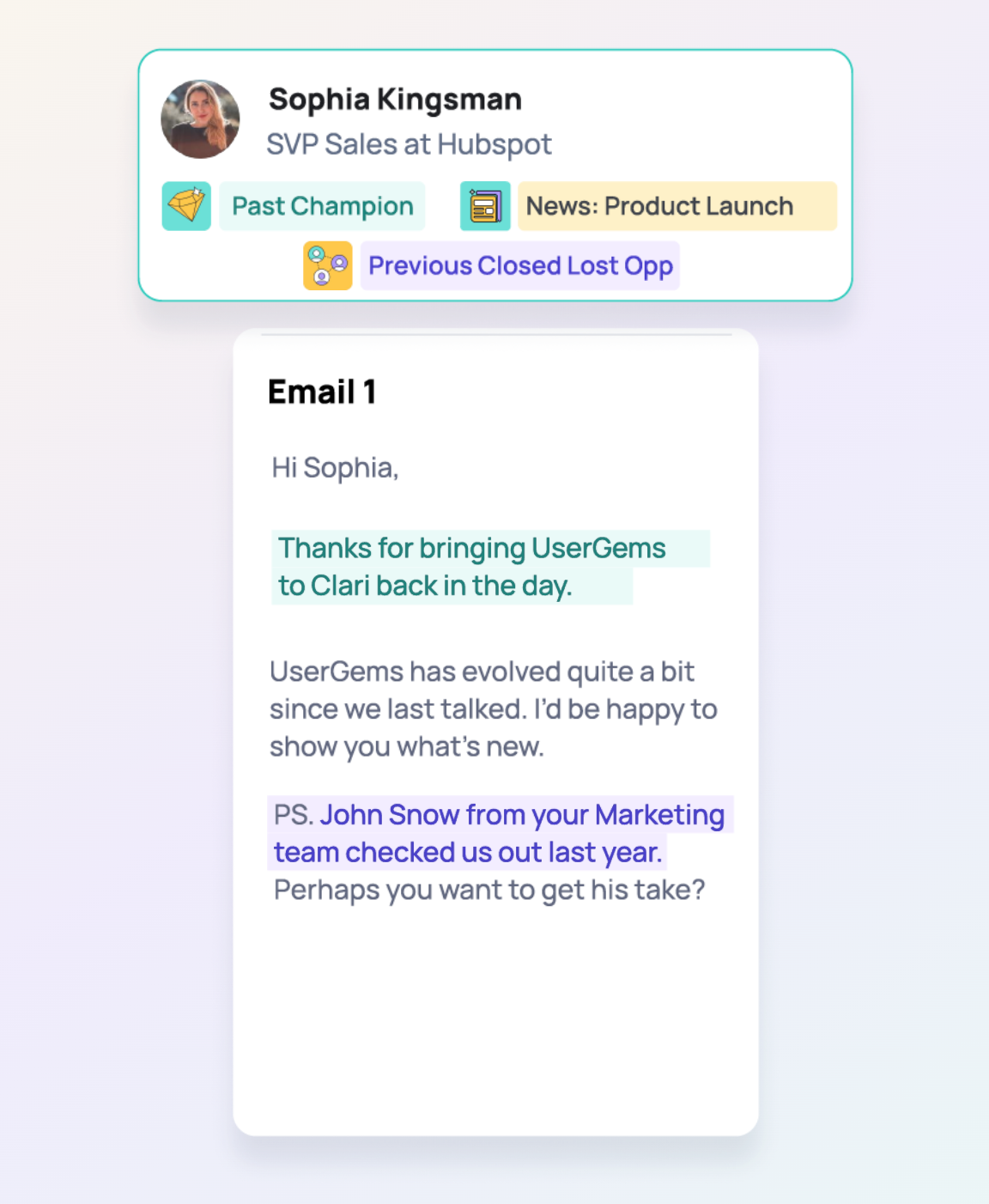
Signal-driven vs. cold outreach: Most AI SDRs start with cold prospecting—scraping databases to find anyone who might fit your ICP. UserGems starts with warm signals: past champions changing jobs, new hires at target accounts, or closed-lost opportunities showing fresh intent. We believe the best outbound starts with knowing who's actually in market. Gem-E triggers outreach based on specific high-value events—like a past champion changing jobs, a target account hiring a new executive, or a closed-lost opportunity showing new intent. This ensures your AI prioritizes warm paths over cold prospecting.
The unified command center: Disconnected AI agents create disconnected customer experiences. UserGems orchestrates your entire outbound sales and ABM motion in one place. It unifies your data, scores your accounts, and executes the outreach, ensuring that your AI agent is aligned with your broader go-to-market strategy.
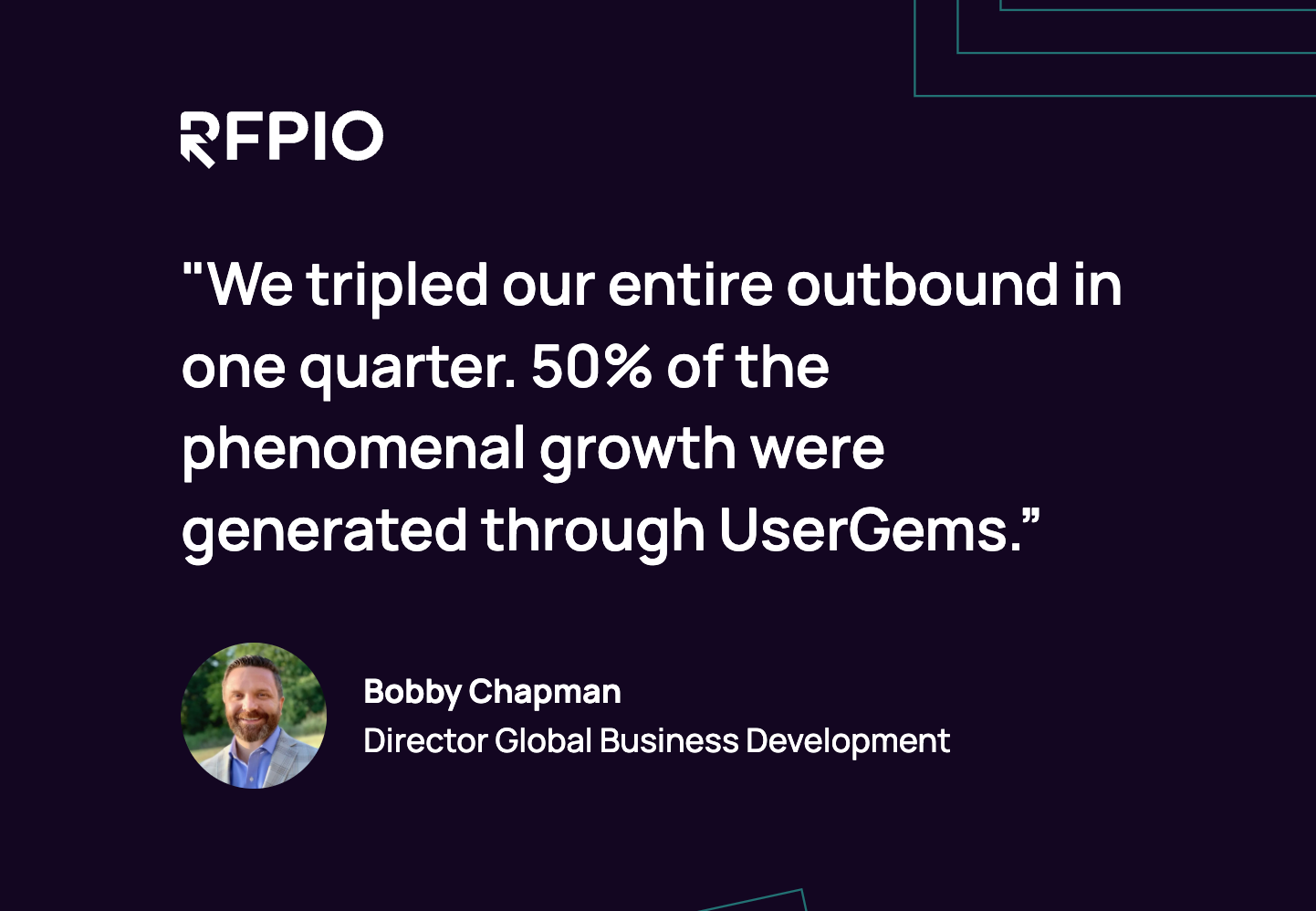
Gem-E writes with deep context: Most AI agents just fill in the blanks of a template. Gem-E analyzes call transcripts, email history, and company news to write messages grounded in real buyer context—not just personalization tokens, but genuine relevance based on what matters to that specific account. This contextual difference drives our users' 6-20% reply rates versus the industry average of 1-2%.
The $100k revenue guarantee: We promise results, backed by efficiency. We are the only platform that backs our technology with a $100k revenue guarantee. If you invest $100k, we guarantee you will generate at least that much in pipeline revenue, or we refund the difference.
See Gem-E in action. Contact us today.
Not ready to talk? Check out our interactive demo and explore UserGems at your own pace.
FAQs
How do AI SDRs work and what specific tasks can they handle?
AI SDRs work by leveraging machine learning and AI technology to streamline your entire sales strategy. They automatically enrich prospects, segment based on CRM data, and deploy personalized emails at scale. Beyond just drafting text, advanced agents manage persistent follow-up, handle booking meetings directly on calendars, and ensure real-time updates to your pipeline.
Can AI SDRs execute a multi-channel approach beyond email?
Yes. Modern SaaS sales require meeting buyers where they are. Advanced AI agents execute a multi-channel strategy that coordinates LinkedIn touches (like connection requests and DMs), SMS, and even cold calling. By orchestrating these touchpoints, the AI helps optimize response rates and accelerate sales cycles, ensuring no lead is left behind due to bandwidth constraints.
How does the day-to-day role of sales development representatives shift with AI?
AI transforms the role from grinding to "piloting." When AI handles the time-consuming work—like lead generation, enrichment, and segmentation—while salespeople step in only when it matters most: for complex problem-solving, navigating nuanced sales conversations, and closing deals. The goal is to establish an AI-assisted workflow in which AI manages volume and human reps manage relationships.
What is the best way to structure the collaboration between AI agents and human reps?
It requires a data-driven approach where roles are clearly defined based on strengths. The AI acts as the "opener," efficiently managing the volume-heavy stages of the funnel. Once a prospect engages or demonstrates high intent, automated handoffs instantly alert your team to step in with the human touch needed for complex relationship-building.

.png)
.png)
.png)