LeanData has built a loyal customer base across more than 1,000 accounts — and those customers tend to stick around.
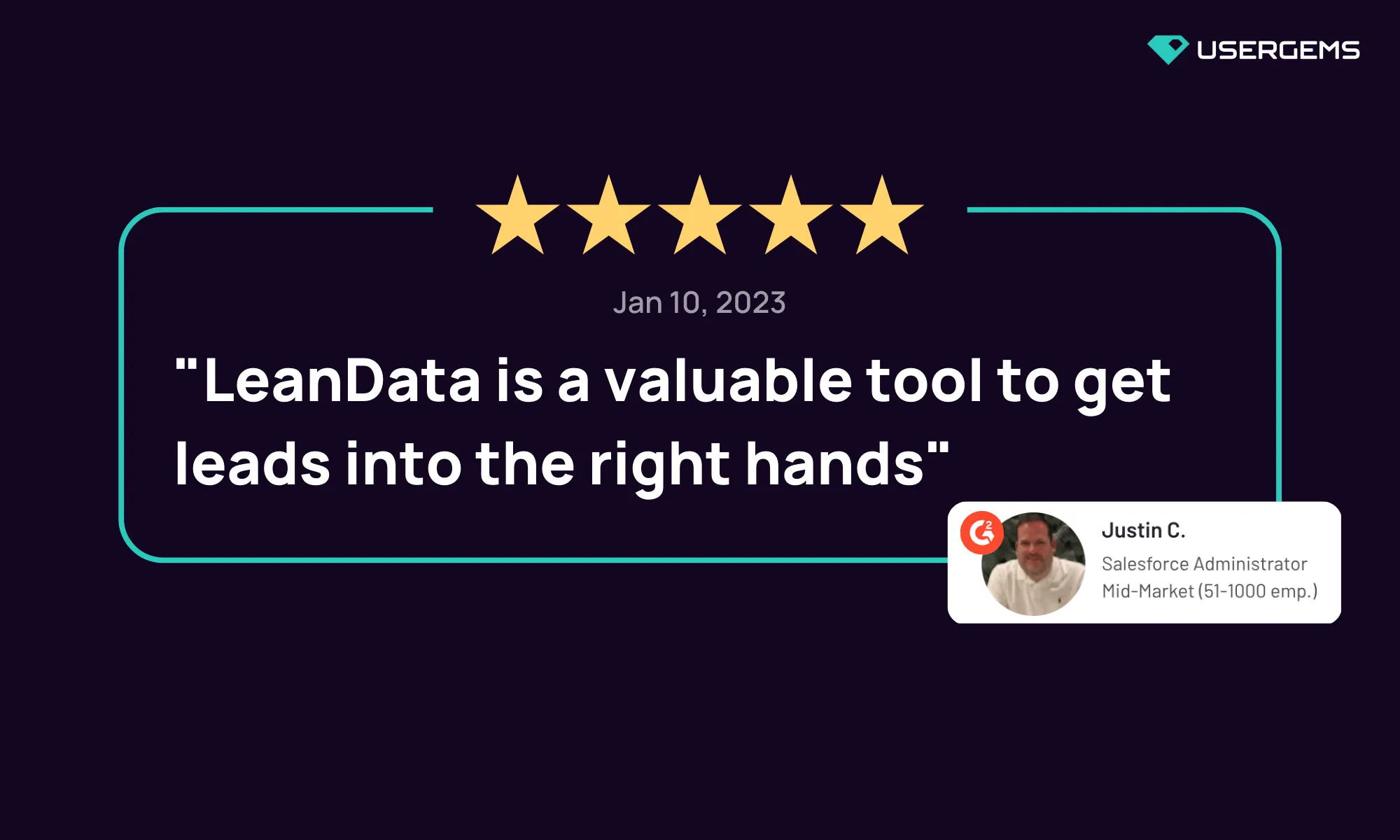
Source: G2
So, when one of the product users from LeanData’s portfolio of over 1,000 customer accounts leaves to join another organization, it opens up a potential expansion opportunity. LeanData terms this a “customer virality play,” where the LeanData and UserGems platforms integrate to drive repeat business by accelerating the identification of relevant buyers, improving lead and contact assignment accuracy, and re-routing lost opportunities for follow up.
Here's how this revenue orchestration play works — starting with what customer virality actually means.
What is customer virality?
A critical component to any outbound strategy is tapping into relationships with past customers. Previous customers already know the product, refer peers, and convert at higher rates than cold prospects. They already have an excellent understanding of our products and solutions, allowing them to move through the buying journey faster and with far fewer touchpoints than a net-new prospect.
LeanData defines customer virality as the set of circumstances that leads a customer to evangelize the LeanData product, solution and experience, sharing with their professional networks.
Importantly, customer virality results in a previous customer bringing the LeanData solution suite with them to subsequent stops in their career ladder. When customer virality works, previous LeanData customers become repeat LeanData customers.
Job turnover & its effect on marketing to previous customers
A recent Pew Research study found 2.5 percent of workers — or approximately 4 million people — switched jobs each month in 2022. This equates to a 30 percent annual turnover of workers. As such, identifying previous customers can be a significant challenge to any customer virality play.
One solution is to pore over LinkedIn. And, while that task can be performed, its manual nature is both time-consuming and expensive. More importantly, it simply won’t scale.
Enter UserGems, the AI command center for outbound and ABM that combines Data Agents, Intelligence Agents, and the AI Chrome Extension — giving revenue teams the intelligence to know who to target, what to say, and when to act. At LeanData, our RevOps team integrates UserGems with LeanData's revenue orchestration platform to execute on customer virality and drive sales pipeline growth.
Defining LeanData’s viral customers & opportunities
LeanData’s customer virality play breaks previous customers and potential buyers into the following four categories:
- Past Champion Contact: Initially identified post-sale as a power user or champion of LeanData, this contact has now moved to a new company.
- Past 'Closed Won Opportunity' Contact: This contact previously held a role in a Closed/Won Opportunity in Salesforce and has since moved to a new company.
- Past 'Open Opportunity' Contact: This contact previously appeared in an Open Opportunity in Salesforce and has since moved to a new company.
- Past 'Closed Lost Opportunity' Contact: This contact previously appeared in a Closed/Lost Opportunity in Salesforce and has since moved to a new company.
While the first contact category includes past LeanData administrators and the like, the last three categories represent prospective customers who were likely once members of a buying group or buying committee. As such, they typically have a good understanding of LeanData, having already evaluated and/or purchased our solutions.
Integrating UserGems into LeanData Routing
When UserGems surfaces a potential buyer, LeanData Routing automatically enters that contact into the appropriate workflow.
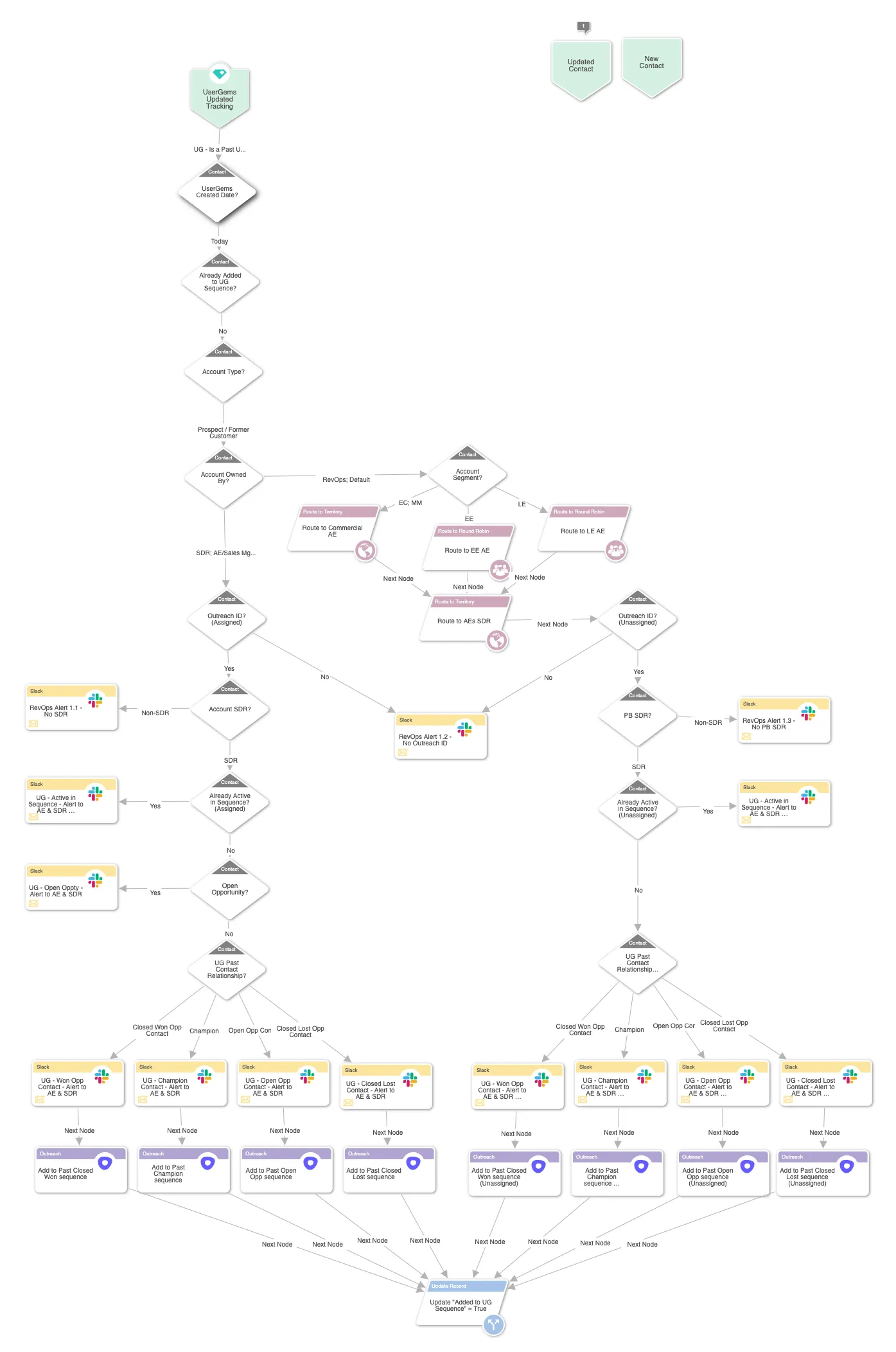
LeanData FlowBuilder Graph.
Step 1: The LeanData routing scheduler automatically creates or updates new records for new job changes detected by UserGems (this can also be performed with the LeanData UserGems trigger node).
Step 2: LeanData Lead-to-Account Matching attaches new leads to accounts or updates existing contact records, and converts new leads to a contact. Leads and contacts from assigned accounts get routed to their respective owners, while those attached to unassigned accounts get distributed to round robin accounts. LeanData sends contextual alerts to the appropriate reps, accounting for accounts or contacts already active in an open deal cycle or Outreach sequence.
Step 3: LeanData automates Slack alerts to the appropriate account executive (AE) or sales development representative (SDR) with context and the appropriate call to action. SDRs research the contact and account, strategize with their AE, and follow up within 48 hours.
Step 4: LeanData automatically enrolls the prospective customer into a persona-based Outreach sequence.
Contextual outbound motions supported by Slack alerts
When the LeanData FlowBuilder graph automates a Slack alert to the appropriate LeanData sales rep, the alert is complete with contextual information that helps personalize any proactive outreach. This contextual information includes the contact’s past relationship with LeanData, as well as their new job title, start date, company name, and new email address.
The LeanData sales rep simply clicks on the contact name in the Slack alert and is taken to the contact record in Salesforce. The contact record now includes a section for UserGems, providing context into the contact’s past interactions with LeanData. The sales rep can investigate the previous account or opportunity to gain intelligence, or potentially identify a LeanData teammate to help make a warm introduction.
Test, learn & repeat
Upon launching UserGems-powered customer virality play, the LeanData revenue team was able to generate $100,000 in new sales pipeline in just over one week. The open rates for SDRs' Outreach sequences exceeded baseline benchmarks [insert specific % lift], while bounce rates remained consistent with standard campaign averages.
This entire customer virality play is monitored and maintained by one RevOps professional, amongst all her other duties — a significant time savings compared to building and maintaining the same play with custom code and dedicated headcount in Salesforce. Additionally, LeanData’s no-code, drag-and-drop platform makes it easy to evaluate the motion through detailed audit logs, and make any necessary changes in real time.
The LeanData and UserGems integration turns a manual, hard-to-scale process into one that runs automatically and feeds pipeline. Automating a high-value motion that used to require constant manual effort — that's the point.
Together, UserGems and LeanData give revenue teams a repeatable system for identifying warm buyers, routing them correctly, and converting signal into pipeline.
Why UserGems
UserGems is the AI command center for outbound and ABM, combining Data Agents, Intelligence Agents, and the AI Chrome Extension to help revenue teams know who to target, what to say, and when to act — driving measurable pipeline and revenue growth.
Companies like Mimecast, Greenhouse, and Medallia use UserGems to turn job change signals into pipeline — running coordinated outbound plays that their teams can actually measure.
UserGems backs every engagement with a money-back guarantee — so revenue teams can act on the platform's intelligence with confidence.

.png)
.png)
.png)