Most startups don't make it. According to Deloitte, only about 0.5% of startups successfully scale, which means that only one out of 200 startups make it to a point where they’re ready (and able) to scale. The ones that do usually didn't follow the obvious playbook.
Christian Kletzl, CEO and co-founder of UserGems, knows firsthand that early-stage startups face various challenges, such as achieving product-market fit and growing a customer base, which can cause startups to fail when founders mishandle them.
Christian’s previous startup was a B2C solution that never gained traction. He applied those lessons to UserGems, which has reached $10 million in annual recurring revenue (ARR) and grown 10x over the last two years.
He was recently a guest on The Scale Up Show with Ryan Staley, where he walked through what actually worked—and what didn't—on the path to $10M ARR. Here's what stood out.
6 practical lessons for scaling up from a founder in the arena
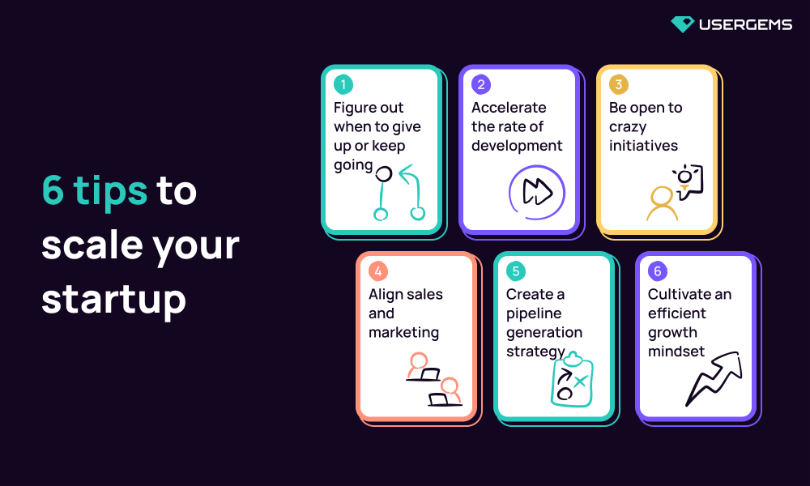
A scalable business model and infrastructure form the foundation, yet successful scaling also requires disciplined execution across people, process, and strategy.
Christian knows that from personal experience. Here are six lessons from his experience building UserGems that are worth applying to your own growth motion.
1. Figure out when to give up or keep going
Deciding when to push forward versus when to cut your losses is one of the hardest judgment calls in building a product or growing a customer base.
If you give up on a new business too early, especially in the B2B space, you might be doing so on the brink of a breakthrough. But if you continue your efforts and it doesn’t work out, you waste time and resources you could’ve spent doing something else.
Christian shares an example from the early days of UserGems:
“For us, when we got our first customer, who was actually big, it took another four months until we got the second one and then another two months until we got the third. And then faster and faster and faster. At first, we thought, ‘Okay, maybe we just got one outlier,’ and maybe this product isn’t going anywhere. But we stuck with it, and suddenly the acceleration hit.”
So how do you actually decide when to stop?
Christian suggests going crazy. “The only way that I've learned to make this decision is to actually go crazy.”
He explains, “What I mean by this is, ask, ‘What is the craziest version of this that I could do?’ It doesn't have to scale. It could be a whole lot of work. It could even be really expensive. But what's the craziest version? And then, if the craziest version doesn't work, you can stop with your non-crazy version of that as well.”
For example, Christian shut down a B2C startup because the response to their most unconventional marketing technique helped them realize it was time to quit.
“We did a whole lot along the way when we did the B2C selling. We went to apartments, put a box in front of their door, and said, ‘Give us the stuff you want to resell, and we'll do it for you. Since the craziest, easiest possible version didn't work, we said, ‘Okay, that's it.’ We stopped with it.”
2. Accelerate the rate of development
Customers will always ask for more features, yet validating demand before building protects your team's time and increases the likelihood of paid adoption.
That means you have to validate any new features before you build them, which takes a lot of time.
Here’s the framework Christian uses for accelerating development in scenarios like this.
“The best methodology is that whenever you say, ‘Okay, someone's asking for this. I'm going to develop this and figure out whether it's interesting.’ Then, you put a timeline on it. Let’s say, two months.
“At this point, my co-founder always asks, ‘Could I have this in two days? What do we need to do to have this in two days? What are we cutting to have it in two days?’ And it's really interesting how these questions accelerate the rate of development. So, I think the framework is just asking these questions at every single point. Even when you think it’s a crazy ask.”
The right feature shipped fast gives customers a reason to stay—and stay longer.
3. Be open to crazy initiatives
Moving forward with crazy initiatives can help you quickly decide whether to continue or abandon certain efforts. And this doesn’t just apply to products but other areas as well, such as business development and marketing.
“Certainly, this should be done by every single department, especially marketing,” says Christian.
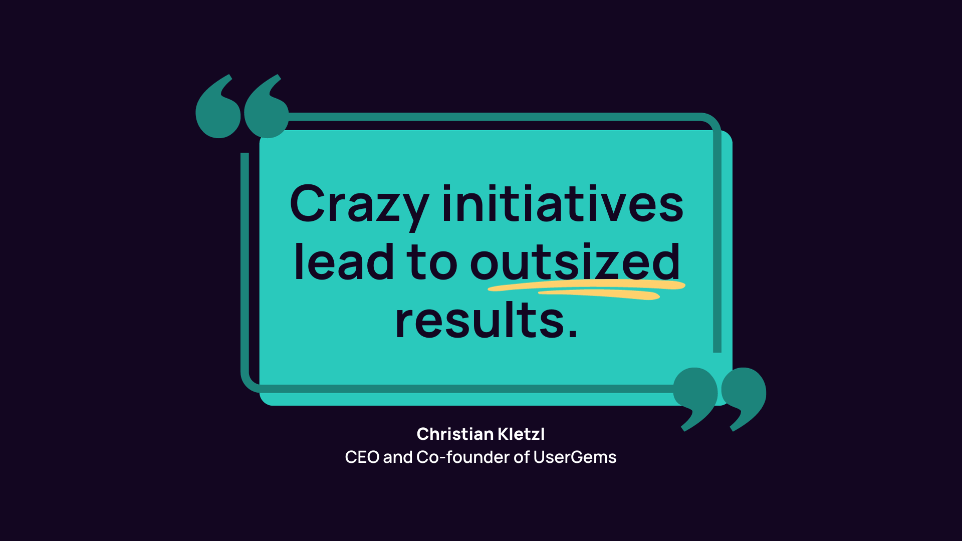
“There are these core fundamentals in marketing that you need to do. For example, you go to conferences, you do X, you do Y, but at least 20 -30% of the budget for the activities needs to be for something completely crazy because it’s the crazy initiative that can have these outsized results.”
In marketing, risky initiatives like this can boost pipeline generation, as demonstrated in the case of UserGems with highly personalized advertising.
“Everyone does highly personalized sales, but we’ve done highly personalized advertising,” says Christian. “We target a company, put the logo of the company on the ad, and that by itself increases the click-through rate tenfold. And that is a lot of work if you have 5,000 companies you're targeting. But with the right process, you can actually get that to work.”
You might wonder if these experiments have a process, but Christian advises founders to avoid obsessing with nailing down a process.
“It's a mistake to think that you need to have a process for it,” he explains. “If you think about the process, then you might not even start because it's completely impossible to start with a process there.”
“Rather, this is where the mantra of Y Combinator comes in: ‘Do things that don't scale. And once they work out, you find a process and a way to scale it.’”
4. Align your sales and marketing team
Aligning your sales and marketing teams increases the effectiveness of your pipeline generation activities, ensuring that you’re targeting the right people at the right time.
“Having a strongly orchestrated sales and marketing motion is our primary revenue growth market strategy,” says Christian.
“We call it outbound, but it's really a combination of sales and marketing. The very same people get the same sales messages and see marketing messages on LinkedIn or any other channel simultaneously. Then they either respond or come inbound through that.
“The key is remembering that we all have a two-second attention span. So, it takes seeing your messaging 10 times in two seconds for someone to remember you. That's why it's so important to orchestrate sales and marketing so that you're reaching the same people with the same messaging at the same time.”
5. Have a pipeline generation strategy
Pipeline generation works best when it's triggered by real buying signals—not arbitrary cadences. Job changes are one of the strongest signals in B2B: a champion who moves to a new company already knows your product and has a reason to buy again.
Even with a strong, scalable product, generating a consistent stream of new customers demands a deliberate pipeline strategy. This makes it hard to grow your revenue and leaves your sales team with pipeline anxiety.
UserGems acts as an AI command center for outbound and ABM, helping revenue teams identify high-priority targets, surface the right signals, and trigger action at the right moment — including routing timely alerts about account changes directly into your existing sales and marketing tools. One high-impact signal: when past customers and champions move to new organizations, your team can reach out quickly, shortening the sales cycle and increasing close rates.
“The idea is if they move to a new organization, then you can quickly sell to them because they already used the product,” says Christian. “It's typically a very easy sales motion, faster and higher lifetime value.”
Your previous customers already know the product. If the experience was strong, that familiarity translates directly into a shorter sales cycle at their new company. Being able to reach out to these former customers when they move to a new job means your sales reps can shorten the sales cycle and close deals faster.
UserGems automates this process by surfacing the right contacts and routing them directly into your existing sales and marketing tools for immediate outreach.
However, Christian notes that there are two aspects to tracking buyer job changes. The first is generating pipeline while the second helps protect revenue.
“A champion leaving is the second biggest reason for churn we've seen,” explains Christian. “Over the last two years, our conversations with customers have always been around revenue generation. But in the last 3-4 months, pretty much all our customers are now focused on active churn prevention.”
The number one thing companies want to do now is protect the revenue base they already have.
“We've seen a huge uptick in ‘tell me who's leaving my customer accounts’,” notes Christian. “And also interestingly, ‘tell me who's joining my customer accounts’, because that's actually another trend risk if there's a new person coming in who now has the budget and they've never heard of you, so you want to go in there as quickly as possible.”
6. Cultivate an efficient growth mindset
Efficient growth isn't just a CFO concern. For revenue teams, it shows up in metrics like revenue per rep, pipeline coverage ratios, and how much of your outbound converts without adding headcount. The revenue-per-employee benchmark Christian uses translates directly: if you're adding SDRs faster than pipeline grows, something's off.
This matters especially for revenue teams. If your SDRs, AEs, and marketing are all chasing different efficiency benchmarks, the motion breaks down.
“Money has been a question for us, especially in the first five years of our existence,” Christian recalls.
“Because we've been pretty much running out of money for the first five years, we've always had this efficient growth mindset. And for us, it actually carried us into this time right now where everyone is now thinking about efficient growth.”
But how do you know you’re growing sustainably in real-time? And what data do you look at? Christian suggests one specific metric.
“There are a whole lot of things to look at, and then you can always cherry-pick the metrics that you like, but the one that I really like is revenue per employee,” he says.
“Revenue per employee has always been the North Star for us because it aligns hiring people with revenue growth. So, unless you're growing at a specific rate, don't grow your team size at a specific rate.
“You should increase revenue per employee over time. But for us, the psychological number was always a hundred thousand. We always wanted to be above the hundred thousand in terms of revenue per employee.”
Generating new business is key to scaling your startup
Keeping costs tight, protecting existing revenue, and consistently generating new pipeline aren't competing priorities—they're the same motion done well. UserGems automates the job change tracking that feeds all three. If that's a gap in your current stack, it's worth a look.
Struggling to generate a steady stream of warm leads for your business?
UserGems can help. We track when your past customers, champions, and prospects move to new roles and automatically surface them in your CRM so you can sell to them again. We also surface the key contacts you need at your target accounts, so you can execute highly personalized outreaches.

.png)
.png)
.png)