Building your tech stacks after Series A funding is critical—but choosing the right tools without overspending or creating bloat is tough. Here's how to evaluate what actually drives growth.
After getting your Series A funding, you’ll likely have access to a bigger budget and be ready to invest in new tools to amplify your company’s growth. But with so many options on the market, deciding which ones meet your needs without breaking the bank can be daunting.
Add change management and cross-team enablement, and balancing priorities becomes nearly impossible.
Here's how to evaluate tools that will actually scale with your business, plus the platforms revenue teams rely on to hit their numbers.
Hi, I'm Cliff Simon, Chief Revenue Officer at Carabiner Group, and we help B2B SaaS businesses develop bespoke RevOps strategies and blueprints that support every stage of their growth.
What to consider when building a Series A tech stack
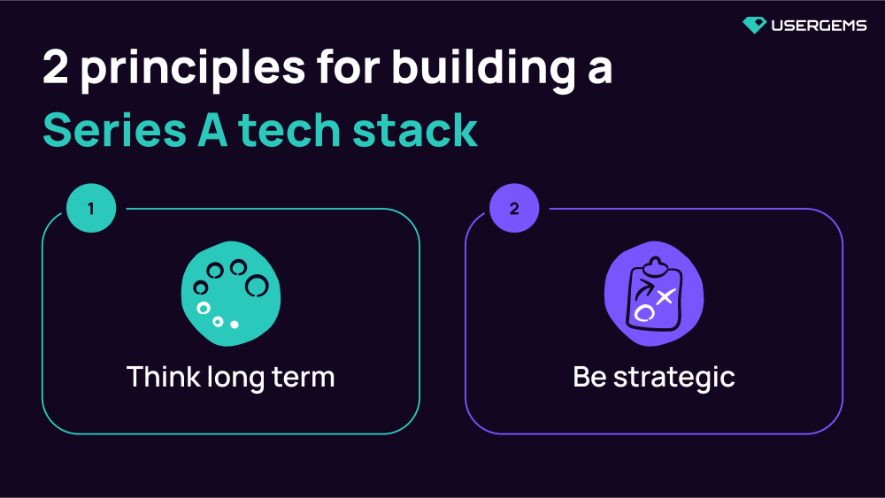
Before you build your Series A tech stack, it’s important to consider which tools will serve you the longest and to prioritize your business’s tech needs. After all, you don’t just want to build a tech stack. You want to build the right tech stack.
Start by following these two tips:
1. Think long-term
You can easily succumb to shiny object syndrome, especially when a tool appears to fit your budget. A tool that looks good today must also meet your needs and fit into your workflow in the long term. Consider whether your business can benefit from a tool, not just now, but in the future.
Make a list of what your business needs now and as it grows. For example, ask yourself:
What systems do I need in 3-5 years?
What data do I want to be able to track historically?
Your tech stack should evolve with your business.
2. Be strategic
Focus on prioritizing tools strategically rather than acquiring everything at once. Instead, prioritize which tools will make the biggest impact on your business.
Start with integral systems, like:
A customer relationship management (CRM) platform
A tool to drive outreach
Something to capture inbound leads
Accounting and invoicing software,
And data enrichment
Prioritizing based on immediate needs prevents you from having a bloated tech stack and simplifies decision-making.
8 tools to have in your Series A tech stack
Once you have a framework for building your Series A tech stack — based on your long-term business needs — it’s time to start exploring different tools and platforms. But with so many out there, getting started can be overwhelming.
Here are some of the most popular types of software to choose from and the most popular tools in each category.
1. CRM software
A CRM gives you a single view of your customer lifecycle—tracking leads, managing interactions, and surfacing insights that guide sales, marketing, and support decisions.
Using a CRM, you can manage your relationship with your customers. It gives startups an overview of the customer’s lifecycle, tracks leads, helps to build relationships with prospects, and manages customer interactions.
In turn, you get insights that guide crucial business activities such as sales, marketing, and customer service.
Here are some CRM platforms to check out:
Salesforce
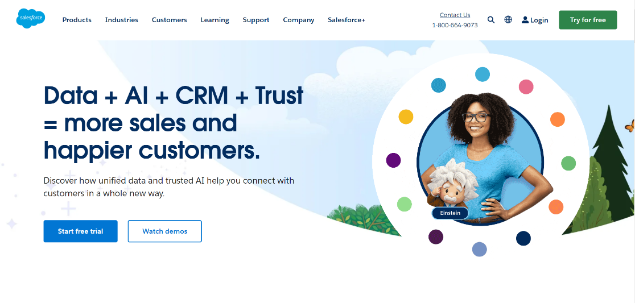
Salesforce is one of the most popular CRM tools on the market today. Its features include lead management, sales pipeline management, customer service, marketing automation, and analytics.
Salesforce centralizes your customer data across teams. It offers a wide range of integrations, so you can connect most of your existing tools to the platform to get rich insights into your customers. It’s also cloud-based, secure, and scalable, so it’s designed to grow with your startup.
HubSpot's CRM
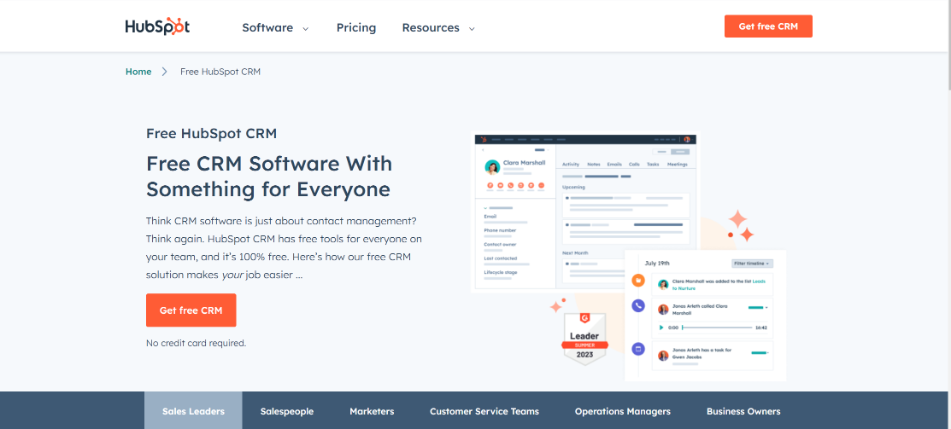
Hubspot’s CRM platform is another popular CRM tool. It provides a CRM platform that’s free for up to 1,000,000 contacts and unlimited users. With Hubspot’s CRM, you can track your customer’s lifecycle, automate emails, and chat with customers.
Hubspot's CRM is free for up to 1M contacts, making it budget-friendly as you scale. However, you can upgrade to their paid options as your needs become more complex.
You can also integrate your Hubspot CRM with their suite of products or your existing systems and processes.
2. Sales engagement platforms
A sales engagement platform is a tool that helps sales teams streamline their outreach efforts and manage their interactions with potential customers. It typically includes features like email and phone outreach, automated follow-up sequences, and analytics to track engagement metrics.
Sales engagement platforms help make conversations with customers more personalized and centered around their needs.
This improves team productivity, speeds response times, and creates better buyer experiences.
Here are some sales engagement platforms to check out:
Outreach
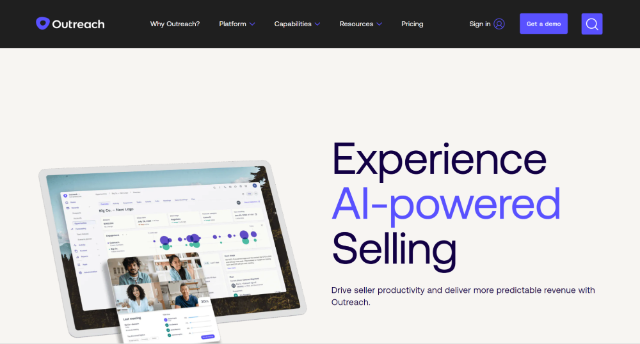
Outreach.io is a sales engagement platform that helps sales teams increase productivity and efficiency by automating time-consuming tasks such as email follow-ups and appointment scheduling.
It also provides valuable insights and analytics to help sales reps better understand their prospects and optimize their outreach strategies. Additionally, Outreach.io integrates seamlessly with other sales tools, such as CRM systems and marketing automation platforms, making it a comprehensive solution for sales organizations.
SalesLoft
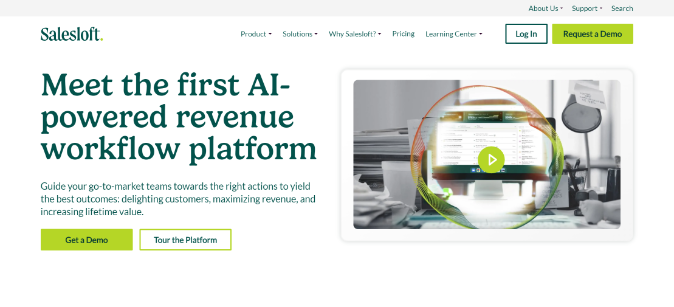
SalesLoft is a sales engagement platform that helps sales teams engage effectively with their customers and prospects. It provides sales intelligence, email tracking, and real-time analytics to help sales reps prioritize their leads, personalize outreach, and close more deals.
With SalesLoft, sales reps can automate their outreach, manage their pipelines, and collaborate with their team members to drive more revenue. SalesLoft is a powerful tool for any sales team looking to improve productivity, efficiency, and success.
Apollo
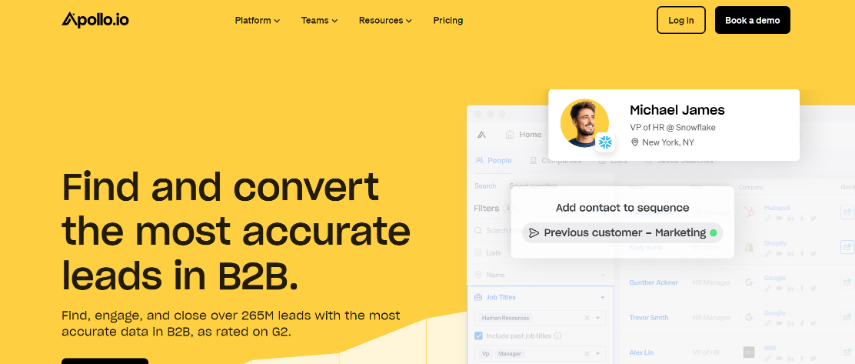
Apollo is a sales acceleration platform that provides sales teams with access to millions of accurate and verified B2B contacts.
It allows revenue teams to build targeted prospect lists, automate their outreach, and track their engagement to improve sales performance. Apollo also offers powerful analytics and reporting features that enable sales teams to measure their success and optimize their strategies.
3. Marketing automation platforms
Marketing automation platforms streamline and automate tasks such as lead generation, email marketing, social media posting, and customer segmentation.
They enable businesses to create targeted campaigns that engage and convert prospects into customers while tracking performance and ROI. With marketing automation, companies can save time, increase efficiency, and provide a better customer experience.
Here are some marketing automation platforms to check out:
HubSpot
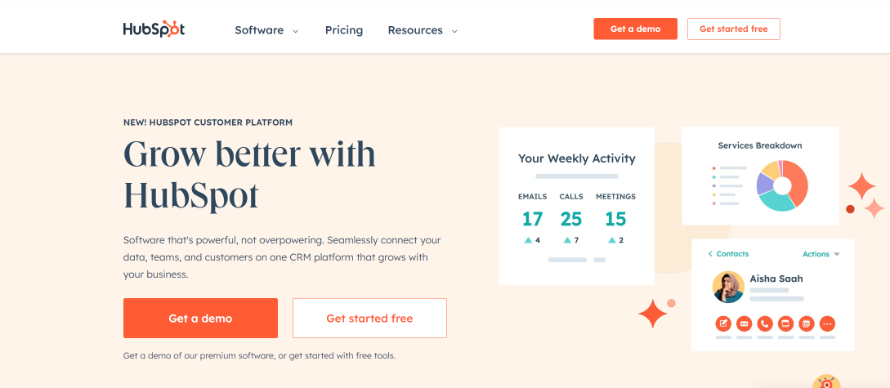
Hubspot offers marketing automation tools that seamlessly integrate with its CRM, like email marketing, social media scheduling, and lead nurturing campaigns. These tools allow users to create targeted and personalized marketing campaigns to convert leads into customers.
Hubspot also offers robust reporting and analytics features, which provide users with valuable insights into their marketing efforts' performance and help optimize future campaigns. These tools allow businesses to create targeted campaigns, track customer behavior, and automate repetitive tasks, ultimately saving time and increasing efficiency.
Marketo

Marketo is a marketing automation platform that helps businesses streamline their marketing campaigns and customer engagement. It provides tools for lead management, email marketing, social media advertising, and analytics to help businesses make data-driven decisions. With Marketo, you can optimize your marketing strategies and better understand your customers' behavior to improve your overall marketing performance.
4. Champion tracking software
Shrinking budgets and economic uncertainty make it vital for companies to figure out how to do more with less. Generating poor quality leads or targeting the wrong accounts will strain your budget without growing your revenue.
That’s where pipeline generation software comes in. It helps you to generate warm leads who are the most likely to buy without wasting your money or having your reps prioritize leads who aren’t ready to make a purchasing decision.
Here are some pipeline generation tools to check out:
UserGems
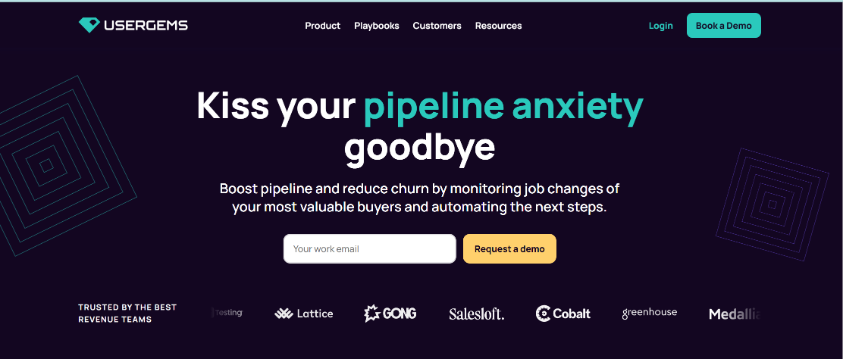
UserGems helps you generate pipeline by tracking job changes of your champions and prospects. UserGems helps companies generate new pipeline (and reduce churn) by tracking job changes of their champions (and prospects).
Champion tracking adds 10%+ to qualified pipeline on average by surfacing high-intent buyers based on job change signals—people who already know your product and are entering new buying cycles. Opportunities with previous champions have more than 2X higher win rate, 54% bigger deal size, and 12% shorter sales cycle.
Your customers and prospects grow and change jobs as your business grows. Keeping track of them manually is a complex process. It's time-consuming, inaccurate, and fails to motivate your sales rep to act on these warm leads. This manual approach causes you to miss 91% of relevant job change signals when doing this yourself.
UserGems alerts you when champions change jobs, enriches their new contact data, surfaces their history with your company, and auto-enrolls them in the right sequence in Outreach or Salesloft—so your reps can reach out with relevant context immediately.
Is your CRM data hygiene too messy to run the champion tracking program?
UserGems has a powerful add-on Meeting Assistant. This feature automatically enriches contacts that have met with your teams and adds these new contacts into Salesforce under the right accounts and opportunities.
This keeps your CRM clean automatically and improves pipeline conversion from your champion tracking program.
LinkedIn Sales Navigator

LinkedIn Sales Navigator also has a champion tracking functionality – allowing users to upload lists of customer accounts and set up filters to surface relevant job changes.
Sales Navigator is great for individual usage, ad-hoc searches, and real-time alerts.
When a job change happens, Sales Navigator will alert the user to review the change and add the contact to their CRM. They can then reach out using InMail or LinkedIn messages. Note that your team still needs to use another tool to enrich these contacts to find their new email address, etc., if they prospect via email or phone.
Seamless AI
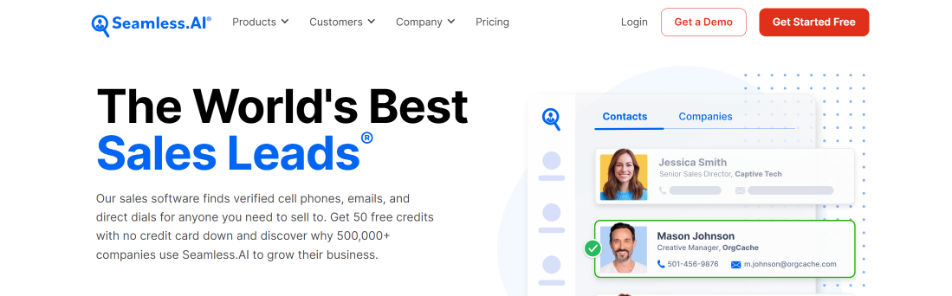
Seamless AI helps businesses increase their sales productivity and revenue by providing more accurate and targeted sales leads.
5. Conversation intelligence software
Conversation intelligence software helps businesses monitor and analyze their conversations with customers.
It can transcribe and analyze phone calls, emails, and chat conversations to identify trends, sentiments, and areas for improvement. This helps you track and measure the effectiveness of your sales team’s conversations and provides coaching and training to improve their performance.
Here are some conversation intelligence software platforms to check out:
Gong
Gong analyzes sales conversations using AI to provide actionable insights and improve sales performance. It identifies key topics and metrics, coaches reps, and offers real-time recommendations to close more deals.
Gong uses artificial intelligence to analyze the content of sales calls and meetings, identifying key topics and themes and individual performance metrics. Gong also provides real-time alerts and recommendations during sales calls, helping sales reps stay on track and close more deals. This means it can be used to coach sales reps and improve overall sales performance.
Chorus
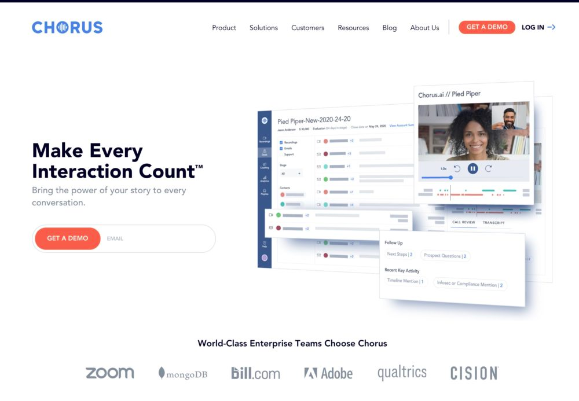
Chorus is conversation intelligence software that helps you capture and analyze customer interactions.
Chorus uses AI technology to transcribe and analyze audio and video conversations, providing insights into customer sentiment, product feedback, and sales performance. The insights from Chorus can help you meet your customer’s needs more effectively and help them find success with your product.
Grain
Grain records your calls and automatically generates key insights from sales conversations. It also integrates with your Hubspot CRM, making it easy to enrich customers’ information based on recent interactions. This helps with onboarding and training sales reps based on previous call recordings.
With Grain, you can capture the voice of the customer in real-time. You hear what customers and prospects say about their needs in their own words. This information can guide product updates and shape product messaging.
6. Configure, price, quote (CPQ) software
CPQ software allows sales representatives to quickly and accurately create quotes for potential customers. It can also help with product configuration and pricing, making it an essential tool for sales teams to quickly and accurately create quotes for complex products and services, ensuring that prices are accurate and margins are maintained. This helps to reduce errors, increase efficiency, and ultimately improve their bottom line.
We recommend:
Nue
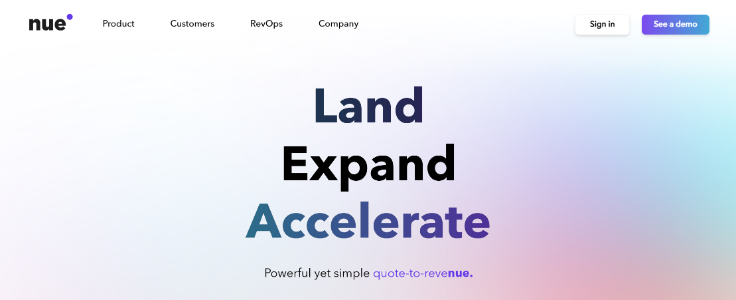
Nue is a quote-to-revenue platform that makes it easy for you to generate quotes and adjust pricing on the go for prospects for hybrid pricing systems.
Prospects can get prompt answers about the cost of using your product, even if they require complex configurations. In turn, this helps to shorten the sales process and improve the buying experience for your prospects.
Nue also integrates your customer’s pricing information in SalesForce, so it’s easier to provide quotes on demand, track customer subscriptions or renewals, and forecast revenue.
7. Booking software
Have a lot of meetings and need a tool to help you stay organized? Whether you’re meeting with prospects or potential business partners, here are some booking tools to try:
Chilipiper
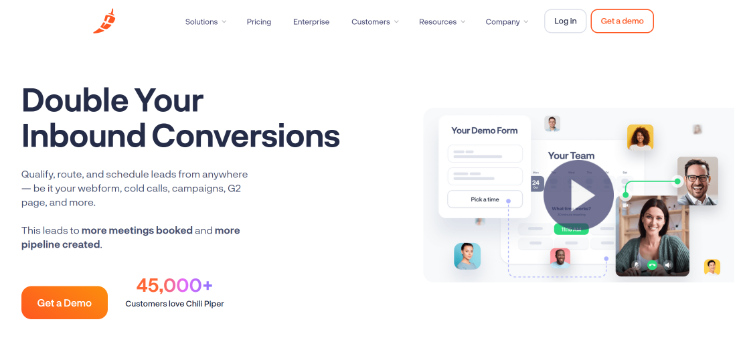
Chilipiper is a tool that helps you automatically schedule meetings with your leads. This helps shorten the response rate for your startup, ensuring that sales opportunities don’t go cold before you have a chance to convert them.
HubSpot meeting scheduler
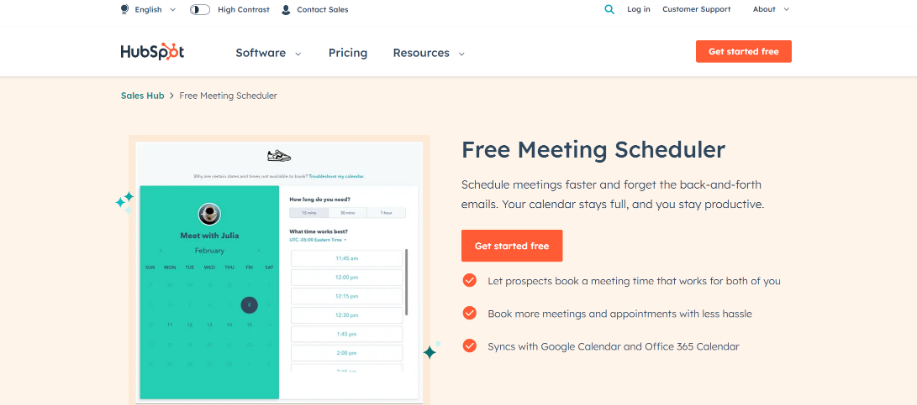
HubSpot provides a free meeting scheduler that you can embed on your website. This means prospects can book meetings to speak with an available rep on your website without going through a complicated system.
The HubSpot meeting scheduler shows available times for multiple team members and allows the prospect to pick a convenient time for the parties involved. You can sync Hubspot’s meeting scheduler to Google Calendar and Microsoft Office 365.
8. ETL/IPaaS tools
Most businesses aim to have a single source of truth — one place to view all business data— but it’s easier said than done. Integration Platform as a Service (IPaaS) and Extract, Transform, and Load (ETL) tools help you unify your data across different platforms.
We recommend:
Syncari
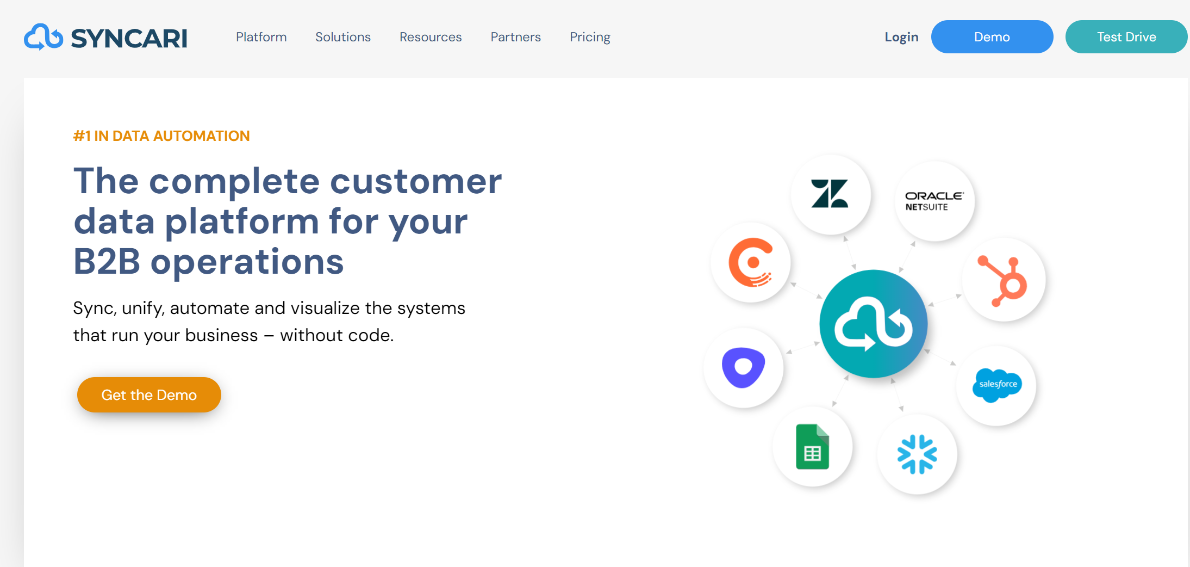
Syncari is a data automation platform that helps you collect and unify customer data from different platforms, even if they weren’t designed to integrate with each other.
If you have multiple CRMs, you can use Syncari to unify information from the different platforms. For example, you can use it to unify and visualize data from HubSpot and Salesforce at the same time. It can also be connected to external databases like Google Sheets.
Syncari is also easy to use — it’s a no-code platform that key team members can edit, update, and use to get a single source of truth for your startup, even if they aren’t IT professionals.
Your Series A tech stack depends on your business goals
Your Series A tech stack should match your specific growth goals and GTM motion.
Start with the core tools of a tech stack, including CRM software, sales enablement tools, marketing automation platform, and pipeline generation software. These tools help you generate pipeline, close deals faster, and retain customers—the fundamentals that drive Series B and beyond.

.png)
.png)
.png)