Sales reps face constant rejection, tight quotas, and the pressure to fill pipelines with quality leads. The result: three in five salespeople struggle with their mental health.
So, it’s not hard to understand why three in five salespeople struggle with their mental health.
Fortunately, building mental resilience in sales can not only help to improve reps’ mental wellness but also increase their productivity and performance.
Not sure how to increase mental toughness in sales teams? In this guide, we share eight expert tips to help you train your team to manage their anxiety (including pipeline anxiety 😀)better and become mentally tough.
TL;DR
- Eight tactics to build mental resilience in sales teams and improve productivity and performance
- Build a supportive culture, give actionable feedback, and encourage a growth mindset to manage stress
- Help sales reps detach from outcomes to handle rejection better and maintain motivation
How does mental resilience help sales teams?
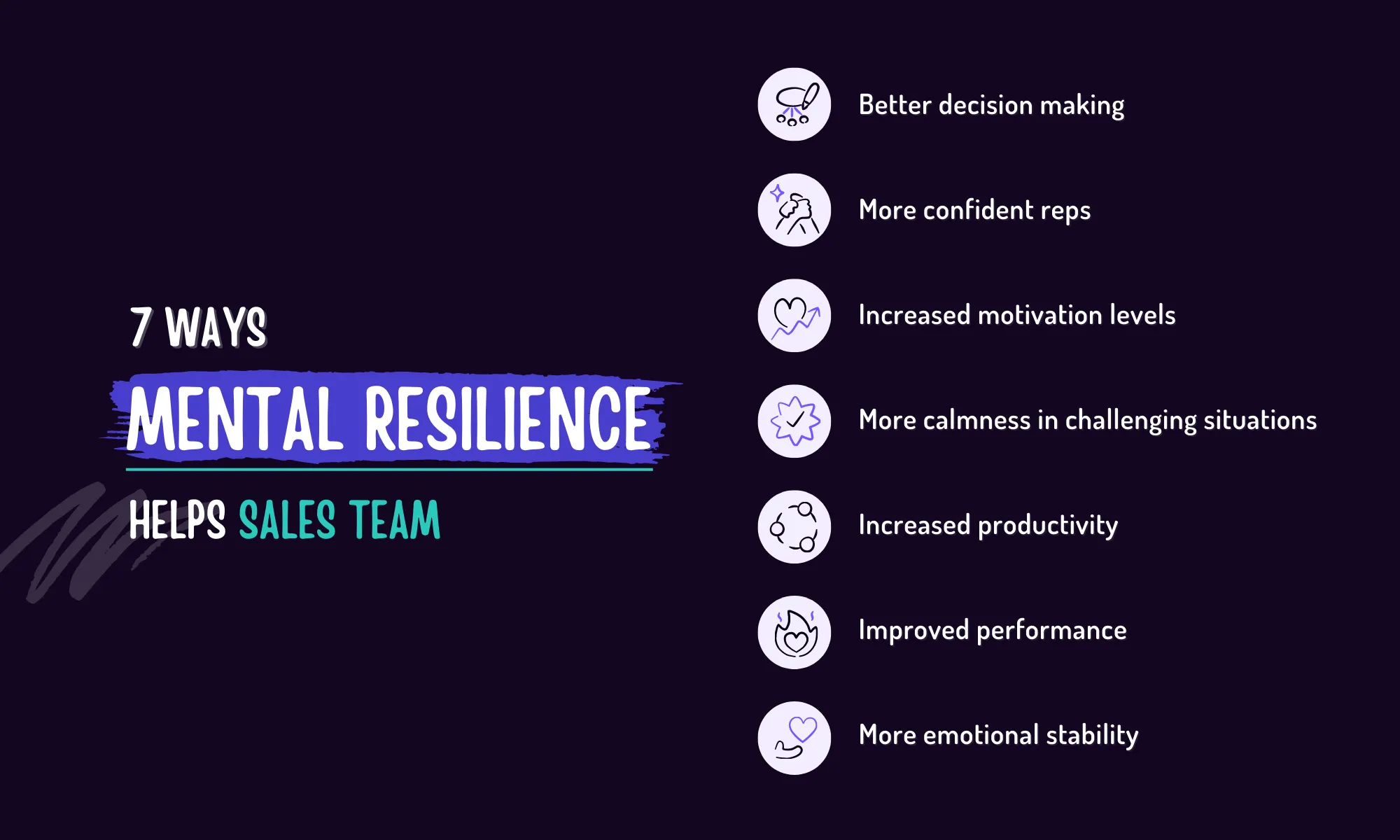
Resilient sales teams are high-performing teams. They handle pressure and stay calm in challenging situations.
Padmaja Santhanam, Partner & Growth Manager at FirstPrinciples, believes that mental resilience in sales leads to better decision-making, more creativity, and increased emotional intelligence.
In fact, Santhanam notes, “In my organization, the significant aspect that I have noticed is that sales teams with higher levels of mental resilience are more likely to perform better, be more creative and make better decisions. Furthermore, the sales teams with higher levels of mental resilience were more likely to achieve more sales, generate greater accounts receivable value, and generate greater cash flow.”
Derek Wang, the Sales Manager at UserGems, also highlights that better resilience improves reps’ motivation levels. “Sales reps need to be motivated to perform at a high level. Being mentally resilient enables us to maintain a more consistent level of motivation.”
“There are inevitable losses and hurdles that will happen in sales. You can’t win every deal, and sometimes that’s a tough fact to accept,” Wang continues. “When the chips are down, it’s easy to get into a vicious cycle of decreased motivation, confidence, and happiness. This negatively impacts productivity and performance. Building mental resilience helps reps bounce back from rejection and maintain performance despite losses.”
Lastly, iMoving’s Founder & CEO, Meyr Aviv, notes that mentally strong salespeople tend to handle rejection well.
According to Aviv, “a resilient salesperson is more likely to maintain a positive attitude, even in difficult situations. This can keep them motivated and focused on their goals, which can lead to better performance.”
“Additionally, a resilient individual is less likely to be discouraged by setbacks. This resilience can help them rebound after a failed sale or negotiation and continue working towards their goals.”
“Finally, a resilient individual is able to take feedback well and learn from their mistakes. This ability to learn from experience can help salespeople improve their techniques and become more successful over time.”
8 ways to build mental resilience in sales
Now that you know the importance of building mental resilience in sales, let’s walk you through eight expert-sourced ways to help your sales reps overcome stress and anxiety.

1. Build trust and a supportive culture
A supportive work culture lets salespeople discuss their wins and losses openly without judgment.
As Chris Cicconi, the Senior Manager of Business Development at Visier, notes, “While everybody needs to be strong enough to get themselves out of that funk, they shouldn’t have to do it alone.”
To build a supportive culture: “Listen to and understand your reps' concerns. It helps you develop and nurture a better relationship and build trust [with them],” suggests Santhanam.
“Give your team time for self-reflection and development. Invest time in helping the team to learn more about themselves and their strengths,” Santhanam adds. “Teach them to collaborate with colleagues and build strong team dynamics.”
2. Work with reps to provide actionable feedback
“Practice with your reps, give them direct and actionable feedback, ask them for feedback on themselves, then check in on how the changes they’ve made have impacted their performance,” advises Sara Angell, the Account Development Manager at UserGems.
One-on-one feedback like this helps reps understand and work on their weaknesses. It also gives them an action plan to improve in areas they’re struggling with. And, by sharing positive feedback such as pointing out what they’re doing well, you can help reps double down on their strengths.
Angell also shares an example to explain how this tactic can help you alleviate stress in your sales team. “For example, we practice cold calls weekly. This includes role play and direct feedback regarding openers, tonality, objection handling, and mentality. The rep also evaluates their own performance."
“It’s a safe space where the call isn’t recorded unless they request it. For the rep, it’s a practice of accepting feedback without ego, adapting quickly, trying new techniques, and most importantly, changing mindsets. The next week’s cold call practice begins with a quick check-in on what went well last week and what was taken away from the previous practice.”
3. Instill a habit of reviewing each week
In your weekly one-on-ones with reps, Adam D’Angelo, UserGems’ SVP Sales & Customer Success, recommends also saving time for weekly reviews to help reps manage anxiety better.
“Take time to zoom out each week, especially during the challenging weeks. It may feel like things aren’t going well, but recency bias is real. Zooming out allows you to really audit how things are going across a longer timeframe. In our world, one bad month feels like 10 bad years, even if the 3 months prior were amazing,” explains D’Angelo.
4. Set real expectations and celebrate them
Cicconi shares another tip for building resilience in sales. He advises setting realistic expectations for the role—both tactical and experiential.
'Make salespeople aware of the emotional and mental challenges they'll face.'
From there, reinforce the set expectations. “Celebrate all victories, even small ones. Booked 2 meetings today? High fives all around because you could just as easily book 0 tomorrow,” shares Cicconi.
“Also, acknowledge the misses. Sure, you booked 0 today, that’s ok, it happens, let’s chat about it and game plan how we can try to minimize the chances of this happening again. We can’t eliminate the possibility, but we can work hard to make sure that the individual feels confident in the role.”
5. Encourage your team to build a growth mindset
A growth mindset focuses on practice over perfection. It emphasizes consistent learning over chasing perfect outcomes.
Aviv recommends this mindset shift for building mental resilience in sales. “People with a growth mindset know their abilities improve with effort and practice, helping them stay resilient through setbacks.”
“Additionally, people with a growth mindset tend to be more open to feedback, which can help them learn and grow from their mistakes,” Aviv notes.
6. Help reps compartmentalize and break down goals
This makes goals more achievable and helps sales teams handle the stress of big targets.
“Aside from transparency and general support to the team, I think that compartmentalization is one of the best things a sales leader can do to help their teams avoid burnout and frustration in their role,” Stephanie Sanders, the Head of Sales at Contractbook points out.
“Helping reps work backward through the sales process with defined metrics and focus points, makes large goals easier to define and ultimately obtain,” Sanders explains.
“Reps need specific daily, weekly, and monthly expectations to stay on pace for quarterly and annual goals. That way, if one day doesn’t go to plan, they can quickly get back on track for tomorrow.”
7. Understand your sales data to help reps better handle rejection
“Understand the numbers behind your sales funnel – for example, how many people you must speak to in order to make a sale,” advises Gary Hemming, ABC Finance’s Commercial Lending Director.
“Once you understand this, it’s easier to contextualize the ups and downs of successful or failed pitches. For example, if you need to speak to 5 prospects in order to make 1 sale, then you’ve got one rejection out of the way and are one pitch closer to a sale. If you’re on 7 failed pitches, then you’re due 2 very soon as long as your pitch and lead quality are up to scratch!”
Equally important here is improving your sales team’s mental health by providing them with the tools that save time and help them do their jobs better.
For example, you can make sales prospecting less stressful by automating lead generation with tools like UserGems (sorry, we couldn't resist 🤭). Using the insights that UserGems gives reps, they can reach out to likely-to-convert people who knew your product and were (hopefully) happy customers. This way, reps can build a healthy pipeline and close more deals, which helps boost their confidence as they meet their sales quota faster.
8. Help reps detach from the outcome
Stress is all too common when reps focus too much on the outcome. It’s why Wang notes it’s important to detach from the outcome for building mental resilience in sales
“Detaching from the outcomes enables us to focus on what’s in our control. We can’t always control the outcomes, but we can control how we act and react,” Wang explains.
“As an example. If I lose a deal, I can have a negative internal reaction, i.e., think to myself, ‘I’m so bad at sales,’ or I can have a positive internal reaction, i.e., think, ‘that’s a bummer, but this will be a great opportunity to learn/improve, and I’ll do better the next time.’”
So how can you help reps detach from the outcome? Here are three helpful tactics:
- Practice meditation and gratitude journaling. “These practices can rewire the brain to automatically build resilience and choose positive internal reactions,” Wang observes.
- “Focus on the process & detach from the outcome,” D’Angelo suggests.“Each part of the process requires execution on specific initiatives. Achieving the initiatives along the deal cycle creates a series of mini wins that boosts resiliency, as it helps confirm consistency and reduce the anxiety that comes with only focusing on the end outcome (deal close).”
- Create a routine that helps you add and offload stress in equal parts within the same day. This one’s a hat tip to Jeff Riseley, the Founder of Sales Health Alliance, who has worked with 6,000 salespeople to help them with their mental health. “This maintains healthy stress levels that support our mental health and ability to cope with stressors in sales. To create a routine like this, I recommend bookending your day with a self-care routine which might involve a workout, morning meditation, and cold shower; and then ending [your] day with a self-care shutdown routine which involves a gratitude practice, making a plan for the next day, and taking a walk outside.”
Ready to increase mental resilience in sales teams?
Building mental toughness boils down to listening to reps’ struggles and providing them with the support and resources they need to feel better.
Encourage your team to invest in gratitude journaling, conduct weekly reviews to reflect on both their wins and losses and adopt a growth mindset.
Most of all, empower your team with the right tools to improve their efficiency and boost confidence. For instance, invest UserGems
With UserGems, your sales team can:
- Automate repeat business when customers and prospects join new target accounts, and then
- Identify the members of the buying committees in those accounts.
The best thing about UserGems is we [automate pipeline generation](http://pipeline generation) end-to-end, from lead capturing & creation in your CRM ... all the way to enrolling them into your sales outreach or marketing emails or advertising.

.png)
.png)
.png)