Account-based marketing (ABM) attribution is hard. In fact, 81% of B2B marketers running ABM campaigns say quantifying results is their biggest challenge.
Essentially, ABM involves sales and marketing teams focusing their efforts on going after specific accounts together, using multiple channels to target them with hyper-personalized messaging.
Since numerous channels are involved in the marketing efforts, ABM attribution is often difficult to track. Fortunately, though, it’s not impossible.
On a recent Women in B2B Marketing podcast, Trinity Nguyen, our VP of Marketing, UserGems, shared how she measures results for the ABM program we run.
Account-based attribution comes down to:
A deep understanding between the marketing and sales teams around which metrics to track
And, taking the warmest paths to target accounts so their odds of converting are high
Want higher close rates? UserGems tracks customer job changes so you can target warm leads who've already used or evaluated your tool. This way, you can strategically go after warm leads that have previously used or evaluated your tool, shortening the sales cycle, and increasing close rates. Request a demo here.
Is ABM attribution real?
It takes a minimum of eight touches across different channels for potential buyers to agree to a discovery call. Plus, the customer journey is never linear, which makes it nearly impossible to credit one channel as the winning source for lead generation.
Trinity agrees:

ABM campaigns use multiple marketing channels to target a specific group of buyers. This further contributes to the challenge of attributing success to just 1-2 channels.
You can measure ABM success. Here's how: Two things matter most:
Never go after vanity metrics (more on this in the next section)
Pre-define which metrics the marketing and sales teams should measure for attribution
As Trinity notes:
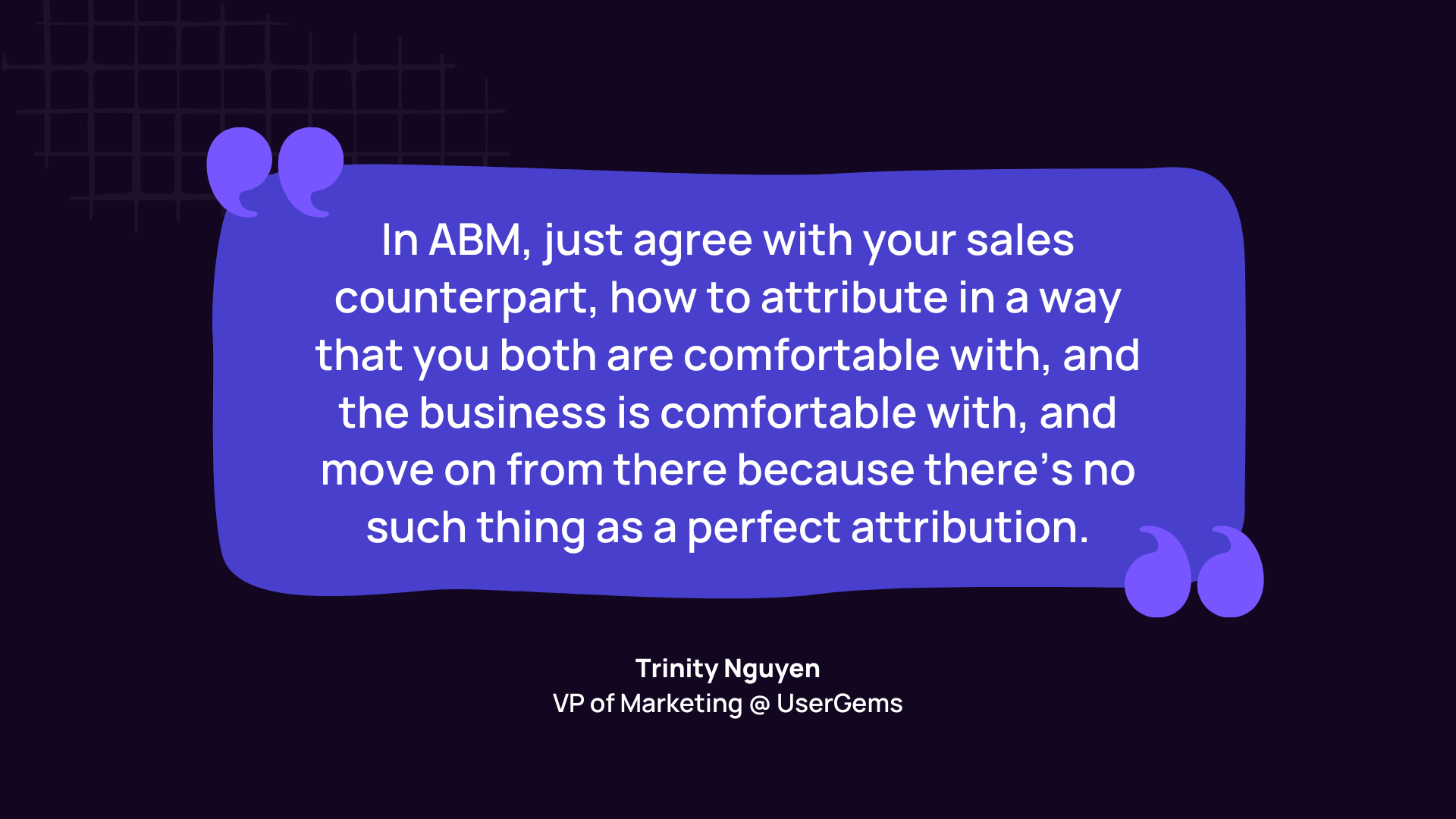
The ABM metrics you shouldn’t focus on
At UserGems, we run a 3-month account-based attribution period, using our tool to source warm leads. These leads are:
Folks who take on a new role and buy software in the first 100 days of a new job.
Or champions (read: alumni customers), meaning people who used our tool in a previous role and now work at a new company.
Not only does targeting these warm leads help us beat pipeline anxiety but it also maximizes our odds of closing more deals.
As we track our ABM program’s performance metrics, we don’t focus on “clicks” or “engagement.”
The reason behind this is simple: lots of marketers intentionally ignore outreach emails or LinkedIn ads to avoid getting sales calls immediately or being retargeted with ads.
However, by the time they book a demo, all the customer interactions — the ads they saw, the emails they read, etc. — have contributed to nurturing them.
Issac Ware, UserGems’ Director of Demand Generation who oversees LinkedIn ads as part of our ABM program, agrees. Isaac shares the LinkedIn ads we run for nurturing stakeholders at target accounts serve an indirect role in conversions despite being hyper-personalized.
Even so, “you’ll see a lot of engagement and then we’ll start hearing about them on sales calls and the post-sales calls or, even some of the calls that I hop into, where they’re saying, ‘yeah, I saw this ad,’ ‘I screenshotted it and sent it off to my team.’”
He continues, "So it starts these conversations a little but earlier in a more natural way. So, instead of that email coming through, which should always happen on the sales side, it's happening in a way where they're actually bringing it up to their team based off of something they've seen.
Which metrics to track for ABM attribution
Instead of focusing on metrics like engagement, pay attention to the following:
Number of demo requests
Number of discovery calls completed
Here at UserGems, we monitor these metrics religiously. Essentially, our ABM strategy thrives on three pillars:
LinkedIn ads
ADR outreach
Our website
The first two work hand in hand.
We start by targeting accounts with LinkedIn ads. At the same time, sales reps reach out to the same people — either via social media or email using a relationship-building approach. Most of the time, when these leads are ready to buy, they visit our website to book a demo.
When this demo request comes in, multiple touchpoints typically contribute to the initial conversion beyond just the website.
As Trinity explains:
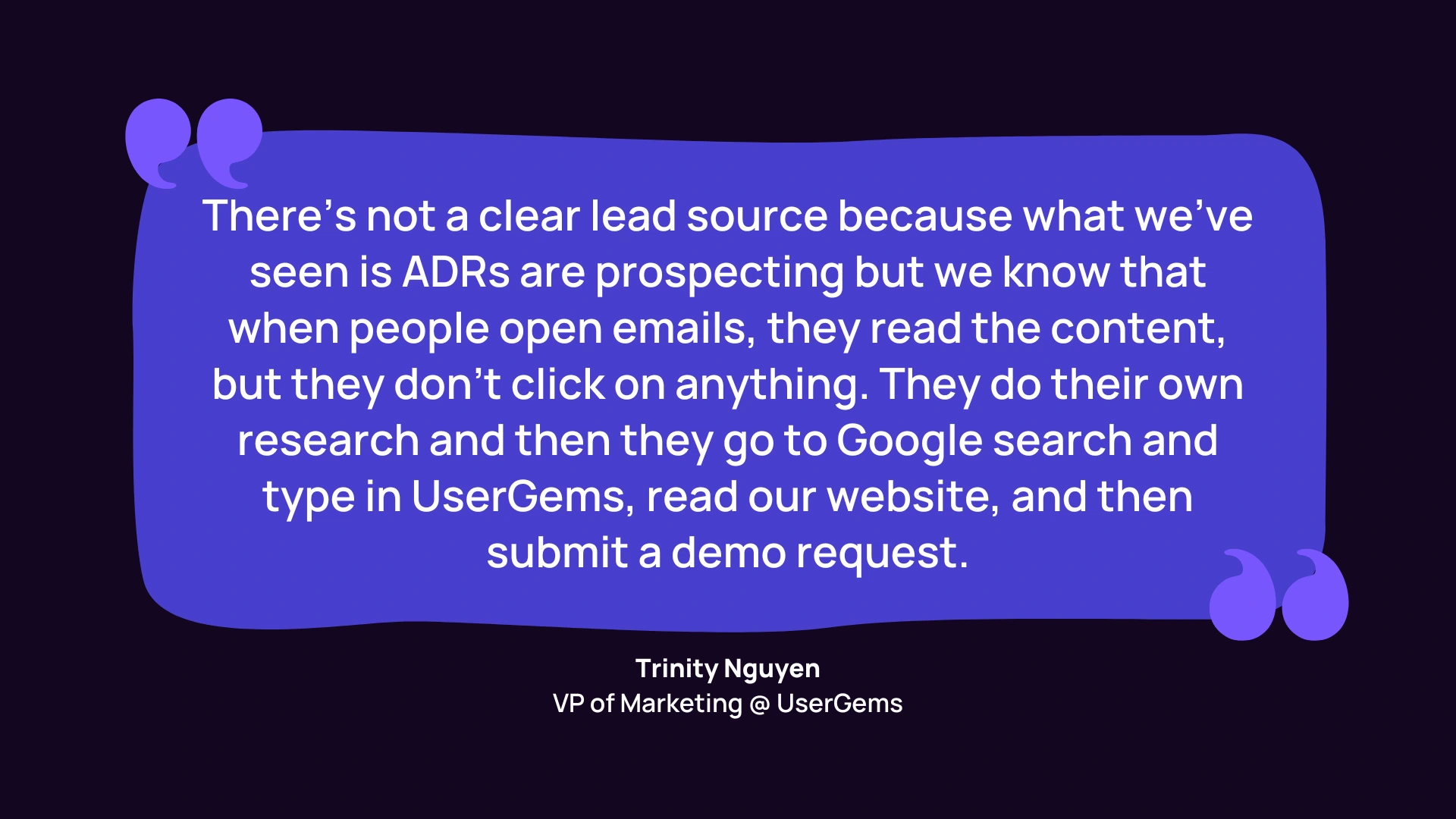
Similarly, they skip engaging with LinkedIn ads to avoid being retargeted. “So we see a lot of demos coming directly from our website, and we know that multiple touchpoints contribute to these conversions.
“In fact, it’s hard to count on one resource: Is it the ADR who got the intention in the first place or is it the website? Or is it the LinkedIn ad they saw?” says Trinity.
Based on this example, it's easy to see that perfect attribution remains extremely challenging. It’s why demo requests and discovery calls completed are the two metrics we trust most to analyze the success of our account-based marketing campaigns.
Take the path to least resistance for successful ABM attribution
Trinity points out, “Everyone running ABM has ICP criteria and a defined list of accounts that they want to go after because they match all the ICP criteria.”
But Trinity recommends being more strategic about which accounts to target, suggesting you go after the ones that are most likely to close.
To this end, review intent data. The right B2B prospecting tools can let you identify which companies are searching for a solution like yours.
Beyond that, go after accounts you already have an existing relationship with so you can track champions and find “the path of least resistance.”
Tracking alumni customers' job changes more than doubles win rates.
In fact, in part 1 of our hidden gems series, we found that deals involving past champions (people who used, bought, or evaluated your tool) or ‘Gems’ as we call them have:
114% higher win rates
54% bigger deal sizes
And, 12% shorter sales cycles
The key is to proactively go after them. Because internal data from part 2 of our hidden gems series confirmed that 91% of Gems don’t return on their own — even after 90+ days at their new jobs.

That means you need to actively prioritize and reach out to them in your ABM campaigns.
You can always track these Gems using tools like LinkedIn Sales Navigator or ZoomInfo, or you can try a manual approach, like Mimecast (a cloud-based cybersecurity services tool) did.
But their experience ended up being “terrible,” according to Kory Himmer, the Director of Marketing Analytics there.
“The internal processes we piloted were oftentimes dependent on individual Marketers, BDRs, and Sales telling us via logging info in Salesforce in a certain way in order to surface these moves,” shares Kory.
This manual process quickly became arduous and hard to scale. The data wasn’t accurate.
“Data or CRM clean-up lacked incentives. Linking the past and new records exceeded our manual and tedious process capabilities.”
They switched to UserGems for champion tracking, which let Mimecast automate pipeline generation, helping them bring in 276 sales opportunities worth over $18M in pipeline.
In fact, as Mimecast adopted UserGems, they ran a data test and found that UserGems surfaced 10-20x more movers than any earlier technologies could surface.
Bonus tip for closing more deals with your ABM marketing activities
Although attribution models aim to identify which channels are driving the most leads, Trinity recommends not relying on them entirely.
In fact, Trinity says, “At some point, whatever already works, is going to plateau out. Also, as you scale, you need to find the channels to feed the beast.”
She recommends dedicating resources to testing new channels — even if it’s a small portion of your marketing budget.
At UserGems, for example, dedicating budget to experimentation helped us find LinkedIn Inmail as a results-driving channel we could invest more in. Now, it’s our second most valuable lead source.
Use this ABM attribution method to close more deals
The buyer journey is never linear. Multiple touchpoints drive conversion. That makes attribution complex.
Even so, prioritizing results-showing metrics such as demo requests booked will help you to understand how well your account-based marketing strategy is working.
Track champions to find your warmest paths to target accounts. Book a free demo today to learn how UserGems can help you close more deals.

.png)
.png)
.png)