.png)
How AI sales prospecting actually works (signal-first)
AI-powered prospecting starts with signals, not spray-and-pray lists. Instead of handing reps a static spreadsheet of names, a signal-first system continuously captures buying signals across hundreds of sources, scores every account and contact against your actual closed-won data, and drafts personalized outreach the moment a signal fires. The result: reps spend time on accounts that are genuinely in market, with messaging that reflects real buyer context.
The architecture has two layers: Data Agents that capture and enrich signals, and Intelligence Agents that turn those signals into prioritized, personalized action.
What are Data Agents and why do they matter?
Data Agents are the foundation of signal-first prospecting. They run continuously in the background, capturing and enriching buyer signals so your team never operates on stale information.
Here is what Data Agents actually do:
- Capture signals from hundreds of sources. Intent data, news coverage, tech stack changes, M&A activity, funding rounds, 10-K filings, leadership changes, hiring patterns. Data Agents monitor all of these simultaneously and surface what matters.
- Ingest first-party data. Your CRM, Gong conversations, marketing engagement history. Data Agents pull context from the systems your team already uses, so every signal includes internal history alongside external indicators.
- Auto-research when a signal fires. When a Data Agent detects a relevant signal (a target account just raised a Series C, a former champion moved to a new company), it automatically researches the account and contact. By the time a rep sees the signal, the research is done.
- Maintain data hygiene. Contact records decay fast. Data Agents continuously validate emails, titles, and company information so reps stop wasting cycles on bounced emails and outdated org charts.
The key difference from traditional prospecting: Data Agents do not wait for a human to define a search query or pull a list. They run 24/7, watching for changes across your total addressable market and enriching records the moment something shifts.
List building
- Traditional prospecting: Manual list pulls from static databases
- Signal-first with Data Agents: Continuous, automated signal capture
Research workflow
- Traditional prospecting: Research done by reps before outreach
- Signal-first with Data Agents: Auto-research triggered the moment a signal fires
Data freshness
- Traditional prospecting: Data decays between quarterly refreshes
- Signal-first with Data Agents: Real-time data hygiene and enrichment
Signal sources
- Traditional prospecting: Single-source intent data
- Signal-first with Data Agents: Hundreds of signal sources combined with first-party CRM/Gong data
How do Intelligence Agents turn signals into prioritized action?
Raw signals are noise without prioritization. Intelligence Agents sit on top of the data layer and answer three questions for every account and contact: Should we reach out? Who specifically? What should we say?
Custom scoring built on your closed-won data
Most scoring models use generic industry benchmarks. Intelligence Agents build a custom scoring model from your CRM's closed-won history. They analyze which signals, firmographics, and engagement patterns preceded your best deals, then apply that model to every new signal. The scoring is transparent: your team can see exactly why an account scored high, with full visibility into the reasoning.
Automated prioritization
Once accounts and contacts are scored, Intelligence Agents rank them and build prioritized lists. Reps do not need to sift through dashboards or export CSVs. The highest-priority accounts surface first, with full context on why they are priority now.
Personalized outreach drafting
Intelligence Agents draft outreach based on the specific signals, research, and CRM history attached to each contact. A former customer who just changed jobs gets a different message than a net-new contact at a company showing high intent. The drafts flow directly into your existing sales engagement tools (Outreach, Salesloft, Gong Engage, HubSpot), so reps review and send from the systems they already work in.
What does the full signal-first architecture look like?
Here is how the pieces connect:
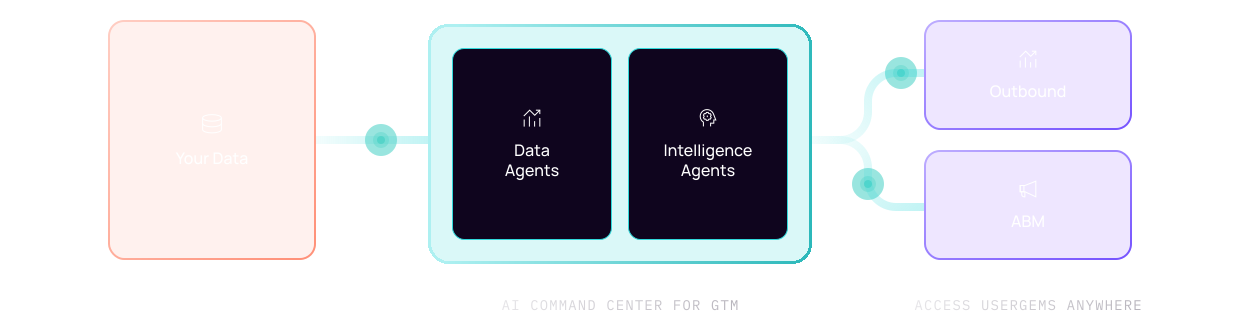
UserGems sits between your system of records (CRM) and your system of actions (sales engagement, marketing automation, ad platforms) as the live intelligence layer. It tells your team who to target, what to say, and when to act, then sends its outputs into whichever tools you already use.
Why does this system compound over time?
Signal-first prospecting creates a closed-loop system that gets smarter with every deal.
- Data Agents capture signals and context. Every interaction, signal, and outcome gets recorded.
- Intelligence Agents score and prioritize. The custom scoring model uses your historical wins and losses.
- Reps act on the highest-priority accounts. Outreach goes out through existing tools.
- Outcomes feed back into the model. Won deals, lost deals, reply rates, meeting conversions. All of it feeds back to Intelligence Agents so the scoring and personalization improve continuously.
Over quarters, the scoring model learns which signal combinations actually predict pipeline for your specific business. A company that sells to mid-market fintech will develop a very different model than one selling to enterprise healthcare. The system adapts to your reality, not a generic playbook.
This is also why UserGems backs its approach with a money-back guarantee tied to pipeline and revenue. The compound loop means results accelerate over time, and the commitment reflects that confidence.
How is this different from traditional prospecting automation?
Traditional prospecting automation focuses on volume: more emails, more sequences, more contacts. Signal-first AI prospecting focuses on precision and timing.
Starting point
- Traditional automation: Static lists or basic firmographic filters
- Signal-first AI prospecting: Live buying signals from hundreds of sources
Research
- Traditional automation: Manual, per-rep, inconsistent
- Signal-first AI prospecting: Automated by Data Agents when a signal fires
Scoring
- Traditional automation: Generic lead scoring based on industry averages
- Signal-first AI prospecting: Custom model built on YOUR closed-won data
Personalization
- Traditional automation: Merge fields (first name, company)
- Signal-first AI prospecting: Signal-aware messaging with full buyer context
Prioritization
- Traditional automation: Alphabetical or round-robin
- Signal-first AI prospecting: AI-ranked by likelihood to convert
Learning
- Traditional automation: Static rules updated quarterly
- Signal-first AI prospecting: Closed-loop system that improves with every outcome
Integration
- Traditional automation: Parallel system reps must adopt
- Signal-first AI prospecting: Outputs flow into existing CRM, SEP, and MAP
Traditional automation asks reps to do more. Signal-first AI prospecting gives reps better accounts, better timing, and better messaging so each action is more likely to convert.
For a deeper comparison, see how AI SDR tools compare to signal-based outbound in practice.
How does scoring actually work with closed-won data?
Intelligence Agents analyze your CRM to identify patterns in your best deals. They look at which signals appeared before closed-won opportunities, what firmographic and technographic attributes your best customers share, and which engagement patterns (email opens, Gong call sentiment, content downloads) correlated with progression.
The model then applies those patterns to every new signal. When a Data Agent captures a signal, the Intelligence Agent scores it in context: Is this signal pattern similar to one that preceded a closed-won deal? How strong is the match?
Your team can inspect the scoring logic. You see which factors contributed to a high score, so reps trust the prioritization and leadership can audit the model. No black boxes.
Learn more about how prospect scoring and prioritization works in a signal-first system.
What signals do Data Agents actually capture?
Data Agents monitor a broad set of signal categories simultaneously:
- Intent signals. Third-party intent data showing which accounts are researching topics relevant to your solution.
- News and events. Funding rounds, M&A activity, earnings reports, leadership changes, product launches.
- Tech stack changes. When a target account adopts or drops a complementary or competing technology.
- 10-K filings and financial data. Strategic priorities, budget signals, and growth indicators from public filings.
- First-party CRM data. Deal history, past interactions, relationship maps, and buying committee context from Salesforce or HubSpot.
- Conversational intelligence. Gong call transcripts and summaries that reveal pain points, competitive mentions, and deal progression signals.
- Marketing engagement. Website visits, content downloads, webinar attendance, and ad engagement tracked in your MAP.
The power comes from combining these sources. A single intent signal might not be actionable. But an intent signal combined with a leadership change, a tech stack addition, and a recent marketing engagement paints a much clearer picture of an account that is ready to buy.
For guidance on tracking what works, explore metrics for measuring signal-based outbound.
Frequently asked questions
Do I need to replace my existing sales and marketing tools?
No. UserGems is the intelligence layer between your CRM and your execution tools. Data Agents and Intelligence Agents send their outputs (prioritized accounts, scored contacts, drafted emails, ad audiences) directly into Salesforce, HubSpot, Outreach, Salesloft, Gong Engage, and LinkedIn Ads. Your team works from the same tools they use today.
How long does it take for the scoring model to start working?
Intelligence Agents build the initial custom scoring model from your existing CRM data, so there is value from day one. The model improves over time as more outcomes (won/lost deals, reply rates, meetings booked) feed back into the system. Most teams see scoring accuracy compound noticeably within the first quarter.
What makes this different from buying intent data and running sequences?
Intent data alone is one signal from one source. Data Agents capture signals from hundreds of sources and combine them with your first-party CRM and Gong data. Intelligence Agents then score and prioritize using your closed-won history, not generic benchmarks. The result is a complete system: the right accounts, the right contacts, the right message, at the right time.
Is there a guarantee?
Yes. UserGems offers a money-back guarantee tied to pipeline and revenue. The AI command center drives real, measurable results, and the guarantee reflects that commitment.
Where can I learn more about the full AI outbound approach?
Start with The AI for Outbound Guide for a comprehensive walkthrough of how signal-first outbound works end to end.
Book a demo with the UserGems team to see the AI Command Center and Gem-E in action.
.png)
.png)
.png)