In 2018, Hubspot’s CEO Brian Halligan introduced the marketing flywheel with a premise that customers are an input source that feeds growth, and that marketing should invest more in customer marketing, more in customer advocacy, and more in creating delightful onboarding for new customers.

Source: Hubspot
Customer marketing efforts should drive both advocacy and lead generation. Focusing solely on advocacy overlooks a high-volume, low-cost lead generation channel.
On average 30% of people change their jobs every year, according to Salesforce. This also applies to your customer contacts, who can champion or purchase your product again, and again, at their next companies.
Your company invests time and resources to acquire and nurture these contacts. But once they leave their current organization for a new one, most of your communication with them is gone.
30% of your customer contacts change their jobs every year
Strong advocates might promote your product at their next company and reach out when ready to buy. But that's only your top 10% of customers.
This holds true for your most loyal customers (i.e. those who consistently give a 10 in your NPS (net promoter score) survey). However, less engaged customers typically wait for you to reach out to them.
These customers may evaluate competing solutions, especially when your competitors contact them first with compelling offerings.
Lead generation is a key growth challenge
As you scale, marketing must source more high-quality leads at the same or lower cost per lead.
Predictably, most B2B marketers cite generating high-quality leads as their number one challenge across company sizes, according to surveys by Marketo and Vital.
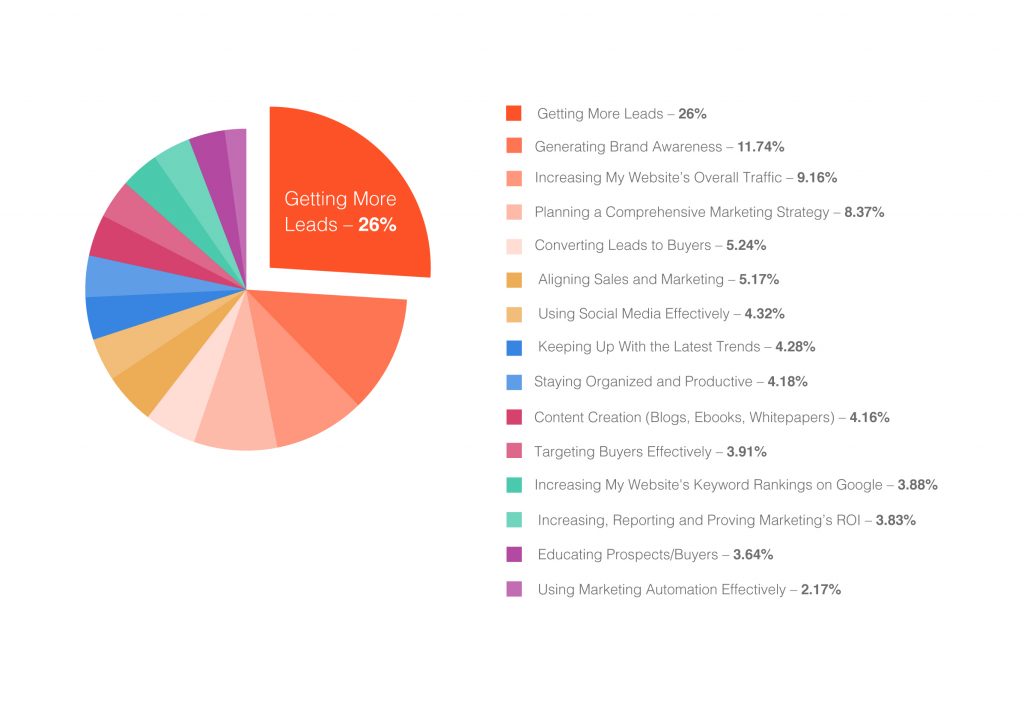
Source: Vital
Re-engaging previous customers and users to drive growth
Compared to typical marketing lead sources, your customer base is the only source that naturally grows as your company grows.
Because they've used your product before, they convert faster and at higher deal sizes than cold leads.
We've seen teams run nurture campaigns like "How to succeed in your new role as X" to re-engage these contacts and pull them back into the funnel.

Invespcro states that the probability of selling to an existing customer is 60-70%. The probability of selling to a new prospect is only 5-20%.
Previous customers convert at higher rates than first-time prospects, which means lower acquisition costs.
Sample emails to use for customer marketing
Scenario 1: A customer switched to a new prospect account
Hi Kyle
Congratulations on your new role at {account.name}! We've enjoyed working with you at {previous.company}. Let us know if ACME can help you hit the ground running in this new role.
Congrats again and please don't hesitate to reach out if I could be of help.
Check out our playbook to reach previous customers
Scenario 2: A customer switched to another customer account
Hi Kat,
Congratulations on your new role at {account.name}! How's the transition going?
We've enjoyed working with you at {previous.company}. Great news—{account.name} is already a customer, so we can continue partnering with you there. Let me know if you need anything and hope that ACME can continue partnering with you.
8 email examples you can swipe for past customers
Who should you track?
How many leads does this actually generate?
Most teams start by tracking one contact per account—the decision-maker or target persona.
Track your power users and product admins as well. These daily users of your product may lack budget authority yet still influence purchasing decisions.
As more executives rely on their teams for tool recommendations, these users can connect your team to the right decision-maker and champion your product during the evaluation.
Which contacts should I track for job changes?
What is UserGems?
UserGems is a lead generation and prospecting automation tool to help marketing and sales teams drive bigger pipeline and faster sales cycle.
Whenever your customers change their jobs, UserGemsautomatically surfaces them as new leads in your CRM along with their new email addresses, and notifies your reps. This allows your team to be in front of the buyers at the right time, and ahead of the competitors.
Tell us how an SDR helped you make a deal on our and product page.

.png)
.png)
.png)