
If you open LinkedIn right now, you'll see the conversation of build vs. buy everywhere.
Apparently everyone's a builder now, people are throwing out SaaS vendors and questioning why pay for something you can just spin up in Claude yourself?
Honestly, it's not wrong, but it's not the full picture either. Even when you're “building,” you're building on top of something. A model, a data layer, an integration. The question is more to do with what foundation are you building on, and are you spending your time on the right layer?
76% of enterprise AI is now purchased rather than built which is almost a complete flip from 2024. At the same time, 35% of teams have already ditched at least one SaaS tool for a custom build, and 78% plan to build more this year.
Both trends are real, both make sense and sitting in the middle of them without a clear framework is where most teams are right now.
This guide pulls together the latest research to give GTM, Sales, and RevOps leaders a clear-eyed view of where things actually stand, and a framework for making the call before someone makes it for you.
Here's where that framework starts:


Feed your GTM brain
How did the market move so fast?
Let’s talk numbers
Enterprise AI has exploded from $1.7B to $37B between 2023 and 2025, already 6% of the entire global SaaS market , despite being three years old.
Most of that $37B is being bought, not built in-house. In 2025, 76% of enterprise AI solutions were purchased rather than built internally, up from 53% the year before.
A lot of software decisions fail for one of two reasons.
One is the tool that gets bought and never touched. Nobody turns it on, and it just sits there. Regular software falls into this trap often, but AI deals convert to production at nearly twice the rate of traditional software — 47% versus 25%.
Then there's the project that never gets built at all. Someone starts it but other priorities creep in and the DIY effort falls apart. Teams that buy or partner get something up and running two times out of three. Teams that build it alone only manage that once out of three.
So if the numbers clearly favor buying, why are teams building more than ever?
Building is accelerating too
Building has never been easier and it’s tempting too. When you can build exactly what you need, why wait on someone else's roadmap, why not own the thing outright? In 2025, 35% of teams already replaced at least one SaaS tool with a custom build, and 78% plan to build more in 2026.
In the last two years, the cost and time to build has dropped dramatically. AI-assisted development went mainstream, teams are getting innovative and shipping custom tools in days. Gartner has predicted by 2028, 75% of enterprise software engineers will use AI code assistants, up from less than 10% in early 2023.
When someone can build exactly what they need over a weekend, buying "good enough" solutions stops being good enough.
The catch

Team "Buy"
Speed to value matters
When a suitable solution exists, buying reduces time-to-market by 70% or more. For GTM and RevOps teams running on quarterly targets, that's the difference between running a campaign this quarter and scoping one for next year.
Even in areas where in-house builds used to be the default like knowledge management and workflow automation, enterprises are migrating toward packaged solutions because the speed and reliability have caught up faster than most teams expected. For most GTM use cases, a long custom build cycle simply isn't competitive anymore.
Real costs of building is almost always underestimated
Most custom software projects run over budget, but custom AI builds can cost significantly more. 85% of organizations misestimate AI project costs by more than 10%, and a significant chunk miss by over 50%. The usual culprits: data preparation taking longer than expected, integration complexity, and infrastructure costs that scale faster than anyone projected.
It's no surprise that the stats show it doesn't get cheaper once you ship. Retraining adds 15-30% ongoing overhead on top of the original build, so that "one-time build cost" is rarely one-time.
On average, a custom build takes 33 months to pay for itself, and that's assuming nothing breaks, nobody leaves, and a vendor doesn't ship the same thing cheaper while you're still building it.
Headcount problems
Someone has to maintain what gets built. Usually that job lands on someone who was hired to sell or run campaigns, not maintain infrastructure. A production AI system needs constant attention: retraining models, fixing broken parts and figuring out why something stopped working. All of this is basically a second job.
Most RevOps and GTM teams don't have spare engineers sitting around for this. Just because someone is good with Claude doesn't mean they should be the maintainer of a system they never agreed to own. If you're building, ask yourself: if this broke tomorrow, who fixes it? What stops getting done while they do?
Vendors carry the risk you'd otherwise own
Most GTM teams handle contact data, CRM records, and intent signals, where compliance is a liability. Getting SOC 2 Type II certified alone takes 6 to 12 months, before you even factor in GDPR, CCPA, and the EU AI Act, which entered enforcement in 2025. Initial compliance setup adds 15-20% to total project costs, and ongoing compliance costs exceed upfront expenses by 25-30% due to continuous monitoring requirements.
Reputable vendors have already absorbed that cost. Building internally means owning it yourself: the audits, the documentation, the annual renewals, and the engineering time it pulls away from everything else.
Compliance failures are a real risk too. In June 2026, a breach at Klue, exposed keys to customers' cloud services across roughly 200 customers, including security vendors like Jamf, HackerOne and LastPass. The point isn't that vendors don't get breached, they do. It's that a reputable vendor has a dedicated security team, an incident response plan, and a legal obligation to disclose fast.
A vibe-coded internal tool has none of those, and the IT team that's supposed to secure it is already stretched across a dozen other priorities.
The “just build it in Claude” trap for outbound
Ask Claude to analyze your calls for the day, prep an account brief, or summarize a prospect's recent news, it works well. That's exactly where the trap is: if Claude can do this, surely you can run your whole outbound motion through it, right?
People aren't wrong to want to build in Claude, but perhaps they need to question more about what it's for. It's great for using it to prototype, to pressure-test an idea, to figure out what you actually need before committing. Where it breaks down is when the prototype ends up becoming the product.
Running elaborate campaigns directly within Claude is very difficult because you need access to thousands of companies, hundreds of thousands of prospects, and you need to coordinate between several different systems, always reaching out to the very best companies at the right time.
Stephan Kletzl

Claude's been life changing for those one-off, time consuming tasks where you hand it everything it needs and it works its magic. But outbound is different as it's a system that runs constantly. You need to monitor your internal sales and customer pipeline while watching thousands of external accounts every day, catch the moment something changes, and act before your competitor does. That's not really something you can quickly prompt your way into.
Another tricky part is each Claude session starts from zero unless you've engineered it not to. For most teams building quickly in Claude, there's no memory, history, or paper trail. That's fine for a one-off task but for an always-on system running at scale, when something goes wrong, you need to investigate when it started, why it happened, and how far it spread. That infrastructure doesn't come for free.
“Looks right” is a verdict you can only render when you already know the right answer. For ten documents your team has read closely, it works. For hundreds you haven’t, it isn’t verification, it’s a guess that scales.
Eric Hawkins

None of this makes building impossible. You can engineer around these limits, memory, data pipelines, security, ongoing maintenance, if you have the technical resources to build them. But the version of “build” that actually holds up in production, one with monitoring, error handling, and someone accountable when it breaks, looks a lot like the product you were trying to build your way around.
Most GTM and RevOps teams don't have spare engineering bandwidth sitting around to build that version, which makes the real question less about whether you can and more about whether a homegrown system is where your business gets the highest ROI. Is it actually your moat? So here's where Team Build actually has a point.
Team "build"
If your data is the moat
This is usually the first place GTM teams land when they argue for building: their data. If you're sitting on signals nobody else has, and no vendor can get their hands on them, a model trained on that data will beat anything off the shelf.
Years of pipeline history, how accounts actually engage, why deals are won and lost, and how your reps behave are exactly the kinds of assets GTM teams are sitting on, and exactly the kind no vendor can get their hands on. Unless, of course, a competitor could just go buy the same insight somewhere else.
Most teams are sitting on this data and never actually put it to work. That's the real missed opportunity, but only if you build at the right layer.
ClickUp evaluated a wave of AI vendors for its GTM operations and didn't find one with the right fit. So they left their Salesforce, Zendesk, and Snowflake stack alone (that data layer stayed bought) and built six AI tools on top of it instead, tools that ran on their own customer and support data. It automated hundreds of hours of weekly work, saved hundreds of thousands in headcount costs, and cut $200K a year in automation software.
Harmonic ran into the same decision from a different angle. A $20K/year third-party tool couldn't move fast enough, so instead of rebuilding their own Salesforce and Gong data underneath it, they rebuilt the tool itself on top of that data. That one rebuild turned into 33 internal apps, still running on the same Salesforce, Gong, Slack, and internal API connections, with audit logs and role-based access built in.
Neither team touched their actual data or the systems holding it. What they built was the layer that used it — the workflows and automations that turned pipeline and support history into something nobody could buy off the shelf. That's the difference: the data stayed bought, the leverage got built.
The data can absolutely be your moat. But rebuilding the infrastructure that stores, cleans, and maintains it isn't where your time pays off. The campaigns and plays you run on top of it are. Owning the asset and owning the infrastructure underneath it are two different decisions. Mix them up, and six months later you're still building the foundation, when all you needed was a better campaign.
Tools should do what you need, not the other way around
The core frustration with SaaS is that products make you work their way. When your workflows are genuinely unique, buying a platform can mean bending your whole motion to fit someone else's assumptions. When it’s not a good fit, new reps take longer to ramp, workarounds turn permanent, and some plays you just can't run because the tool was never built for how you actually sell.
Digital Applied costed this out and they came to the conclusion that over three years, building it yourself costs about 5% more than renting the SaaS version, $88,600 versus $84,400. A hybrid setup beats both, at $79,600. More on that later.
Close enough that price isn't the deciding factor, fit is. A SaaS tool that doesn't match how you work costs you in ways the sticker price hides: slower ramp for new reps, workarounds that never go away, plays you simply can't run. That's where building earns its place: the workflow layer, the part that reflects how your team actually prioritizes, works, and closes.
Vendor lock-in: The case for building your way out
One of the key arguments is that vendors are making it harder to leave. Forrester puts it plainly: "your next major software decision is a bet on a single vendor's security posture, pricing model, and innovation capacity for the next decade". Switching typically costs twice your initial investment and if you do, only 42% of executives in 2025 who tried switching said it actually went smoothly.
The lock-in tax shows up in the numbers. HubSpot raised prices on its Professional and Enterprise tiers 19-25% in 2024. Webflow's CMS plan jumped 43.75%, from $16 to $23 a month, when it raised prices across the board in 2022.
Right now people are willing to try a lot of AI tools. But the time when people will consolidate tools and restrict budgets is coming. So trying to understand whether these business models are really durable — and whether you're joining a company that's number one or two in its space and not three or four — is really important.
Christina Cordova

POV from the people
Eric Hawkins, CTO of a private markets AI company, offers three conditions that all have to be true before a build decision makes sense. The scope has to be contained. The logic has to be uniquely yours, encoding judgment that reflects how your firm actually works, not generic best practice. And the maintenance burden has to be one your team can realistically sustain long-term. When all three are true, building creates a durable advantage. When any one is missing, you're starting a maintenance treadmill you'll regret in 18 months.

Scope contained

Logic uniquely yours

Sustainable upkeep
The hybrid playbook
So where does that leave you? Build has a real case; Buy also has a real case. If you've been nodding along to both sides, that's the right read. You don’t need to be choosing one or the other.
78% of organizations that successfully deployed AI worked with external partners for at least part of it. The hybrid model now accounts for the majority of enterprise AI spend: buying the foundation, building the intelligence layer on top.
The key question isn't build or buy. It's which layer you're talking about, because the answer changes completely depending on where in the stack you're deciding. That's the hybrid playbook.
Companies no longer want to choose between buying and building software, they actually want both. What companies want are proven platforms that have all their data, signals, and infrastructure, and they want to build on top of it — generating their own campaigns, their own workflows, their own agents.
Christian Kletzl

What it actually looks like in practice
Nobody building on Shopify debates whether they're "really" building a business. They are, because they're making real product decisions, growth decisions, campaign decisions. The foundation is bought and the value is built on top.
The same logic applies here. Some things you buy: the models, third-party signal data, infrastructure, compliance controls. Some things you build: the plays, the priorities, the calls about who to go after and when. The pattern that's emerged across the data: buy for speed and reliability at the base, build for differentiation where you actually compete.
AI has reduced the cost of creating software but it hasn't eliminated the cost of owning it. Once you've built something, you're in for model updates, governance, security risk, and components that can quietly break, then scale. Before committing to building any layer, be honest about what sustaining it actually requires.
Decision framework
So which SaaS tools are actually replaced with DIY?
You saw the top-line number already: 35% of teams have replaced at least one SaaS tool with something they built, and 78% plan to build more. That number sounds like it should worry every vendor. It shouldn't, not every tool is equally at risk, and knowing the difference tells you where you should actually be building.
What's actually getting replaced tends to be internal workflow tools: dashboards, approval flows, document routing. Basic stuff that was always overpriced relative to what it did. A decent RevOps person with a weekend and Claude can rebuild most of it. This is the market correcting itself, not a verdict on SaaS. Buyers are also consolidating. They're looking for fewer, deeper relationships with platforms they can actually build on top of, not more point solutions to manage. That favors vendors who make it easy to extend, configure, and connect.
So the build movement is really more of a filter. It's clearing out the tools that never had a real moat. It's not touching the platforms with data depth, compliance infrastructure, or signal coverage that takes years to build. Those are exactly the foundations teams need before they can build anything worth building.
The real unlock: Closing the feedback loop
Now there is a third consumer of this data: AI Agents. AI Agents needs to be fed just as much as our reps and our marketing team. It needs signals, it needs context, it needs prioritization. And so if our data layer is messy or if we have incomplete data, AI is not going to be working right.
Clara Borges

That's a command center actually running, and it starts with getting the three layers right today.
Conclusion
What's different now is that for the first time, almost anyone can build, which makes the decision much harder.
UserGems' CEO and co-founder, Christian Kletzl, came up as a product manager, and the most important skill he learned was knowing how to say no, because every yes costs you something else. That discipline matters more now than it ever has, because the barrier to building has dropped so far that the thing standing between a good decision and a bad one is often just the willingness to ask whether you should.
The teams should be getting honest about what their job actually is. RevOps isn't just ops. It's revenue.
Everything you build, buy, or maintain should be in service of revenue, not infrastructure for its own sake. When a build decision pulls your best people away from generating or protecting revenue and into tool maintenance, that's the wrong layer getting your attention.
There's also something worth saying that doesn't get said enough: nobody has fully figured this out yet. The question of where AI actually creates surprise value (not incremental efficiency, but genuine capability you didn't have before) is still being answered in real time. The honest move is to stay curious, stay skeptical of hype in both directions, and keep asking whether the thing you're building or buying is moving the number that matters.
Buy what you need, build what only you can build, and know when to say no.
We'd be hypocrites not to answer that ourselves, so here's how we actually apply it at UserGems.
What we build vs. buy at UserGems
(an interview with Trinity Nguyen, CMO at UserGems)
Within the scope of Outbound and ABM, below is how we make the decisions even if we were not at UserGems:
It’s a LOT cheaper to buy this data from vendors than paying AI tokens. Plus, no risk of AI sessions being timed up.
Having said that, make sure of data quality. Garbage in, garbage out - especially with AI.
Accounts & contacts
So again, “Buy” is a LOT cheaper - vendors are responsible for verifying email addresses & phone numbers too.
For one-off campaigns or experiments (eg. new industry, seasonal competitive target), we build.
Individual use cases (sales, CS, marketing):
- Meeting prep
- Call coaching
- Pre-qualify accounts
Interview with UserGems CMO, TRINITY NGUYEN
My #1 responsibility to the business is pipeline & revenue, not building internal tools. My team is very AI-pilled but I want to make sure that we never lose sight of why we're here.
Trinity Nguyen

However, once the model is proven and adopted, I'd buy a solution to scale.
At UserGems, our Account Score has 600+ ICP Fit criteria and 40+ Signals updated weekly. The data is too dynamic and too large that I would not trust or be able to verify a DIY model.
We’re also using the scoring model across the entire GTM motion - the business impact is too high, so that’s why I would buy - and have a vendor that I can count on - instead.
I'd buy.
It’s also easier to investigate deeper in Claude or GPT than in most off-the-shelf solutions.
It reflects something the data in this guide supports: teams increasingly want proven platforms they can actually build on top of. The right response from a platform is to become better infrastructure, not a more closed system.
For updates on our MCP launch, subscribe to our newsletter.
We don't think this makes the build vs. buy question easier. We think it makes it more precise. The teams we see winning aren't asking "should we build or buy?" They're asking "where does buying give us the foundation we need to build the things that are genuinely ours?" That's a harder question. But it's the right one.
FAQ
Buy the infrastructure and commodity layers, build the layer where your data or workflow is genuinely different. In 2025, 76% of enterprise AI was purchased rather than built, and buy-or-partner projects succeed 67% of the time versus 33% for solo builds. But almost no team that gets this right chooses one path across the board, they decide per layer: data, intelligence, and action.
No. The real decision is layer by layer, not company-wide. Buy the data layer (signals, records, infrastructure), decide build-or-buy on the intelligence layer (scoring, orchestration) based on how differentiated it actually is, and expect to build on top of whatever action layer (SEP, ad platform, CRM) you already run.
Three conditions have to be true at once: the scope is contained, the logic is genuinely yours (not something a competitor could buy off the shelf), and your team can sustain the maintenance long-term, not just ship it once. Miss any one of those, and building creates more risk than it solves.
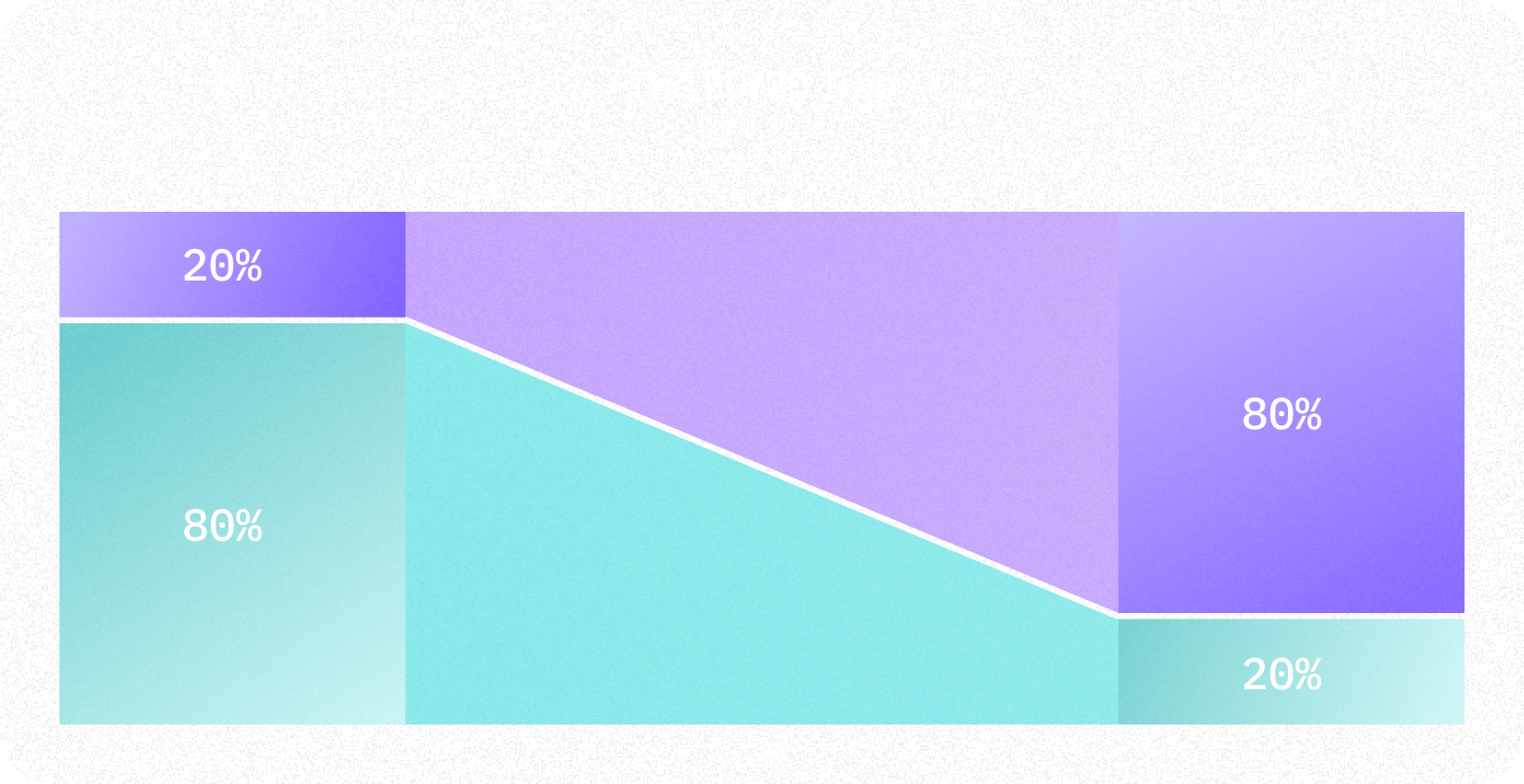
Buy anything that's infrastructure or a system of record: CRM, security, compliance, identity. Buy anything a competitor could purchase off the shelf too, that's not a moat, it's a commodity with your logo on it. And buy anything where you don't have the AI ops maturity to maintain it forever, since the build is the easy 20% and the maintenance is the 80% nobody budgets for.
AI scoring in ABM works best when it's transparent and specific. UserGems' scoring model analyzes 600+ signals weekly and surfaces a clear explanation for why each account or contact was prioritized. When reps can see the reasoning and say "yeah, that tracks," they actually use it. Admins can also adjust signal weights and preview changes without needing a data science team, which keeps the model aligned with how your team actually sells.
Maintenance, not the initial build. A production AI system needs constant retraining, debugging, and monitoring, and on most GTM teams that job lands on whoever's best with Claude, not an engineer. If that person leaves, you're left with infrastructure nobody owns and nobody can fix.
Yes, and it's increasingly the standard model. As more platforms go headless, exposing their data and intelligence layer through interfaces like MCP, teams no longer have to choose between buying a system and building their own workflows. You buy the foundation, and build the agent workflows, scoring logic, or campaigns that are actually yours on top of it.