With AI allowing everyone to build, a lot of companies are debating which parts of their GTM stack they should own. For account and prospect scoring, teams have been weighing this decision for years, long before the current hype.
Does it make sense to build your scoring model in-house with AI, or do third-party models have the edge? And if they do, can they explain their outputs well enough to earn your trust?
Why B2B scoring is so hard
Today's B2B companies use hundreds of signals, both account and contact level, with agents running custom industry-specific research and piping that data back for scoring and messaging. They maintain multiple ICP and persona definitions, and evolve them over time.
Marketing and sales teams will also want to bring their own hypotheses and opinions which provide real value because they know what works in segments where data is scarce or noisy.
To keep up with this, the model needs to keep hitting a constantly moving target and do it accurately and consistently across tens of thousands of accounts and often millions of potential prospects every day for you to get the most out of it. If you reach out to a hot prospect that was researching you 7 days ago, a competitor will beat you to it.
You might choose to ignore this complexity and just have a simple point-score model that weights different factors and call it a day. The team can learn to trust such a model and understand it but at the same time you leave so much on the table that this tradeoff simply doesn’t cut it anymore. On the other hand, you might have a complex model that predicts which accounts and prospects to reach out to but if your team doesn’t always understand why, this brings little value.
Can you have an advanced model without sacrificing explainability?
.png)
What great looks like
Let’s take a look at different kinds of scoring models and the tradeoffs they bring.
To make sense of the options, we'll compare them across 3 criteria - they need to be trustworthy, easy to maintain and capable.
To be trustworthy, models need to score high on Explainability and Scoring Capability. To be scalable in production, they need to score well on Ease of maintenance.
The very best model will learn from your data, adapt to an ever changing market and new signals but at the same time give you a chance to be opinionated and configure it your own way. And of course, it will provide clearly understandable outputs that humans can trust.
Even the simplest models must be adjusted over time and this work rarely has an owner once the person who built the first version moves on. With more complex approaches, this burden increases dramatically.
This makes the case for building internally hard to justify.
How about building it with AI
Any of the models above can be built faster using AI and this clearly sounds tempting.
For simpler models, that can make sense as you can probably understand what the model should look like and evaluate that it makes sense. AI might bring your maintenance costs down in this case.
Building a more complex model requires advanced statistics or machine learning know-how to understand that conclusions really stand against the data and be able to evaluate each new version.
You also will need to crunch tens of thousands of accounts and millions of prospects and integrate the model tightly with the rest of your stack to make sure you can take action on it fast.
Why this matters now
In the past, the decision to build was often made because having explainable and therefore trustworthy outputs far outweighed the benefits of a powerful black box model.
Today, research agents and complex signals can bring valuable information and the sheer volume of both quantitative and qualitative data coming in is massive.
Acting on that data is increasingly difficult. This is where the real challenge is today and the reason why simpler models simply don’t cut it anymore.
Building such a complex system in-house is usually either prohibitively expensive or simply not possible due to lack of enough clean historical data to begin with.
The good news is you don't have to choose between power and trust.
UserGems approach to scoring
Great scoring doesn’t live in isolation. At UserGems, Account and Prospect scoring is an essential part of our GTM Brain. It sits right in the Intelligence Layer, between Data and Actioning part, deeply integrated to make sure the entire system takes advantage of it at any moment.
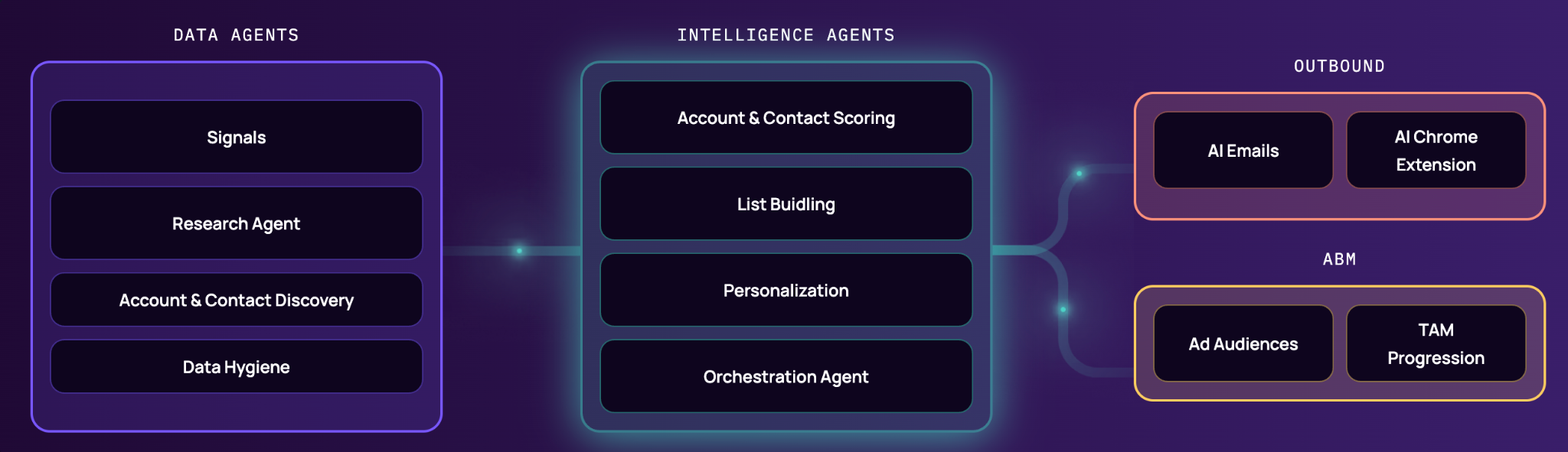
Under the hood, it’s a complex system that requires close cross-team collaboration between engineers, data scientists but crucially also marketing and sales professionals to make sure the final product is simple and valuable.
There are two distinct questions our model is answering:
- Which accounts look good for us based on the ICPs defined?
- Which accounts and specific prospects are currently in the buying cycle?
Once you’ve identified that, the Brain can automatically put them in an appropriate workflow, sending them to the right sequences and using the best converting messaging. All of this happens before your SDRs even need to touch the prospect.
Here are some ways our scoring model is put to work.
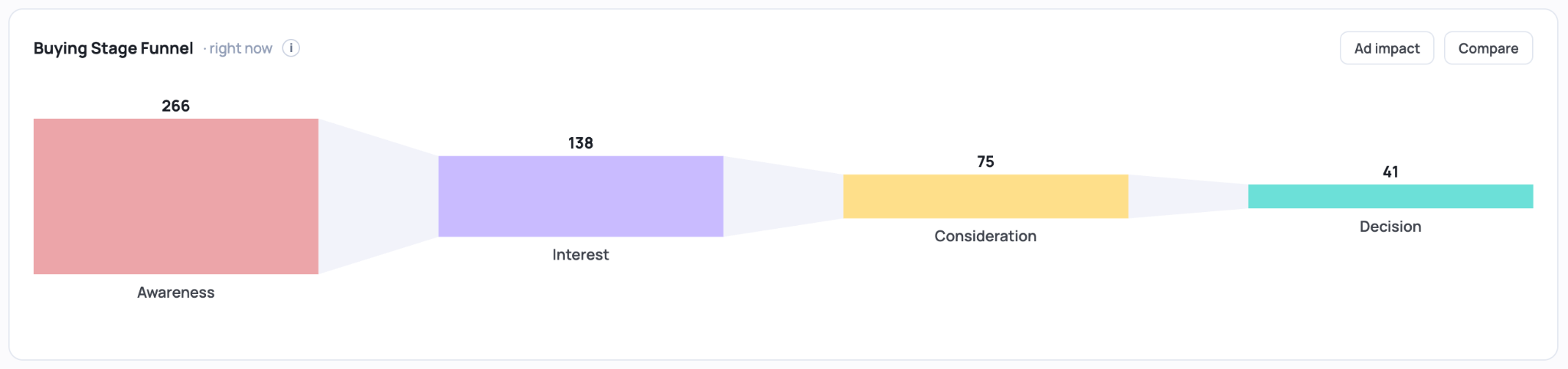
See the funnel of buying stages
For each account, see where they are in their buying journey and take the right action at the right time.
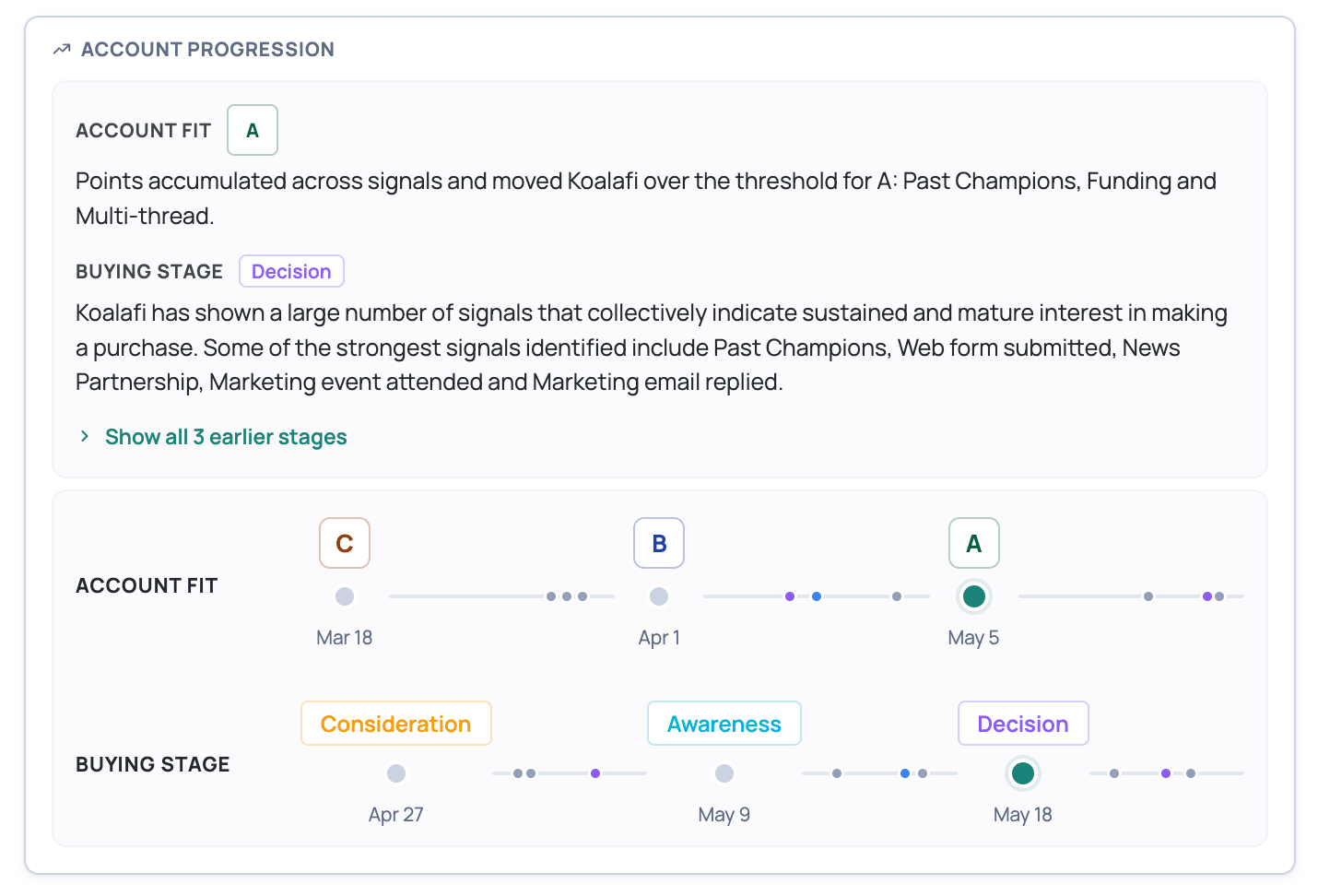
Why is each account in each stage and how did they get there?
Clear, human readable explanations that bring trust and value to your team.
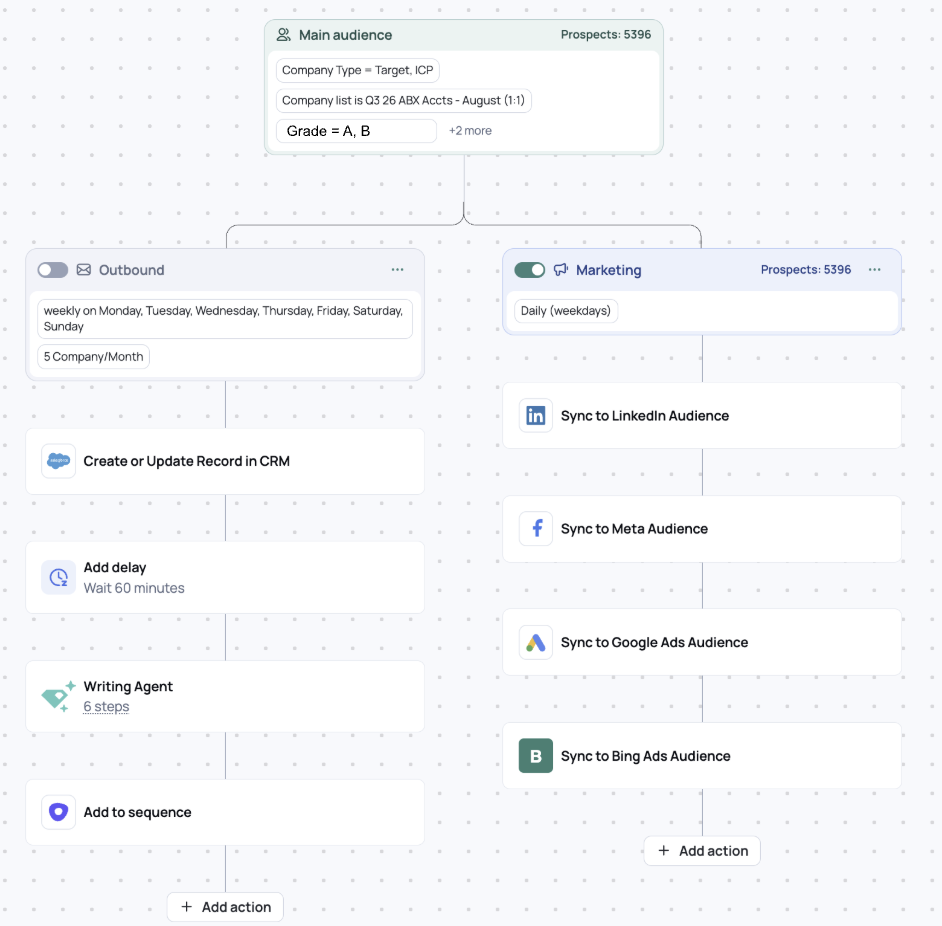
Action on the right prospects
Coordinate both marketing and sales activities for the right accounts to move them through the buying stages.
So, should you build or buy?
If simple point scoring covers your needs and someone on your team will own it for the long haul, build it. AI makes that faster than ever.
If you need scores your team can trust and act on at scale, buy. Go back to the table: the AI-assisted model wins on explainability and scoring capability. Its only weak spot is maintenance, meaning constant retraining, tuning it alongside your own rules, and running it daily across millions of prospects. That's the part that sinks most in-house builds, and it's exactly the part a vendor should own.
That's the thinking behind UserGems scoring. It learns from your sales history, lets your team bring its own ICPs and hypotheses, and explains every score in plain language. You get the model you'd want to build, without having to build or maintain it.
.png)
.png)
.png)