UserGems Insiders, 15th September 2026.We have our own AI GTM brain. Here's how we boost it with UserGems
Speaker: Alex von Stegmann, GTM Engineer and Strategist, Frontify
Every GTM leader eventually runs into the same question we've written a whole guide on: build this yourselves, or buy it? Alex von Stegmann, GTM engineer at Frontify, used his session to answer that with a framework rather than an opinion, one he credits to Mark Kosoglow of Docebo. It's worth remembering, because it reframes a conversation most GTM leaders are already having with their own leadership.
Tier 1, just for me. Anyone on a commercial team can wire together their own tools in Claude or Codex for individual use: prepping for calls, resolving RFP questions, drafting follow-ups. It's fast and personal, but it creates silos that make reporting difficult, and it runs expensive once dozens of people are burning through tokens on their own custom setups.
Tier 2, recommended. Tools the team relies on but that aren't mission-critical if they go down for a bit. Frontify's example: a simple internal quoting tool that skips the full CPQ process (finance, legal, the works) for straightforward deals, giving reps a price indication in minutes instead of the 10 to 15 it normally takes.
Tier 3, required for teams. Workflows the whole team depends on, where a break causes real pain. Email and call recording fall here (Gmail, Gong), and so does orchestrating GTM between marketing and SDRs, which is exactly the category UserGems sits in for Frontify. It works, and when something breaks, there's a team on the other end to fix it.
Tier 4, systems of record. Salesforce, your data warehouse: things that need to work almost all the time, with a vendor SLA tight enough to trust.
.jpg)
Why UserGems was the right buy
Twelve months before this talk, Frontify's commercial team decided to go all in on ABM, aligning SDRs and marketing more closely because warmed-up prospects are easier for reps to reach. At the time, there was no centralized account scoring. Alex was tracking territories in a spreadsheet, marketing had its own separate target account list, and SDRs prospected within their own books with no shared prioritization.
The core value UserGems brought from day one was identifying which accounts actually mattered, based on similarity to Frontify's best customers, and layering signal-based scoring on top so the team wasn't just looking at the right companies but the right companies at the right time.
One detail Alex added: feeding your customer list into UserGems for similarity scoring only works if that customer list is actually good. Frontify knew that every year they sign some customers who aren't a strong fit and either churn early or drag down usage metrics. So before feeding customers into the model, the team built a scoring layer of their own using KPIs like monthly adoption, ARR, and tenure, and only fed in customers who cleared those thresholds. That extra step made sure UserGems was learning from Frontify's best customers.
Once ICP scoring was in place, it became the foundation for everything downstream: the best accounts went to marketing to warm up, and the highest-scored accounts went to the SDR team to work once marketing had already primed them.
.jpg)
The numbers behind the scoring model
The results showed up quickly in Frontify's data. An A-graded account is 1.6x more likely to convert to a booked intro than a B-graded account, and 3.1x more likely than a D-graded account (A, B, C, D are UserGems' own scoring tiers). Within a few months of launch, UserGems-sourced campaigns were driving nearly 40% of Frontify's SDR-generated pipeline.
.jpg)
Building the internal brain: Revi
Buying UserGems freed Frontify's team from staying up all night fixing a homegrown signal pipeline. The tier-4 category, systems of record, is where Frontify has invested in building rather than buying, because their team has spent three or four years building out verified KPIs in Snowflake, checked meticulously by their head of data.
That verified foundation let Frontify build an internal agent called Revi, short for revenue insights, that answers leadership's pipeline questions using only verified data. Ask Revi whether the team is winning fewer deals or taking longer to close them, and it runs an actual SQL query against the verified tables rather than guessing, then returns an answer flagged with a green shield to show it's grounded in real numbers. In the example Alex shared, Revi confirmed the sales cycle was shortening, not lengthening, with a chart any leader could take straight into a board meeting.
.jpg)
The reason Revi works is that it's built entirely on data Frontify has already verified. Alex said directly: any AI agent is only as good as the data feeding it, and building a KPI layer worth trusting took years.
Layering external signals on top of internal context
Frontify's next build is a layer that evaluates the softer data sitting in Gong calls: whether an opportunity is hitting standard fields like MEDDPICC, but also Frontify-specific things, like whether the conversation actually touched a real Frontify use case or followed the internal sales process. No external vendor could build that layer, because it depends entirely on knowing what matters to Frontify specifically.
If a customer has strong product adoption, says all the right things in meetings, and has a great relationship with their CSM, but the team has no visibility into that same customer reporting a bad quarter in their 10-K or getting acquired by a competitor or a PE firm, the internal brain is flying blind on exactly the kind of event that should change how the account is handled ahead of a renewal.
That's the gap UserGems fills for Frontify: external context layered on top of verified internal data, so next-best actions draw on both what's happening inside the relationship and what's happening outside it.
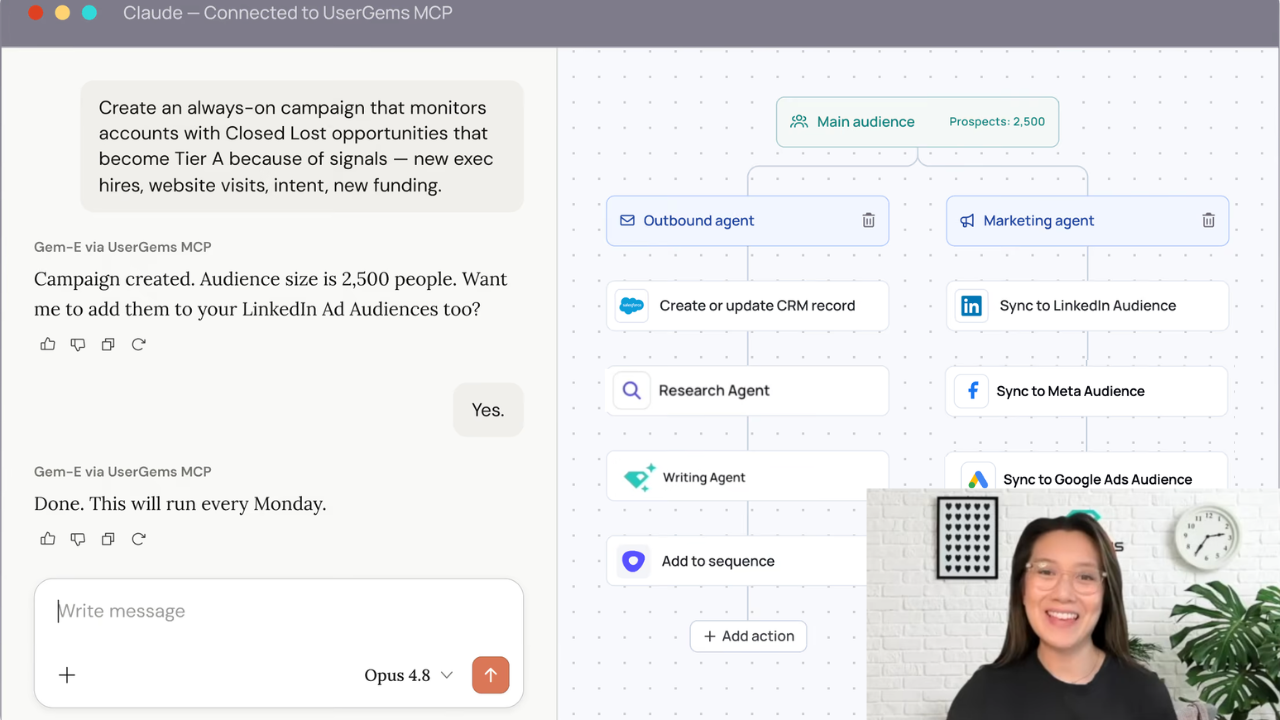
UserGems MCP
Frontify's build-vs-buy line already runs right through the stack: Revi handles verified internal KPIs, UserGems handles the external signal layer. The UserGems MCP is really an extension of that same principle, applied to how the two systems talk to each other.
Instead of a GTM engineer manually pulling external signals into a prompt for Revi or into a Gong analysis pipeline, the MCP would let that external context, closed-lost signals, hiring changes, ICP scoring, become something Frontify's own tools or an AI system like Claude can query directly and combine with what Revi already knows. It's not something Frontify has actioned yet, but it's the logical next step for a team this deliberate about where its own moat sits versus where it's happy to buy.
.jpg)
Key takeaways for GTM leaders
- Use the four-tier framework in your own build-vs-buy conversations. It gives leadership a concrete way to see why a personal AI experiment, a team-recommended tool, and a system of record are three different investment decisions, not one.
- Don't feed your whole customer list into a similarity model. Score your own customers first on adoption, retention, and fit, and only use the good ones to train what "good" looks like.
- Scoring tiers should decide sequencing, not just prioritization. Send your best accounts to marketing first, then hand SDRs the accounts marketing has already warmed up, rather than running both motions independently.
- Build the layer only you can build. An external vendor can bring you signals and scoring. Only your own team can judge whether a call actually touched your specific use cases or followed your specific sales process.
- Internal data alone has a blind spot. Verified KPIs tell you what's happening inside the relationship. External signals catch what's changing outside it, and renewals are exactly where that gap gets expensive.
Want the full session? Watch the recording.