UserGems Insiders: 15th September 2026. Latest market trends AI GTM: How to build and scale an AI brain.
Speaker: Christian Kletzl, CEO & Co-Founder, UserGems
Every GTM leader is asking the same question right now: which signals generate the most pipeline? Christian Kletzl, CEO and co-founder of UserGems, opened UserGems Insiders by telling a room of marketing and sales leaders that this is the wrong question to start with.
There are clear answers on the surface. Past champions changing jobs convert at 5x the rate of a regular lead. Website visitors, intent data, and new hires all move the needle too. Account-level signals like customer competitors, revived closed-lost deals, custom AI research, and hiring patterns matter just as much.
Most companies treat these signals as a pile of independent triggers, each running its own if-this-then-that workflow through a Clay table or a CRM automation, often twenty of them at once. That setup reacts to whichever signal fires first instead of the one that matters most. If a prospect visits your site once and then, six weeks later, posts on LinkedIn about the exact problem you solve, a single-signal workflow has usually already burned that outreach window, and reaching out again so soon rarely lands well.
The stronger predictor is how many signals show up on the same account at the same time. UserGems' data shows accounts with more than six active signals convert to opportunities at 19x the rate of accounts with just one or two. Signals work as a proxy for pain, and when several show up together on one account, that pain is real rather than incidental.
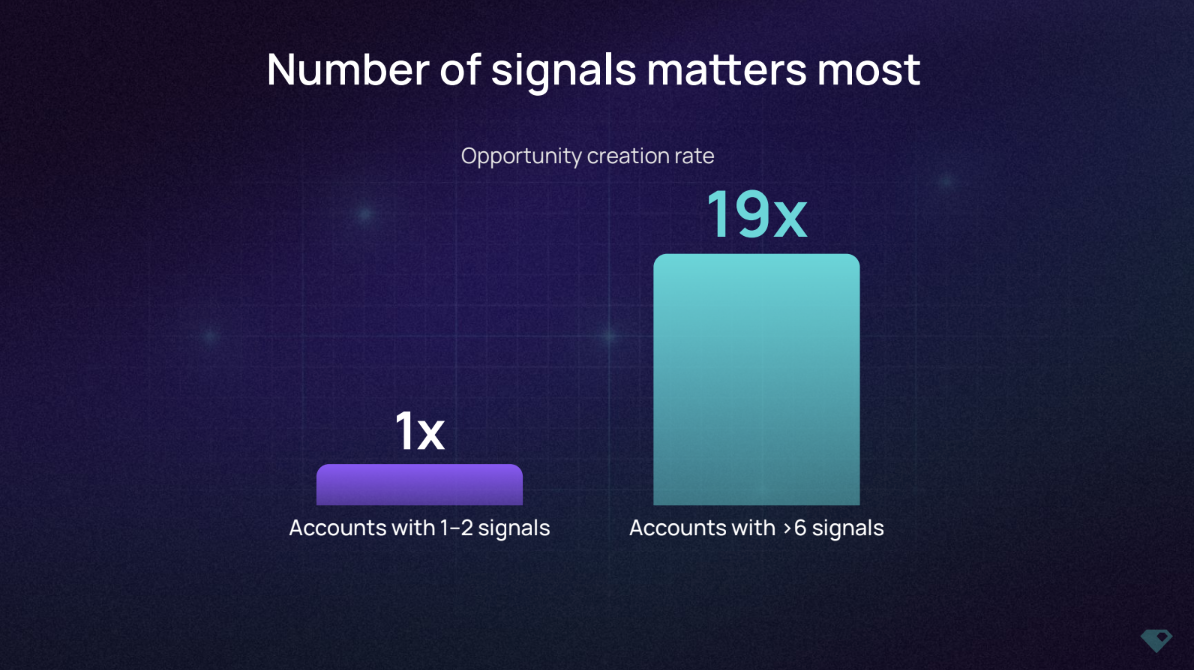
That's the real go-to-market alpha: looking at an account holistically, everything happening at once, and reaching out at the moment the full picture says now. Getting there requires something most GTM stacks don't have yet, which is an AI GTM brain.
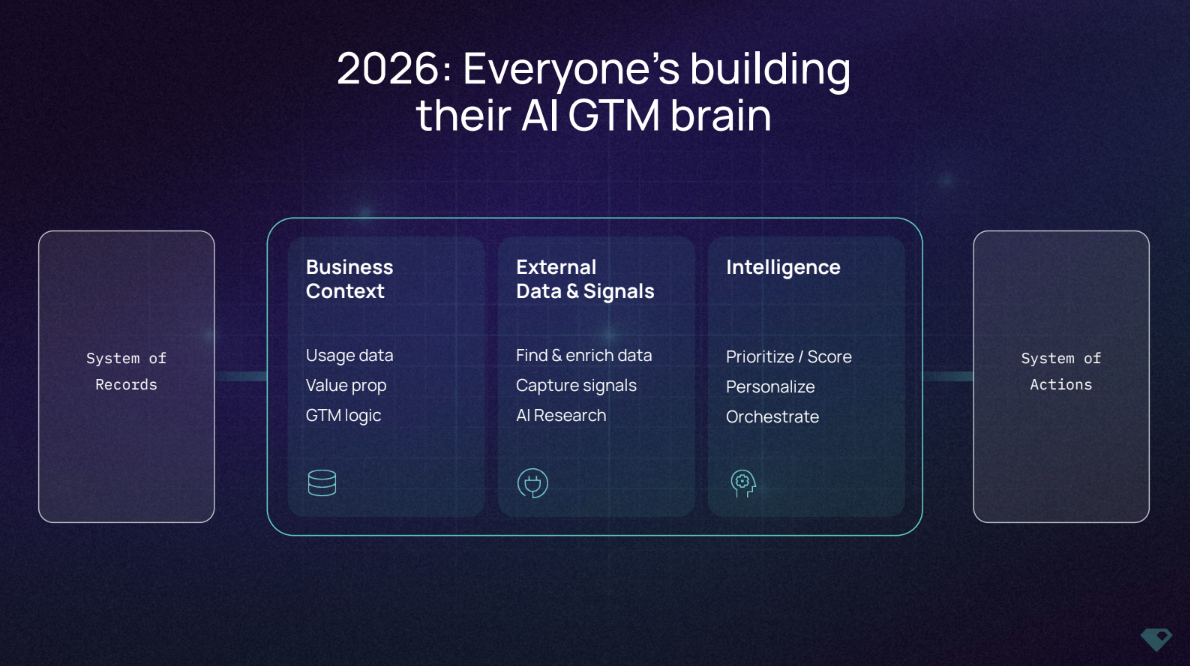
What's actually in an AI GTM brain
Nearly every GTM team says they're building one in 2026, but the word covers a stack of three distinct layers. Christian broke down each one.
1. Business context. This is the data you already have, scattered across systems: opportunity info and product usage, marketing engagement such as who attended a webinar or visited your site, and deal intelligence from call recordings and notes. Alongside it sits your GTM logic: who owns what, and the rules of engagement when a signal fires on a customer account versus a target account. Your value proposition rounds it out: messaging, case studies, and proof points organized so an AI system can actually use them.
2. External data and signals. This is the layer most companies underestimate. You need a full, current list of target accounts and everyone in the buying group, and that list keeps changing as people get promoted, leave their roles, or join new companies. On top of that you're layering signals such as tech stack changes, hiring patterns, LinkedIn activity, and ad engagement. Getting this right also means using AI research to answer bespoke qualifying questions per account, like whether a prospect mentions SOC 2 on their privacy page or who their current provider is, so you can prioritize who to go after.
3. Intelligence. Once the first two layers are in place, intelligence is what turns raw data into action: prioritizing and scoring accounts and contacts, personalizing outreach, and orchestrating the send across sales and marketing at the same time.
Most teams already have the first layer in some form, even if it's fragmented across tools. The second layer is where the real difficulty starts.
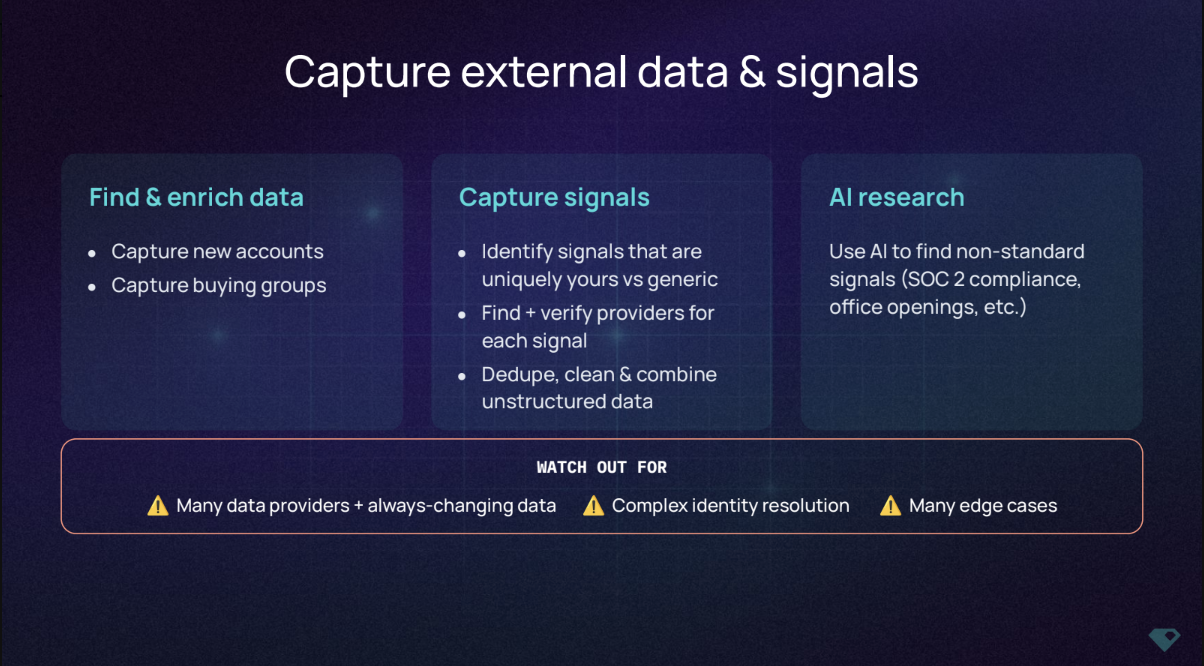
Why the external data layer is the hard part
Christian drew a comparison worth sitting with here. AI in coding works because it draws on your own codebase. AI in legal works because it references the actual contract in front of it. GTM is different: you need your own data, plus an external layer that keeps changing underneath you.
That external layer isn't something you build once and leave alone. It requires ongoing work across three areas:
- Sourcing full account and buying-group coverage, refreshed continuously as people change jobs
- Capturing signals such as website visits, tech stack changes, hiring, LinkedIn activity, and ad engagement, often through a different provider for each one
- Resolving identity by deduping, cleaning, and merging unstructured signals into one coherent account or contact record, which is the unglamorous work that most homegrown builds quietly struggle with
Christian's warning for anyone considering building this in-house is that it isn't a project with an end date. New providers, new edge cases, and constant refresh cycles keep the maintenance burden ongoing. That's the cost every GTM leader should weigh before deciding to build.
The Waymo analogy for build vs. buy
Every leadership team hits the same question in the AI era: can we just build this ourselves? Christian's answer drew on a comparison he credits to Mark Cosgrove of The Table. When Waymo set out to build self-driving cars, the company didn't start by building a new car. It bought Jaguars, then built the self-driving layer on top of an existing platform.
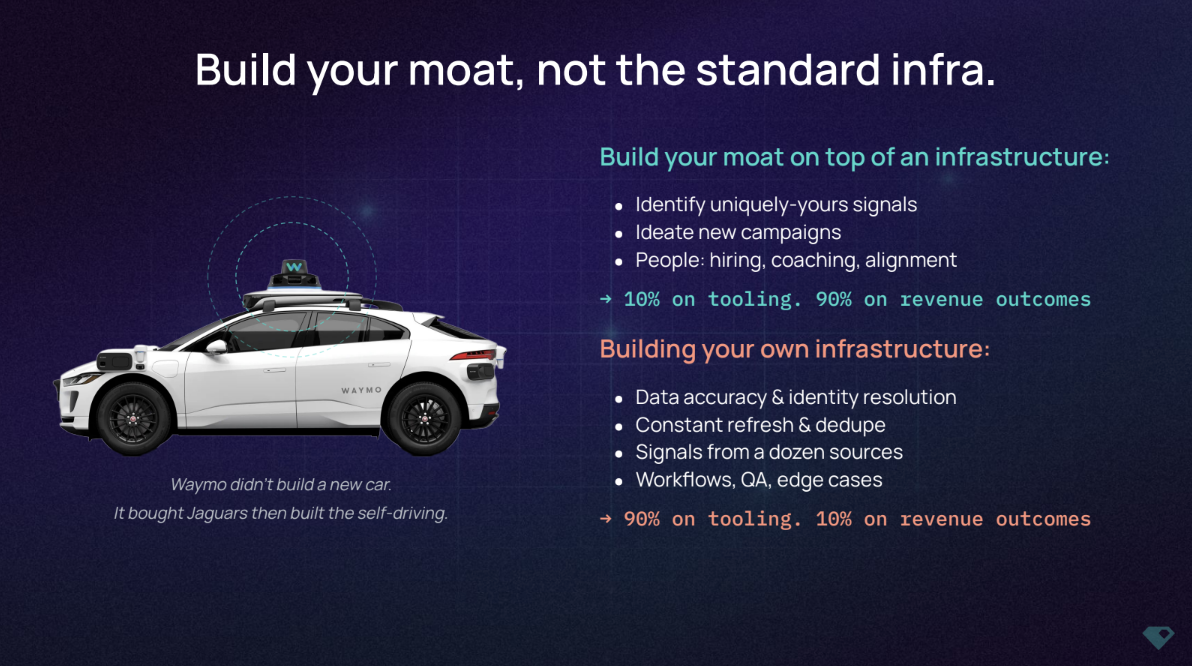
The same logic applies to a GTM brain. Data accuracy, identity resolution, and constant signal refresh are the standard infrastructure, similar to the car itself. Building all of that yourself typically means spending around 90% of your team's time on tooling and only 10% on the revenue outcomes it's meant to produce. Buying that infrastructure changes the ratio, freeing up roughly 90% of your team's time for the work that actually differentiates you: the signals that are uniquely yours, new campaign ideas, and the people work of hiring, coaching, and alignment across sales and marketing.
The takeaway is to build your moat on top of infrastructure you've bought, rather than spending your time rebuilding that infrastructure from scratch.
What buying the infrastructure actually gets you
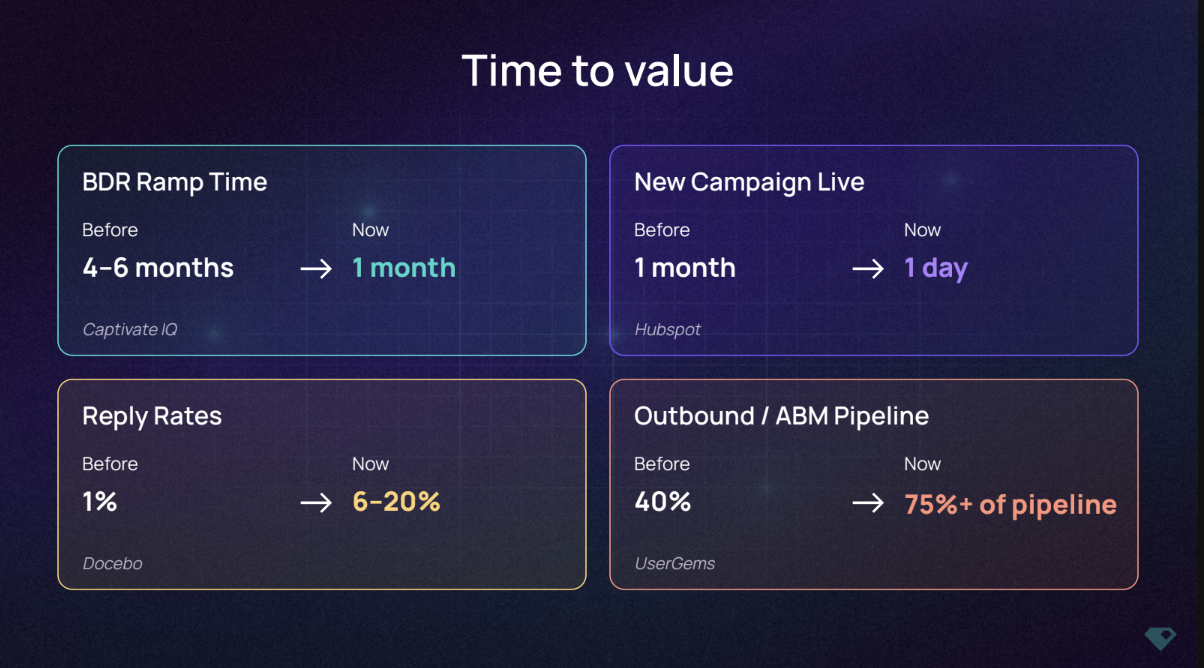
Spending time on top of infrastructure instead of building it shows up directly in time-to-value. In the session, Christian shared a handful of real customer numbers:
- HubSpot cut the time to launch a brand-new campaign, complete with new persona and new messaging, from about a month down to a single day, because the infrastructure was already in place
- CaptivateIQ cut BDR ramp time because the AI brain selected the right accounts and contacts automatically and handed reps the reasoning behind each pick, so reps could move straight to outreach
- Docebo grew outbound and ABX pipeline contribution from roughly 40% to more than 70% of total pipeline without a proportional headcount increase, since reply rates rise when outreach targets accounts with the most real pain signals
The common thread across all three is that these results came from teams that stopped rebuilding infrastructure for every new initiative and started reusing a brain that already understood their accounts, their signals, and their messaging.
What's next: the UserGems MCP
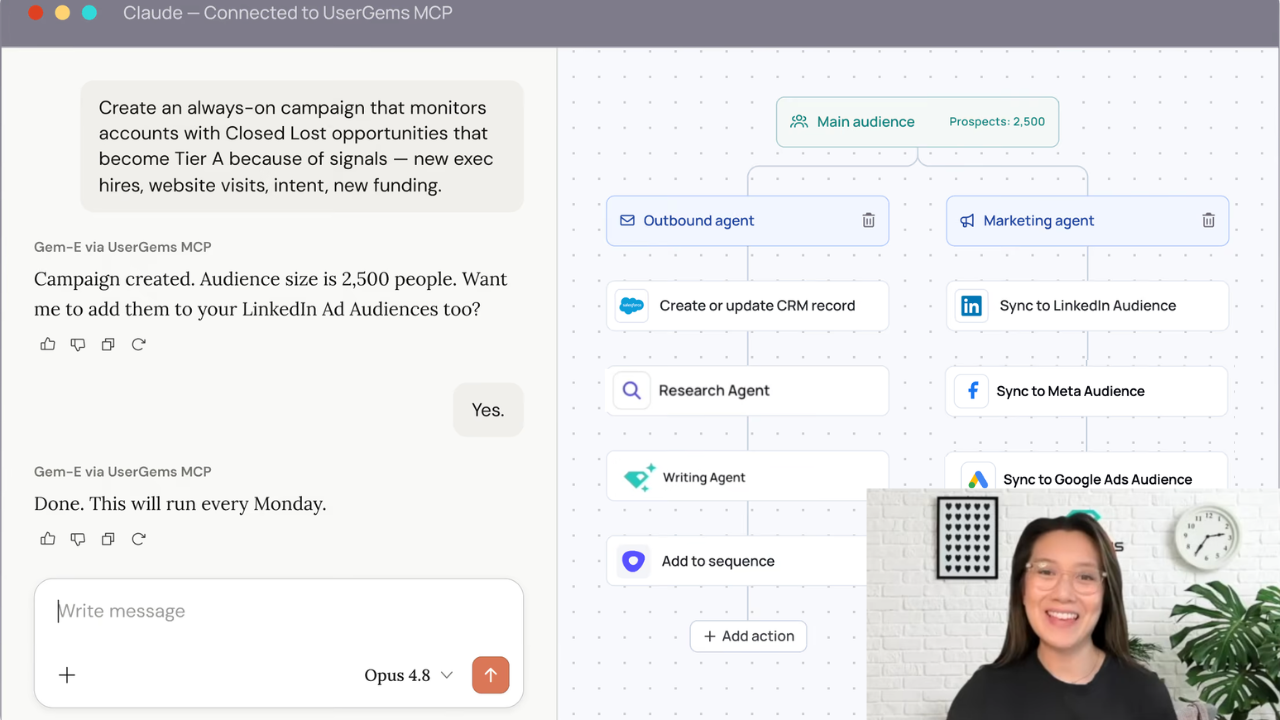
Most MCPs (Model Context Protocol servers) simply hand an AI model your data: here are the accounts, here are the contacts, go figure it out. The UserGems MCP goes further, exposing everything the platform can do rather than just the data it holds, so an AI system can build campaigns and configure signals directly instead of only reading from them.
Christian explained three stages we've moved through:
- Yesterday, humans clicked: logging into the platform, building lists, and setting up sequences by hand every time
- Today, humans prompt: setting up signals, audiences, and campaigns in UserGems by talking to Claude or ChatGPT
- Next, AI runs campaigns: continuously evaluating what's working across your own programs and the broader UserGems customer base, then recommending and launching updates on a brain it can trust
The end-user angle matters just as much. Through the AI Chrome Extension inside Salesforce, HubSpot, Outreach, and Salesloft, reps get this same intelligence wherever they're already working, without opening a new tab. It's the same brain, available from wherever the work already happens, rather than a separate tool layered on top.
Key takeaways
- Stop optimizing for single signals. Chasing the first trigger instead of the strongest one costs you opportunities, so look for accounts where multiple signals are stacking up and treat those as your real priority list.
- Map your three layers before you buy or build anything. Business context, external data and signals, and intelligence are distinct problems, so know which ones you already own and which one is genuinely hard (it's almost always the external data layer).
- Price in the maintenance, not just the build. Identity resolution and signal refresh are ongoing operational costs rather than a one-time project, so factor that into any build-vs-buy conversation with your team.
- Buy the infrastructure and build the moat. Spend your team's time on the signals and campaigns that are uniquely yours, instead of re-solving data accuracy problems every other GTM team is also solving.
- Start thinking in prompts. With MCPs like UserGems', the next skill your GTM team needs isn't necessarily a new tool. It's knowing how to direct an AI that already has your GTM brain behind it.
Want the full session? Watch the recording here.
.png)
.png)