Motivating your sales team to perform 2X better is a long-term investment.
And with an ever-increasing quarterly or monthly sales quota, running a team of confident, results-driven reps requires more than handing out colorful PDF templates or offering unlimited free coffee from the shop next door.
Here are five ways sales leaders are building teams that stay motivated and consistently hit their numbers.
Why you should motivate your sales team
In the current economic downturn, sales teams are dealing with pipeline anxiety while striving to meet increased revenue targets.
As the frontline team in charge of closing deals and generating new business, staying motivated is crucial to their success.
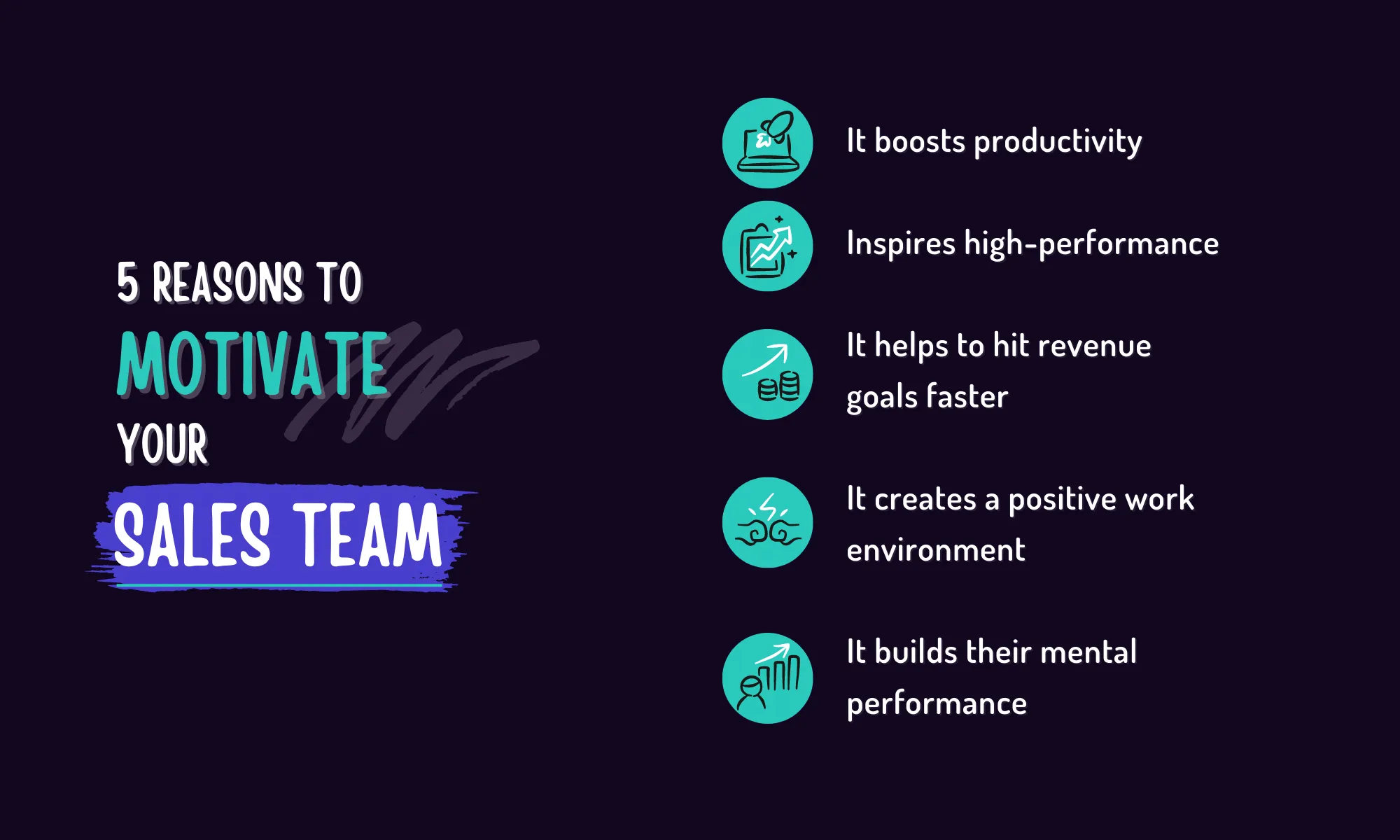
Besides ensuring that a company stays in business, a motivated sales team will:
- Have increased productivity
- Meet revenue goals faster
- Enjoy their work
- Exhibit high mental performance
How to motivate your sales team
We asked founders and sales leaders for their ideas to motivate a sales team and inspire high performance. Here’s what they had to say:
1. Gamify your prospecting process
B.F. Skinner's work on operant conditioning helped popularize gamification, making it a natural fit for the hyper-social, competitive nature of most sales reps.
You can break down large tasks (quarterly quota) into manageable tasks for each sales rep to complete weekly. Each week is a chance to overcome obstacles and rank higher, and the winner at the end of the week/quarter/year takes home the grand prize.
For Olivia Tan, business communications leader and co-founder of CocoFax, gamifying the sales process led to about a 50% increase in sales.
She believes sales leaders need to reward the right things for gamification to work.
"Take time to analyze your business goals and turn them into effective key performance indicators (KPIs)," she explains.
Here are some tips to gamify your prospecting process:

Set up a points system
You can allocate points to each step in your process. The more steps a sales rep completes, the more points they get. You can award bonus points to reps who follow the rules or complete tasks within a set of guidelines. This discourages reps from cheating the system to gain points.
Use leaderboards
Tom Winter, CRO at DevSkiller, uses gamification as a core productivity driver for his sales team.
“We have a leaderboard with detailed statistics for the sales team. However, instead of calculating performance individually to determine the reward, we take the average score of the team to determine the reward."
"So, say, they reach 100 points on a given week, they get an unlimited pizza and beer night. If they pass 1000 points for the month, they get a company-paid weekend getaway to a nearby spa, casino, or resort,” he continues.

Flash contests/missions
Add in the occasional mission or flash contest with a special prize for the winning sales rep (or teams). It could be as simple as an increased number of daily cold calls or as complicated as resurrecting a closed-lost opportunity.
Short feedback loops
Set up a feedback system where the team gets notified as soon as they move up or drop in rankings. This provides positive reinforcement, instant gratification (if they move up the leaderboard), and motivation to do better next time (if they get bumped down).
More ways to improve your sales team efficiency
2. Build and share a clear development plan with your reps
Some of your sales development reps (SDRs) want to become account executives (AEs) as soon as possible.
In contrast, some are content with being high-performing SDRs, while others want to move into sales enablement or revenue operations.
And as Meganne Brezina, Head of Revenue Effectiveness at Lessonly, puts it, "managers should help the sales rep identify and focus on one clearly defined area for improvement at a time, based on the data that resulted from the rating scale."
"This data-driven approach provides clear direction on the top place to focus. Commit to one skill improvement at a time. Trying to fix everything at once usually fixes nothing," she adds.
Developing a clearly defined training and development path alongside matching KPIs that align with the individual reps' goals while achieving business objectives can catalyze improved performance.
Here’s how to motivate and inspire your sales team with a clear development plan:

Encourage/incentivize a strong relationship between SDRs and AEs
Naturally, these two roles should have a symbiotic relationship. SDRs cast the net while the AEs reel the prospects in. Encouraging better collaboration between SDR and AE roles improves the overall team performance, and SDRs who aspire to move into an AE role someday have a better understanding of the nuts and bolts within the AE role.
Define personal and team success
Develop and agree on a clear career path along with your reps to make sure everyone is headed in the same direction. This way, everyone understands what the business expects of them and can see the path to the next level in their career.
Create coaching and learning opportunities for your reps
Encourage and incentivize your reps to learn and develop. This could include using tools like Gong to share great sales calls to learn from each other. Or it could mean introducing them to a mentor or a peer who excels in an area they'd like to develop and offer to cover lunch so they can ask questions and learn directly from someone who's done it.
Provide continuous training
According to Accenture, investing in continuous learning and development has an ROI of 353%. That's a return of $4.53 for every dollar invested. Regardless of experience level or performance, each team member should receive continuous training on new trends, techniques, and tools that could improve their performance. Make sure to use different training methods to keep everyone engaged.
3. The Post-it Notes check-in exercise
On our ‘The First 100 Days’ podcast, Jesse Osborne shared an effective tip that helped him hit the ground running as the VP of Sales Development at Tipalti.
For Jesse, the post-it notes exercise is a fast way to surface alignment issues and build trust with a new team from day one.
In his words, "you put everyone in a room and hand them three different colors of post-it notes. Next, ask them to write down what we need to stop doing, what's wasting time, and what we should start doing on separate sticky notes."

He continues, "use primers like 'what have you been saying that we should be doing but no one's listening to me' to get them going. Spend 45 minutes on each color, then have them put all their post-it notes on the wall. You can then start picking them off according to common themes."
When Jesse conducted this exercise at Tipalti, they discovered that most of the sales team didn't know how to calculate their commission. And some others thought their quotas needed revisiting.
One caveat is that it's most effective if you manage a team of 5 - 15 people.
4. Encourage team-building activities
Team building activities help improve collaboration in your team and build a positive work environment.
These activities also encourage friendly competition that inspires high performance in your sales team. And they can even dispel some of the anxiety that comes with the job.
Some team-building activities to consider include:
- Jumping on sales calls together or running practice sessions
- Pairing newer reps with experienced team members for structured mentorship
- Going on company retreats together
5. Equip your sales team with the right tools
Your key responsibility as a sales leader is to create an environment where your team can be successful. So, aside from gamification and training, you need to make sure the sales prospecting tools your team uses are actually doing their job.
Prospecting can feel like grunt work. Don't make it harder than it already is.
The best thing you can do is to make sure that the tools you have in place allow your reps to automate all the tedious and unproductive tasks so they can focus on one thing — selling.
Here’s how to make your sales teams’ lives easier:

Automate the repetitive work
UserGems tracks buyer signals, including job changes, promotions, and new stakeholders entering accounts, and surfaces them directly in your workflow. That means your reps know exactly which contacts to prioritize and why, without manually monitoring LinkedIn or cross-referencing CRM data.
- Eliminate copy and paste tasks after meetings by automatically creating new records in your Salesforce for new contacts, assigning them to the right accounts, and adding them to existing opportunities.
- Built-in intelligence keeps your contact data fresh and flags timely moments to engage, like when your contacts change jobs or get a promotion, so your reps spend less time researching and more time selling.
- Enrich existing contact data with current information, such as other teammates in a company that can be looped into one sales call.
Encourage them to prospect smarter
You need both quality and quantity when prospecting. However, you want your team to go after the most likely buyers instead of chasing down any lead they can find.
One solution is to use UserGems, the AI command center for outbound and ABM, which helps your team know who to target, what to say, and when to act. UserGems surfaces high-priority prospects, including alumni customers who recently moved into new roles, who are 3X more likely to buy again, driving faster pipeline and stronger revenue outcomes. UserGems backs it with a money-back guarantee, so your team can commit with confidence.
Use our playbooks for pipeline generation to boost your sales teams' performance.
Reaping the rewards of a motivated sales team
Improving your team's booking rate is a long-term investment.
It comes down to equipping your reps with the right prospecting tools, investing in their development, and building processes that keep them focused on the right opportunities.
Start with one change. Track what moves the number. Build from there.

.png)
.png)
.png)