UserGems Insiders, 15th September 2026. ABM-ify your event playbooks
Speaker: Mason Cosby, Founder & CEO, Scrappy ABM
Mason Cosby, founder and CEO of Scrappy ABM, has one rule for events: make the ROI positive before the plane takes off. He generated 31 opportunities in 3 days from a single event, using a pre-event program built almost entirely inside UserGems.
The client had invested $200,000 in the event and brought Mason's team on six weeks before it started, at which point there was zero pre-event plan. Cosby was quick to note that this is an extremely common pattern: heavy investment up front, then a scramble once the event date is suddenly close.
The client had a strong plan in place: a speaking session with executives from recognizable brands in their space, a partnered happy hour, a private meeting suite, executive car service coordinated through the event organizer, and premium gifts (AI-enabled smart glasses). The problem was that none of it was connected into a single path. Each asset existed on its own, with no plan tying one touchpoint to the next.
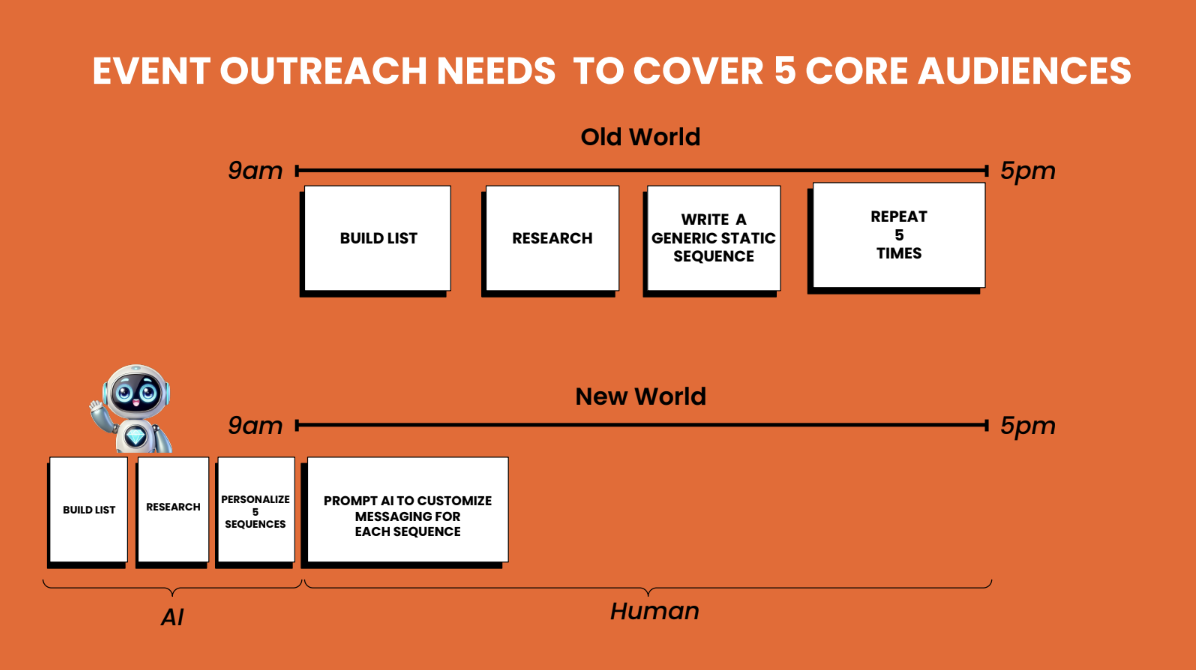
Mason's team mapped the audiences that already existed and used those ingredients to build what he calls an in-person conversion path: before the speaking session, drive as many people as possible to attend it. After the session, move them toward the happy hour. From the happy hour, book meetings, or if someone wasn't ready yet, move them into a nurture sequence. Most events skip this kind of sequencing entirely and settle for a single generic ask, but once you can see everything at your disposal, mapping a real path through it becomes straightforward.
The five core audiences every event has
Mason believes the same five audiences exist for nearly every event, regardless of industry or format, and treating them as distinct is what makes the rest of the planning tractable.
Last year's list. Most events see meaningful year-over-year return, often in the 50 to 70% range, so if you sponsored the same event last year, that list is highly likely to include people coming again.
This year's registration list. If you sponsor an event, you typically get access to the registrant list, sometimes with regular drops as more people sign up.
A geographically targeted list. Events happen where their core buyers tend to already be, so target accounts in the same city or region are worth a free ticket offer even if they weren't already planning to attend.
Social signals. People post publicly about attending events they haven't been formally invited through, and those posts are a free source of intent worth watching.
Sponsor bases. A less obvious fifth audience: the sponsors exhibiting at the same event are themselves trying to sell to attendees, which can make them a target list of their own for events adjacent to your own market, like HR conferences if you sell into HR-adjacent tools.
The ingredients, and the half-a-gift play
Once the audiences were mapped, Mason matched each of this client's assets to a specific piece of the journey. Anyone geographically close to the event got offered a free ticket. The registration list got an exec-connect push aimed at getting people to attend the speaking session, since a captive audience there is easier to convert than a cold booth conversation. From the session, the happy hour became the next step, including a raffle. Mason was upfront that his team always rigs the raffle on purpose, specifically to manufacture real conversations with target accounts rather than leave attendance to chance.
The standout tactic came from the executive car service. Thirty executives from target accounts were picked up from the airport, and Cosby's team gave each of them a gift in the car, but only half of it: the case for a pair of AI smart glasses, with the glasses themselves waiting at the meeting suite. This is known as the half-a-gift play, a tactic Mason credits to Brandon Redlinger, and it works because it converts a gift into a reason to physically show up somewhere private. In this case, 80% of the executives who received the case came by the meeting suite to collect the glasses and took a demo while they were there. That one tactic alone more than justified the rest of the program.
The happy hour raffle worked the same way. Winners were told to come back the next day to collect their prize rather than handing it over on the spot, funneling more people into the private meeting suite where the team could have a real conversation away from the noise of the show floor and either book a meeting directly or start a nurture sequence for anyone not ready yet.
How this ran as five automated workflows
What makes this repeatable, according to Mason, is that each of the five audiences was set up as its own workflow inside UserGems, connected to Salesforce for record updates and CRM campaign membership, with outbound sequencing actually running through Apollo. Each workflow updated the record, added the contact to the right CRM campaign, and prompted the writing agent to personalize messaging based on the event itself and whatever signals were available for that person.
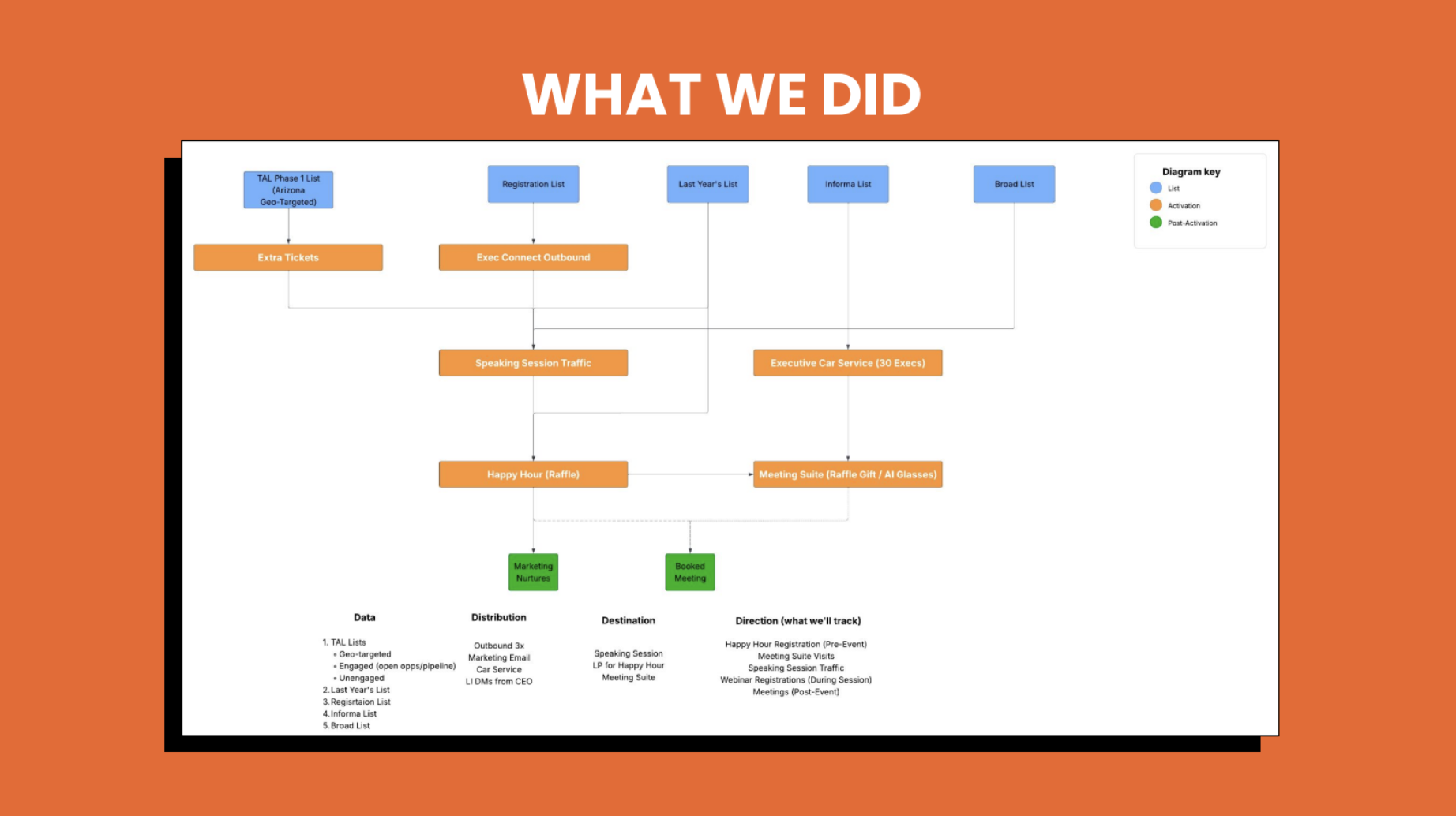
Mason drew a direct contrast with how event outreach traditionally gets built: research a list, write one static sequence, then manually adjust it for each segment, repeated five separate times across the five audiences, usually consuming most of a working day. With this setup, the list-building and research still happen, but the sequences are personalized for each segment by prompting AI rather than manually rewriting each one, which frees up the rest of the day for the meetings that actually matter.
Mason gave credit to Ryan on the UserGems team, who spent hours perfecting the prompting behind the scenes to make sure the personalization held up across every audience and every touchpoint.
The results, and what to take from them
31 opportunities in 3 days, with exact-fit target accounts, is the number Mason kept returning to, and he was careful to note it wasn't magic. It came from good strategy applied consistently: segmented audiences, real offers tied to each segment, and signals feeding the personalization, all connected into one path instead of five disconnected efforts.
His closing point is worth holding onto for any team planning their next event season: if the ingredients aren't connected into an actual journey, having great assets on their own won't produce great results. The audiences, the offers, and the signal-driven personalization all have to work together, and once that connective work is done once, it's genuinely repeatable for the next event.
Key takeaways for GTM leaders
- Map your five core audiences before the event, not during it. Last year's attendees, this year's registrants, a geographic list, social signals, and sponsor bases cover nearly every event, regardless of industry.
- Build a real conversion path, not a single ask. Move people from session to happy hour to meeting, rather than hoping for one conversation to do all the work.
- Use partial gifts to earn a private conversation. A half-a-gift play converts a nice-to-have into a reason for a target account to physically show up somewhere quiet enough to talk.
- Rig the raffle. If the goal is real conversations with target accounts, leaving that outcome to chance defeats the purpose of running one at all.
- Turn each audience into its own automated workflow. Personalizing five segments by prompting AI, rather than manually rewriting five sequences, is what frees up the actual event week for meetings.
.jpg)