UserGems Insiders: Introducing: UserGems MCP, Research Agent, Writing Agent
Speaker: Taylor Vo, Product Marketing Associate, UserGems
At UserGems Insiders, Christian Kletzl's session laid out the theory of an AI GTM brain. Taylor's session showed what it actually looks like running, starting with a baseline walkthrough for anyone newer to UserGems before moving into the new agents and the MCP.
The example: building a revive closed-lost campaign. Taylor started with an audience filtered on the Revive Closed-Lost signal, then layered in more signals to prove the timing was right rather than just pulling a generic list: new hires and promotions at those accounts, people who went through a past evaluation, and recent website visits or intent. The scoring agent used those combined filters to rank which accounts, and which people at those accounts, to prioritize first.
Once the audience was built, both branches activated together. Demand gen pushed revive closed-lost ads to the same list the outbound team was working, so a prospect who wasn't ready to answer a rep's email still saw the message elsewhere. Because the audience is dynamic, accounts and contacts enter and exit automatically as they meet or stop meeting the criteria, so reps and marketers are always working a live list rather than a static export. Outbound volume was capped on purpose too, so marketing could reach everyone on the list while SDRs stayed focused on the accounts worth a personal touch.
The writing agent: personalization that actually scales
The writing agent is built to draft outbound emails at scale, without leaving that work to reps. It pulls in the signals attached to each account and contact automatically, so a marketer at a target account and a RevOps leader at the same company can each get a genuinely different pitch built around what applies to them, not a template with a name swapped in.
Reps can also chat with the writing agent directly to adjust tone. Ask it to sound more casual, and it checks what that means before rewriting, rather than guessing and hoping. The agent also knows which case study or piece of content to attach based on the account, and that logic can be scoped on the fly: tell it to apply a specific case study only to accounts in a certain industry, and it will, without anyone manually sorting the list first.
The distinction that matters for anyone evaluating AI writing tools broadly: a general-purpose AI can write an email, but it isn't built for B2B go-to-market out of the box. It takes heavy prompting and training to get there. The writing agent is purpose-built for outbound emails that convert rather than emails that read well, and it already knows which proof points belong with which account, work reps would otherwise do by hand every time.
The research agent: custom questions, fed straight back into the workflow
The research agent goes further than a generic AI search. Taylor's example: build an audience of companies with SOC 2 violations in the past 12 months. Or find the headquarters address of every target account. What sets this apart from asking a general AI tool the same question is what happens to the answer afterward. Ask a typical AI assistant a research question and it hands back an answer, but that answer doesn't automatically flow into your scoring model or your outbound messaging. Someone still has to copy it over and stitch it together by hand.
With UserGems, the research agent's output becomes an audience on its own, and that audience then feeds directly into the scoring model and the writing agent. Taylor used a gifting example to make this concrete: instead of manually looking up which target accounts have offices in the Bay Area, the research agent found the addresses and fed them straight into the personalized messaging, so a rep sending a physical gift already knew exactly where to send it and why that account mattered.
That closes the loop Kletzl described in his opening session: signals, research, scoring, and messaging all drawing from the same brain instead of living in separate tools that someone has to manually reconcile.
The UserGems MCP: building a campaign by talking, not clicking
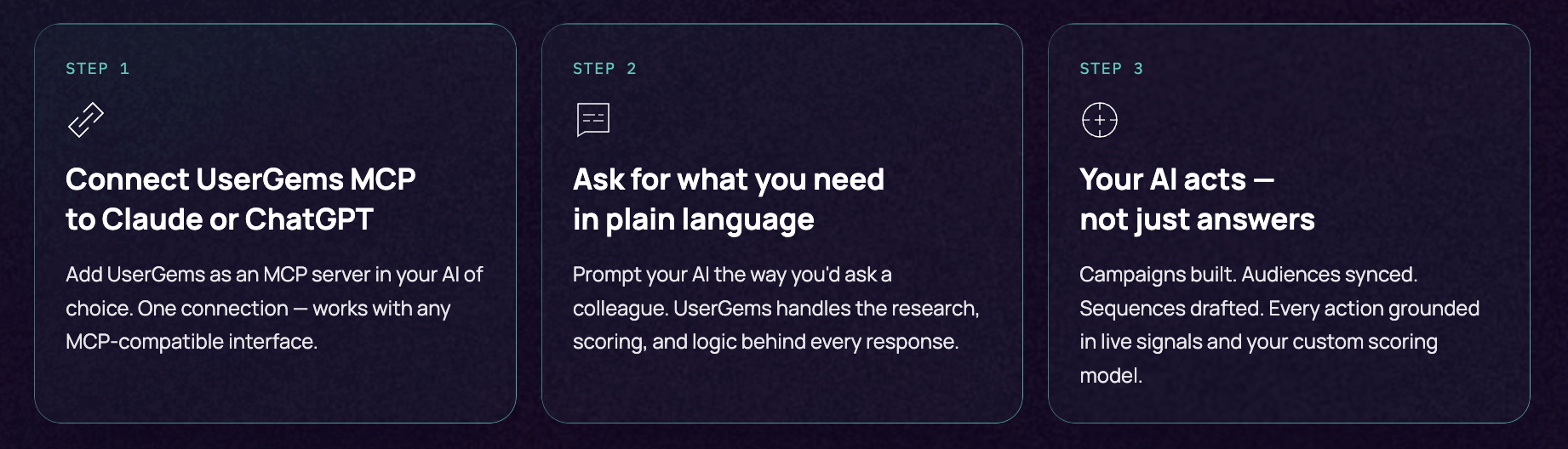
Everything Taylor demonstrated up to this point, filtering audiences, scoring accounts, writing personalized emails, running research, can now be done by talking to Claude or GPT directly. Most MCPs focused on GTM data simply help a rep find information. The UserGems MCP goes further: it lets an AI build campaigns and audit existing programs, not just read from them.
In the live demo, Taylor typed a simple prompt into Claude: build a revive closed-lost campaign in UserGems. The MCP walked through the setup one question at a time rather than guessing at the details. It asked whether closed-lost should mean the original opportunity contact still at the account, or closed-lost contacts who had since moved to other companies, a distinction that changes the whole campaign. UserGems ships with seven playbooks by default, covering scenarios like past champions, competitive takedowns, closed-lost revival, and website visitors, and the MCP configured each action inside the chosen playbook by asking targeted questions along the way.
Once everything was configured, the MCP handed back a link to open the finished campaign directly inside UserGems, so the team could review it before switching it on. Nothing activates without a human confirming it first.
What this looks like for a rep or AE
Taylor then switched perspectives to show what a rep or AE working that same revive closed-lost campaign would do day to day. Say a rep wants to research a specific account before reaching out, and find additional people there worth looping in. Inside Claude, they can ask the UserGems MCP to prospect into that account and explain who to go after first and why. It returns an account overview with the account's grade, the reasoning behind why it's warm, and the specific people worth contacting.
From there, the rep can ask the MCP to use the writing agent to draft an email, and watch as it pulls the writing agent's own instructions directly into the conversation. Every instruction and every piece of content already configured in the writing agent follows the rep wherever they're working, not just inside the UserGems platform itself.
The point Taylor was making runs through the whole demo: whether someone is building a campaign from scratch or working a lead inside one, they're pulling from the same UserGems brain, and they can reach it from wherever they already are.
Key takeaways for GTM leaders
- Audiences should be dynamic, not exported lists. Building an audience that adds and removes accounts automatically as signals change keeps both sales and marketing working the same live list instead of a stale one.
- Cap outbound volume on purpose. Letting marketing cover the full audience while limiting how many accounts SDRs work at once keeps reps focused on the highest-value conversations rather than spread thin.
- Personalization should be signal-driven. The writing agent's ability to pull different case studies and messaging per persona is what actually makes each email feel individually written.
- Push research into the workflow. A research answer only compounds in value once it becomes an audience that scoring and writing can use directly.
- Try the MCP on a real playbook before building anything custom. Start with one of the seven default playbooks and let it ask the clarifying questions. That's the fastest way to see whether prompting replaces a meaningful chunk of manual campaign setup for your team.
.png)
.png)