.png)
San Francisco, CA — UserGems, the AI command center for outbound and ABM, today released "Build vs. Buy: A guide for AI-powered GTM teams," a data-backed resource for revenue leaders navigating one of the most contested questions in GTM right now: should you build your AI stack in-house, or buy it?
The guide's answer: stop asking the question company-wide. The real decision happens layer by layer — data, intelligence, and action — and the right call is different at each one.
"Companies no longer want to choose between buying and building software, they actually want both. What companies want are proven platforms that have all their data, signals, and infrastructure, and they want to build on top of it — generating their own campaigns, their own workflows, their own agents." - Christian Kletzl, CEO & Co-Founder, UserGems
Why "build vs. buy" is the wrong framing
The guide pulls together the latest market research to show both sides of the debate are simultaneously true. In 2025, 76% of enterprise AI was purchased rather than built, up from 53% the year before. At the same time, 35% of teams have already replaced at least one SaaS tool with a custom build, and 78% plan to build more in 2026.
Both trends are accelerating because they're answering different questions at different layers of the stack:
- Data: signals, contact and account records, enrichment, infrastructure. What tells you who to look at.
- Intelligence: scoring, prioritization, orchestration built on top of the data. What tells you who to prioritize, and why.
- Action: where it reaches a human or a channel: outbound sequences, ad audiences, landing pages. Where the work actually gets executed.
The guide's central argument is that most teams that get burned mixed these layers up — rebuilding infrastructure that was never their moat, or buying "good enough" software to run a workflow that was actually their differentiation.
"Running elaborate campaigns directly within Claude is very difficult because you need access to thousands of companies, hundreds of thousands of prospects, and you need to coordinate between several different systems, always reaching out to the very best companies at the right time." - Stephan Kletzl, CTO & Co-Founder, UserGems
What's inside
The guide includes a four-question decision framework revenue leaders can apply to any tool or system they're evaluating: Is this infrastructure or a system of record? Could a competitor buy the exact same capability off the shelf? Will the advantage survive the next model release? And can the team actually maintain it long after launch, not just ship it once?
It also features an unusually candid, on-the-record interview breaking down exactly what UserGems itself builds versus buys across its own outbound and ABM stack — including why the company buys signal capture and data enrichment (cheaper and lower-risk than burning AI tokens on it) but builds its own reporting layer, plus a build-to-start-then-buy-to-scale path for account scoring.
"As a GTM team at UserGems, we build our data layer because that's our product... But if I were at another company, I'd 100% buy the data layer because I'd never have enough resources to build and maintain a data infrastructure. More importantly, my #1 responsibility to the business is pipeline and revenue, not building internal tools." - Trinity Nguyen, CMO, UserGems
Beyond UserGems' own team, the guide draws on outside operators to pressure-test the framework. Eric Hawkins, CTO at private-markets AI company Ontra, contributes a three-condition test for when building actually creates durable advantage. Christina Cordova, COO at Linear, weighs in on vendor durability as AI tool consolidation approaches. And Clara Borges of HubSpot's demand generation team addresses a wrinkle most build-vs-buy content ignores: AI agents are now a third consumer of GTM data, alongside reps and marketers, and a messy data layer breaks agent output just as fast as it breaks a rep's pipeline.
Who it's for
The guide is aimed at GTM, sales, and RevOps leaders currently weighing a build decision, whether that's a homegrown scoring model, an internal Claude workflow, or a custom-built reporting tool, and unsure whether they're solving the right problem or just recreating one a vendor already solved. It's especially relevant for teams that have already been burned by the "prototype that became the product": a Claude-built tool that worked great as a one-off and has since become an unmaintained system nobody signed up to own.
"Build vs. buy: A guide for AI-powered GTM teams" is available now as a free, ungated resource on UserGems' website.
Frequently asked questions
Should GTM teams build or buy their AI stack? Buy the infrastructure and commodity layers: data, signals, compliance, systems of record. Build only the layer where your data or workflow is genuinely differentiated. Teams that buy or partner get a project into production 67% of the time, versus 33% for solo builds.
Is build vs. buy really one decision? No. It's a per-layer decision: data, intelligence, and action each get their own build-or-buy call, and the right answer for one layer doesn't predict the right answer for another.
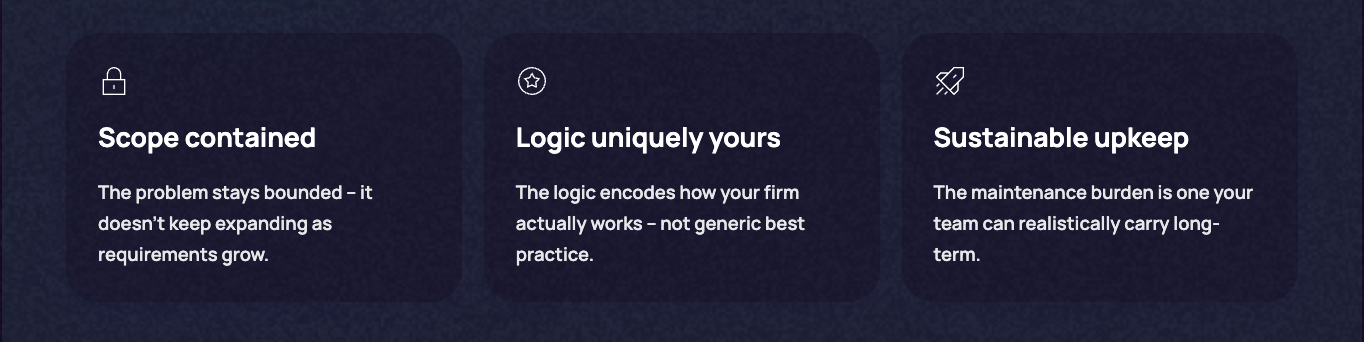
When does building actually make sense? When three conditions are all true at once: the scope is contained, the logic is genuinely proprietary (not something a competitor could buy off the shelf), and the team can sustain the maintenance long-term, not just ship it once.
What's the biggest hidden cost of building AI tools internally? Maintenance, not the build itself. Retraining alone adds 15–30% ongoing overhead on top of the original build cost, and a custom AI build typically takes 33 months to pay for itself.
Can teams build on top of a platform instead of replacing it? Yes, the guide frames this as the emerging standard. As more platforms expose their data and intelligence layers through interfaces like MCP, teams buy the foundation and build the campaigns, scoring logic, and workflows that are genuinely theirs on top of it.
About UserGems
UserGems is the AI Command Center for B2B revenue teams — the brain that sits between your CRM and your execution tools. It unifies buying signals, prioritizes accounts and contacts using a custom, transparent AI scoring model built on your own sales history, and deploys Gem-E AI agents to automate outbound and ABM execution. Customers include Mimecast, Workday, Salesloft, and Sendoso. Learn more at www.usergems.com.
.png)
.jpg)
.png)